Sophia’s Thoughts On Flash Loan DeFi Risk

Flash loan attacks have quietly drained USD 1.211 billion from DeFi platforms since 2020, yet mainstream retail conversations about yield almost entirely overlook the infrastructure risk they represent. As capital flows into on-chain lending vaults and liquidity pools, the question is whether the market has yet priced in the structural vulnerability these attacks expose.
These are Sophia's Thoughts:
A peer-reviewed study covering February 2020 to July 2024 identified 72 flash loan attacks that collectively drained USD 1.211 billion from DeFi platforms, representing 18.44% of all losses to DeFi exploits over the same period.
More than 80% of those losses occurred on Ethereum, and the attacks have grown more sophisticated over time, yet one anonymous platform representative described even state-linked attackers as "not at all advanced" from a blockchain security perspective, pointing to how vulnerable the underlying code remains.
With deposits in digital asset lending vaults now approaching USD 10 billion and institutional risk frameworks only beginning to emerge, retail participants entering DeFi yield strategies may be absorbing risks that neither auditors nor market participants have yet fully quantified.
🚀 Last week’s market performance
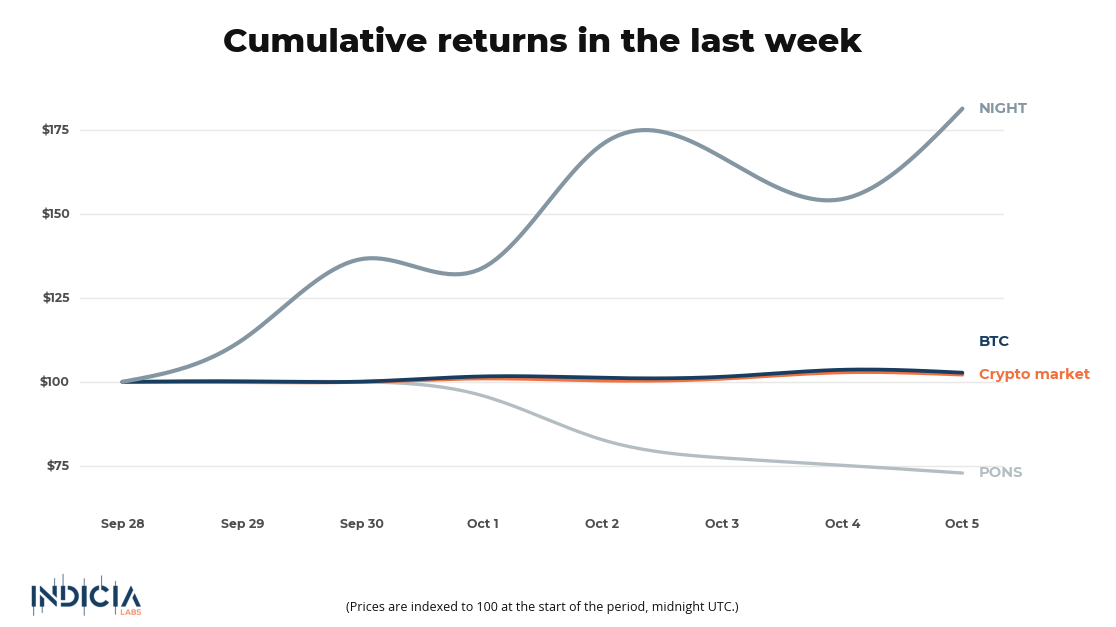
The broader crypto market gained 2.1% over the past seven days, with Bitcoin (BTC) rising 2.7% as sentiment remained constructive. NIGHT (NIGHT) led all performers, surging 81.3% amid a sharp spike in speculative activity around the token. PONS (PONS) posted the steepest decline of the week, dropping 27.1% as momentum reversed and liquidity thinned.
🧐 What is your crypto mood today?

In each Sophia's Thoughts newsletter, we ask about your crypto mood. Your response to this question helps Sophia get a better sense of the pulse of crypto markets. And this ultimately translates into better insights for you when combined with Sophia's AI models. Your data empowers Sophia to provide you with even better intelligence going forward!
⚡ A USD 1.2 Billion Blind Spot
A peer-reviewed study published in the Journal of Financial Crime and covered by Decrypt has put a precise number on a risk that most retail participants in DeFi have never stress-tested. Between February 2020 and July 2024, 72 flash loan attacks drained USD 1.211 billion across 254 total DeFi exploits identified over the period. Individual incidents ranged from USD 80,000 to USD 197 million, a range that illustrates the scale of a single well-executed attack relative to most protocol reserve buffers.
Flash loans are uncollateralized borrowing mechanisms, meaning a borrower puts up no capital as security, because the loan is issued and repaid within a single transaction block. An attacker borrows a large sum, manipulates an on-chain price oracle (a mechanism that supplies external price data to smart contracts) or governance parameter, extracts profit from the resulting distortion, and repays the loan, all before the block closes. The speed and self-contained nature of the attack is precisely what makes it so difficult to defend against. Professor Tim Hall of the University of Winchester, one of the study's authors, observed that "we now are seeing crimes that we have never seen before, some capable of stealing mind-boggling sums of money, often in the tens of millions of dollars."
What the study also surfaced was a structural vulnerability in the audit process itself. An anonymous representative of a platform that suffered a major flash loan attack described the exploited bug as one that auditors and the platform's own team had both missed, suggesting that multi-layered review processes are not a reliable shield. Professor Hall was explicit that the research carries practical weight beyond academia: "We are keen that this isn't seen just as a piece of academic research. The analysis we did has a host of applications for the cryptocurrency industry, for regulators and for legal and law enforcement agencies."
🏗️ Infrastructure Cracks and Institutional Responses
The flash loan problem does not exist in isolation. It sits within a broader DeFi infrastructure that S&P Global Ratings has now formally begun to assess. As Cointelegraph reported, S&P launched a Vault Risk Assessment (VRA) framework for digital asset lending vaults, evaluating six categories: portfolio credit quality risk, liquidity mismatch risk, curator risk, blockchain risk, protocol risk, and vault security and governance risk. Deposits in these vaults reached approximately USD 10 billion, up from USD 1.5 billion two years earlier, a trajectory that makes the absence of standardized risk disclosure increasingly difficult to justify.
Lisa Schroeer, an analyst at S&P Global Ratings, articulated the core problem with precision: "there are many points of risk/failure that can break." The VRA framework is deliberately non-compensatory, meaning, as Schroeer noted, "a material weakness in any factor can constrain the overall VRA. A strong score in one factor does not offset a material weakness in another." That architecture reflects a hard-won lesson from DeFi's track record: governance strength alone cannot substitute for sound smart contract security. As Cointelegraph reported, lending protocol Term Finance lost an estimated USD 8.5 million after an attacker exploited governance control of its Meta Vaults, demonstrating exactly the kind of scenario the framework is designed to flag.
The S&P VRA framework will not constitute credit ratings and will not evaluate yields. Its stated purpose, according to Schroeer, is to "provide more transparency on the risks so that any entity can make more informed decisions when deciding how to allocate capital to DeFi vaults." For retail participants, that framing matters: the framework is a disclosure and assessment tool, not a safety guarantee, and its coverage of the broader USD 10 billion vault market remains partial at present.
🔗 Ethereum's Structural Exposure
Ethereum sits at the center of the flash loan risk profile. More than 80% of the USD 1.211 billion in flash loan losses identified by the study occurred on Ethereum, a figure that reflects both the chain's dominance in DeFi and the density of interconnected protocol interactions that flash loans exploit. The same interconnectedness that makes Ethereum's DeFi ecosystem productive is what makes a single misconfigured price oracle or governance parameter a viable entry point for a large-scale theft. The study's own data also offer a counterpoint worth noting: flash loan losses represent 18.44% of total DeFi exploit losses over the period, which means that other attack vectors account for the majority of DeFi risk by value.
Separately, the Ethereum development community is working on a different layer of infrastructure risk. Eduardo Antuña Díez, a contributor to the Ethereum Economic Zone, reported the completion of the first atomic cross-chain transaction between Ethereum's main chain and a Layer 2 network, a milestone that refers to a transaction executed simultaneously across two networks with no possibility of partial failure. Friederike Ernst, co-founder of Gnosis, had previously told Cointelegraph that "the lack of synchronous composability," meaning the inability of protocols on different networks to interact in real time within a single transaction, "forces protocols to maintain separate deployments across L2s, fragmenting liquidity into multiple markets," a fragmentation that also complicates the monitoring of anomalous activity across chains.
The anonymous representative of one attacked platform offered the starkest summary of what flash loan exploits do to the teams behind affected protocols: "most often it ends up fracturing them and destroying them." For retail capital entering DeFi yield strategies, the structural question is whether the audit frameworks, institutional risk assessments, and protocol-level defenses now emerging can mature fast enough to match the sophistication of attacks that, by the study's own account, do not even require state-level technical capability to execute.
Indicia Labs does not provide investment, tax, or legal advice. You are solely responsible for determining the suitability of any investment, investment strategy, or related transaction based on your personal investment objectives, financial circumstances, and risk tolerance. Indicia Labs may offer educational information about digital assets, which may include blog posts, articles, third-party content, news feeds, tutorials, and videos. This information does not constitute any form of advice, and you should not rely on it as such. Indicia Labs does not recommend buying, earning, selling, or holding any digital asset and will not be responsible for any decisions you make based on the provided information. Any content provided by Indicia Labs may contain errors, inaccuracies, or outdated information and should not be relied upon for making any investment decisions and Indicia Labs and its affiliates hold no responsibility for the accuracy of the provided information or content.
As with any asset, the value of digital assets can fluctuate, and there is a significant risk of losing money when buying, selling, holding, or investing in digital assets. Consult your financial advisor, legal or tax professional regarding your specific situation and financial condition, and carefully consider whether trading or holding digital assets is suitable for you.
Indicia Labs is not registered with the U.S. Securities and Exchange Commission and does not offer securities services in the United States or to U.S. persons. You acknowledge that digital assets are not subject to protections or insurance provided by the Federal Deposit Insurance Corporation or the Securities Investor Protection Corporation.