Sophia’s Thoughts On Treasury Yields Driving Bitcoin Now

Bitcoin is trading in a range defined less by crypto sentiment than by the U.S. Treasury market and oil prices. The question worth asking is whether this reflects a temporary macro overhang or a durable shift in how Bitcoin is priced.
These are Sophia's Thoughts:
Treasury yields reached multi-decade highs this week, with the 30-year breaching 5.60% and the 10-year hitting 5.26%, pinning Bitcoin below the USD 85,000 resistance level and suppressing gold simultaneously.
Bitcoin is currently exhibiting elevated co-movement with macro variables including bond yields and crude oil prices, though whether this reflects a durable repricing regime or a temporary macro overhang remains an open empirical question.
If yields remain elevated into Q4, Bitcoin's path higher may depend not on sentiment or ETF flows alone, but on whether macro conditions shift enough to reduce the opportunity cost of holding a non-yielding asset.
🚀 Last week’s market performance
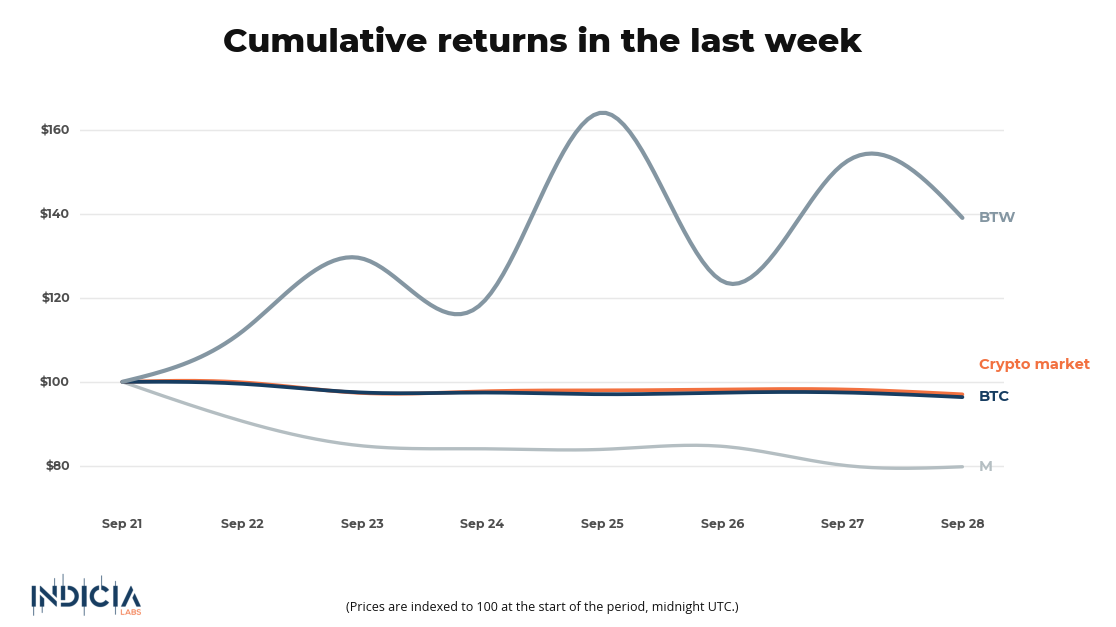

In each Sophia's Thoughts newsletter, we ask about your crypto mood. Your response to this question helps Sophia get a better sense of the pulse of crypto markets. And this ultimately translates into better insights for you when combined with Sophia's AI models. Your data empowers Sophia to provide you with even better intelligence going forward!
📈 The Yield Ceiling
Bitcoin reached a local high of USD 84,540 before retreating below USD 83,000 during the U.S. trading session, according to CoinTelegraph's market analysis. The proximate cause was not a shift in crypto fundamentals but a surge in U.S. bond yields to levels not seen in over two decades. The 30-year Treasury yield breached 5.60%, its highest since 2002, while the 10-year hit 5.26%, a level last observed in June 2007.
The Kobeissi Letter, a market commentator, noted on X that "the surge in yields is creating an extraordinary disruption across the precious metals market," a dynamic that extended visibly to Bitcoin. Gold fell 3.6% on Monday to USD 4,115 per ounce before partially recovering, illustrating how rising yields compress non-yielding assets across the board. Kyle Rodda, senior financial market analyst at Capital.com, framed it plainly: "The rise in crude prices is capping non-yielding assets, so Bitcoin's rally has taken a bit of a pause."
Decrypt reported that Brent crude topped USD 108 per barrel on Monday before falling to below USD 104, compounding inflationary expectations and reducing the probability of near-term Federal Reserve rate cuts. Hamad Hussain, senior climate and commodities economist at Capital Economics, told Reuters that "while greater flows through the Strait of Hormuz is easing some of the upward pressure on prices, the bigger picture is that the oil market remains in a deficit." For Bitcoin, elevated oil prices function as a secondary ceiling: they sustain inflation, delay monetary easing, and raise the relative attractiveness of yield-bearing assets.
🧱 The Supply Wall and the Structural Bid
The macro headwinds collided with a specific technical obstacle. According to CoinTelegraph, Glassnode, the onchain analytics platform, told its X followers that "$BTC has stalled under its heaviest supply cluster. More long-term holder coins sit at 84k-85k than at any other price on the chart. Price needs to break through and hold above this level for the rally to continue." Exchange order books showed ask liquidity concentrated around USD 85,000, meaning the asset faced simultaneous pressure from macro conditions and onchain supply density.
Yet the institutional bid has not disappeared. Spot Bitcoin ETFs recorded eight consecutive sessions of inflows totaling roughly USD 3 billion, per Farside Investors data. September inflows into U.S. crypto investment products reached a month-to-date figure of approximately USD 4.1 billion as of the reporting date, with the final monthly total coming in at approximately USD 4.44 billion, Bitcoin products leading at USD 2.84 billion, according to CoinShares data cited by CoinTelegraph. James Butterfill, Head of Research at CoinShares, observed that "at the moment the basis trade has an attractive yield at 6%, and month to date IBIT has seen over 53% of the $4.1 billion inflows" (the basis trade refers to a strategy in which traders buy spot Bitcoin ETFs while shorting Bitcoin futures to capture the yield spread between the two).
Meanwhile, Strategy purchased an additional 1,665 Bitcoin for USD 142.7 million, bringing its total holdings to 847,666 BTC, with the acquisition financed through MSTR share sales. The average purchase price for the latest tranche was USD 85,681 per Bitcoin, above the current spot price, suggesting the firm views current levels as representing long-term value rather than near-term momentum. The coexistence of persistent ETF inflows and corporate accumulation alongside price suppression illustrates the core tension in this market: structural buyers remain active, but macro conditions appear to be setting the near-term ceiling.
🔭 What the Correlation Shift Means for 2026
QCP Capital, in their latest analysis, warned that "Bitcoin's recent technical strength faces potential pressure from the convergence of geopolitical uncertainty, macroeconomic data risk, and broad-based deleveraging." Rekt Capital, a trader and analyst, identified USD 82,500 as the line that determines the broader trend, writing that "in this cycle, the ~$82,500 level is the analogous level to the very top of the 2022 Accumulation Pattern," and adding that failure to hold it "could revert Bitcoin back into the $60k-$80k range." Bitcoin did rebound to USD 84,000 without violating that level, which Rekt Capital described as a trend-defining retest.
Veteran trader Peter Brandt offered a longer frame, stating: "There's a good possibility we have seen the low and now are entering a new bull market cycle in Bitcoin," while cautioning that "one thing that could happen, of course, is we just had too many people now chase the market. They have bought the idea that the Bitcoin low is in and they have loaded up on the rally." BTC is up just over 40% for Q3 2026, its best Q3 performance since 2017, and Q4 has historically averaged 77% returns since 2013, per CoinGlass data. But Brandt's broader caution applies: "Markets do something, traders need to create a narrative. More often than not, the narrative is at least partially wrong. Let price be king."
The takeaway from this week is that Bitcoin's price range is currently being set by macro variables that lie well outside crypto markets, though it is an open question whether this co-movement reflects a durable regime or temporary overhang. If Treasury yields ease and oil retreats, the suppression may lift and ETF inflows could translate more directly into price appreciation. If yields remain elevated and inflation expectations stay sticky, even strong institutional demand may prove insufficient to clear the supply concentrated above USD 85,000, and the observed correlation between Bitcoin and the bond market could continue to define the asset's ceiling into year-end.
Indicia Labs does not provide investment, tax, or legal advice. You are solely responsible for determining the suitability of any investment, investment strategy, or related transaction based on your personal investment objectives, financial circumstances, and risk tolerance. Indicia Labs may offer educational information about digital assets, which may include blog posts, articles, third-party content, news feeds, tutorials, and videos. This information does not constitute any form of advice, and you should not rely on it as such. Indicia Labs does not recommend buying, earning, selling, or holding any digital asset and will not be responsible for any decisions you make based on the provided information. Any content provided by Indicia Labs may contain errors, inaccuracies, or outdated information and should not be relied upon for making any investment decisions and Indicia Labs and its affiliates hold no responsibility for the accuracy of the provided information or content.
As with any asset, the value of digital assets can fluctuate, and there is a significant risk of losing money when buying, selling, holding, or investing in digital assets. Consult your financial advisor, legal or tax professional regarding your specific situation and financial condition, and carefully consider whether trading or holding digital assets is suitable for you.
Indicia Labs is not registered with the U.S. Securities and Exchange Commission and does not offer securities services in the United States or to U.S. persons. You acknowledge that digital assets are not subject to protections or insurance provided by the Federal Deposit Insurance Corporation or the Securities Investor Protection Corporation.