Sophia’s Thoughts On Institutional Crypto Adoption
Price volatility commands the headlines, but the deeper story this week is structural. While markets declined, major institutions quietly moved to embed crypto into the financial architecture that serious capital actually uses.
These are Sophia's Thoughts:
Standard Chartered launched institutional custody for Ripple's RLUSD stablecoin in Dubai, Russia's Sberbank received central bank authorization to trade Bitcoin and Ether, and Metaplanet issued USD 329 million in convertible bonds, signaling that institutional infrastructure is expanding even as prices fall.
Each of these moves reflects a distinct mechanism: custody rails extended by regulated banks, state-sanctioned trading frameworks formalized in new jurisdictions, and treasury-strategy financing that relies increasingly on capital markets rather than direct Bitcoin accumulation.
The forward question is whether this infrastructure buildout accelerates institutional participation quickly enough to offset the structural risks, including hardware security failures and supply-chain vulnerabilities, that continue to surface alongside the progress.
🚀 Last week’s market performance
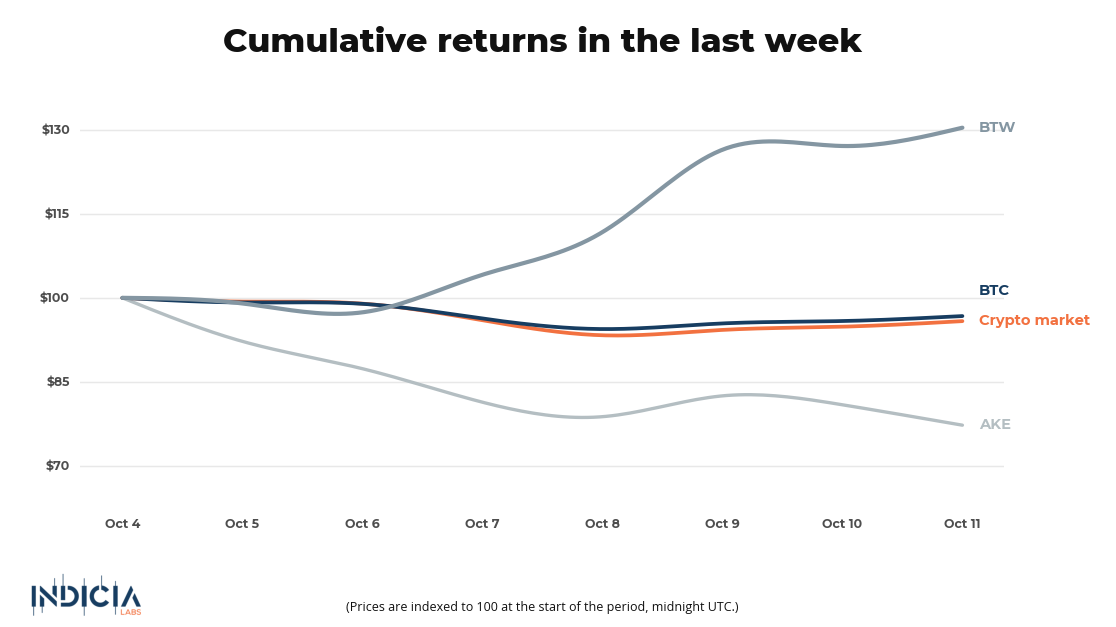
The broader crypto market fell 4.2% over the past week, with Bitcoin (BTC) declining 3.3% as risk-off sentiment weighed on digital assets. BTW (BTW) stood out as the week's top performer, rising 30.4%. AKE (AKE) was the worst performer, falling 22.7% as the token reversed sharply from recent gains.
🧐 What is your crypto mood today?

In each Sophia's Thoughts newsletter, we ask about your crypto mood. Your response to this question helps Sophia get a better sense of the pulse of crypto markets. And this ultimately translates into better insights for you when combined with Sophia's AI models. Your data empowers Sophia to provide you with even better intelligence going forward!
🏦 The Custody Layer Expands
The clearest signal of institutional momentum this week came from Standard Chartered's announcement that its Dubai International Financial Centre branch now offers institutional custody for Ripple's RLUSD stablecoin on the XRP Ledger. As the bank stated in its official release, "Standard Chartered today announced that it now supports institutional custody of Ripple USD (RLUSD) issued on the XRP Ledger (XRPL), giving eligible clients access to the Bank's digital asset custody infrastructure." The service operates under the regulatory oversight of the Dubai Financial Services Authority. RLUSD has grown to approximately USD 2.45 billion in market cap, though that represents less than 1% of the USD 306 billion stablecoin market.
Waqar Chaudry, head of digital assets in Standard Chartered's securities services unit, framed the rationale directly: "Institutional clients want to participate in digital asset markets without compromising on how their assets are safeguarded." That framing matters because it points to what has held institutional capital back: not conviction about digital assets, but the absence of custody infrastructure that meets the risk standards of regulated balance sheets. Standard Chartered is one of the 29 banks the Financial Stability Board classifies as globally systemically important, which makes its entry into stablecoin custody a signal with weight beyond the product itself.
Meanwhile, Sberbank, Russia's largest lender, received authorization from the Bank of Russia to trade Bitcoin, Ether, and Tether's USDt, with a planned December 1 launch across its SberBank Online, SberInvestments, and SberBusiness platforms. The Bank of Russia's updated register now lists 10 authorized crypto exchange operators and six digital custodians, up from four and five respectively the prior week. The Standard Chartered and Sberbank developments suggest that custody and trading authorization are advancing in parallel across multiple regulatory jurisdictions, each on its own timeline. Whether either development translates into meaningful transaction volumes or asset flows in the near term remains to be seen.
💴 The Treasury Trade Deepens
Metaplanet's decision to issue 52 billion yen (USD 329 million) in zero-coupon euro-yen convertible bonds due in 2031 illustrates a financing model that is becoming more elaborate as it matures. Zero-coupon means the bonds pay no periodic interest, returning principal only at maturity; euro-yen refers to yen-denominated bonds issued outside Japan that can be converted into equity. Of the net proceeds, approximately USD 149 million will repay Bitcoin-collateralized loans (loans where Bitcoin holdings are pledged as security against borrowed funds), and USD 179 million will fund share buybacks under a repurchase program targeting up to USD 380 million in total. Metaplanet, the second-largest Bitcoin treasury company globally, is not acquiring more Bitcoin with this capital; it is refinancing existing Bitcoin exposure while returning capital to shareholders.
That distinction matters because it changes the market impact of the transaction. Earlier treasury-strategy issuances were primarily accumulation events, adding buy-side pressure to Bitcoin. This structure is more defensive, prioritizing balance-sheet management over position expansion, and may signal that the crowding in the treasury-strategy space is beginning to constrain further accumulation at current prices.
The more serious risk lies in the reflexive nature of the model itself. If Bitcoin prices fall materially, the value of Bitcoin held as collateral declines, which could trigger margin requirements or forced repayment on collateralized borrowings, converting treasury buyers into net sellers. If convertible bond markets remain open and Bitcoin prices hold, these buyers act as a persistent structural bid; if financing conditions tighten, the same mechanics run in reverse. The Metaplanet issuance is a competent execution of a well-understood playbook, but the playbook depends on conditions that are not guaranteed.
🔐 Hardware Trust, Broken
While institutions build the infrastructure intended to carry crypto into mainstream finance, a hardware security incident exposed a gap in the physical layer that regulated custody does not face. Malicious LTE-enabled implants were discovered in Ledger wallets sold by CryptoBilis, an authorized reseller operating in Indonesia, Malaysia, and the Philippines. The implants captured users' 24-word recovery phrases during device setup and transmitted them over cellular networks using an embedded SIM. Blockchain investigator Specter estimated losses at USD 86 million, while cybersecurity outlet Yfarmx raised its own estimate to USD 103 million; Ledger confirmed that at least one affected device contained an unauthorized implant, though its core infrastructure and security chips were not compromised. Confirmed losses are tied to the Southeast Asia cases; separate reports of tampered devices purchased from MediaMarkt locations in Germany remain under investigation, and Ledger stated no fund losses were confirmed in that case.
The response from retail channels was swift. MediaMarktSaturn removed Ledger products from physical stores and online platforms internationally, with a spokesperson stating: "The products have been removed from our product lineup internationally in all of our countries. We did this as a precautionary measure." That decision reflects how quickly supply-chain uncertainty can trigger precautionary action even in the absence of confirmed losses beyond the original incident.
The broader implication for self-custodying investors is practical: purchasing directly from Ledger or a verified primary retailer, rather than through third-party marketplaces or regional resellers, materially reduces exposure to this category of supply-chain attack. For institutions evaluating custody models, the incident is a reminder that regulated custody infrastructure, precisely because it does not depend on hardware wallet supply chains, is designed to avoid this class of risk. A USD 86 to 103 million estimated loss is meaningful at the retail scale where it occurred, but the more significant question is whether authorized-reseller oversight standards are adequate for a market that is rapidly attracting more serious capital.
If the week's developments are taken together, they describe a crypto ecosystem where regulated institutions are extending trusted infrastructure into digital assets at a pace that would have seemed unlikely three years ago, while supply-chain failures in the physical layer serve as a reminder that the foundations of that trust are still being stress-tested. The structural buildout is real. So are the gaps it has not yet closed.
Indicia Labs does not provide investment, tax, or legal advice. You are solely responsible for determining the suitability of any investment, investment strategy, or related transaction based on your personal investment objectives, financial circumstances, and risk tolerance. Indicia Labs may offer educational information about digital assets, which may include blog posts, articles, third-party content, news feeds, tutorials, and videos. This information does not constitute any form of advice, and you should not rely on it as such. Indicia Labs does not recommend buying, earning, selling, or holding any digital asset and will not be responsible for any decisions you make based on the provided information. Any content provided by Indicia Labs may contain errors, inaccuracies, or outdated information and should not be relied upon for making any investment decisions and Indicia Labs and its affiliates hold no responsibility for the accuracy of the provided information or content.
As with any asset, the value of digital assets can fluctuate, and there is a significant risk of losing money when buying, selling, holding, or investing in digital assets. Consult your financial advisor, legal or tax professional regarding your specific situation and financial condition, and carefully consider whether trading or holding digital assets is suitable for you.
Indicia Labs is not registered with the U.S. Securities and Exchange Commission and does not offer securities services in the United States or to U.S. persons. You acknowledge that digital assets are not subject to protections or insurance provided by the Federal Deposit Insurance Corporation or the Securities Investor Protection Corporation.