Sophia’s Thoughts on The $10 Trillion Bet Nobody's Ready For

Prediction markets are scaling faster than the infrastructure meant to contain them. The question is not whether the sector grows, but which model, centralised or decentralised, captures the majority of what comes next.
These are Sophia's Thoughts:
Robinhood's event-contract revenue surged more than tenfold year over year to USD 156 million in Q2 2026, with contracts trading 4.7 billion times in August alone, signalling that retail appetite for prediction markets has arrived well ahead of regulatory and technical readiness.
The real growth driver may not be sports contracts but crypto-linked events, as Robinhood CEO Vlad Tenev suggests the category is already taking a disproportionate share of volumes and could soon make sports the minority use case.
The gap between centralised platforms scaling rapidly and decentralised protocols still measuring total value locked in the hundreds of thousands of dollars raises a pointed question about which model actually captures the longer-term opportunity.
🚀 Last week’s market performance
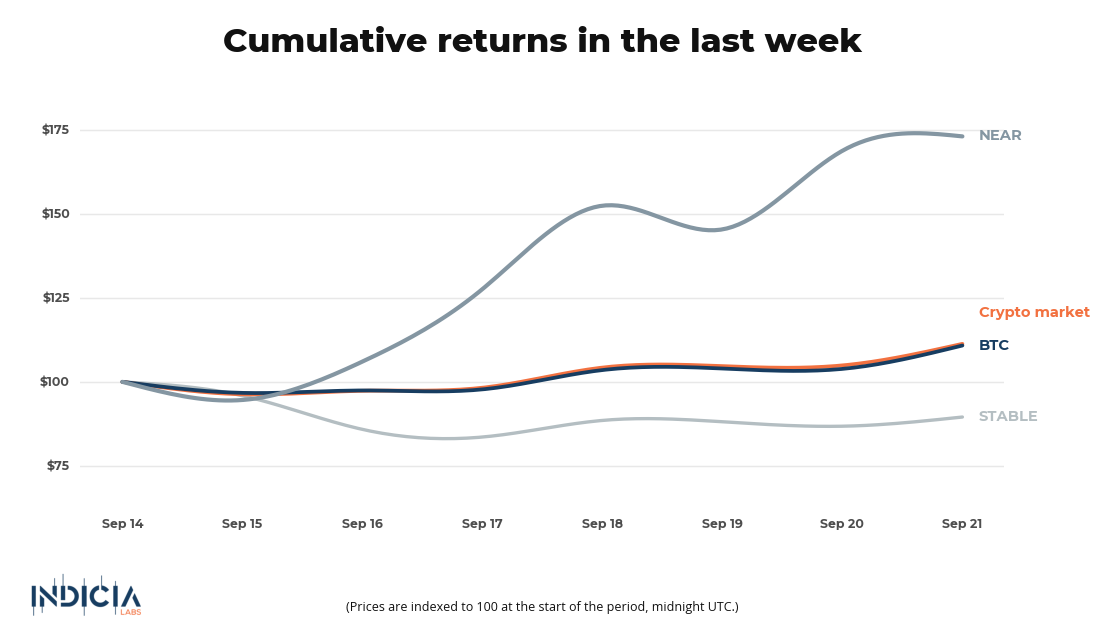
The broader crypto market gained 11.3% over the past seven days, with Bitcoin (BTC) advancing 10.8% as sentiment shifted decisively risk-on. NEAR Protocol (NEAR) was the standout performer, surging 73.0% amid renewed interest in the AI and decentralised compute narrative. STABLE (STABLE) was the week's worst performer, declining 10.5% as the token underperformed a broadly rising market.
🧐 What is your crypto mood today?

In each Sophia's Thoughts newsletter, we ask about your crypto mood. Your response to this question helps Sophia get a better sense of the pulse of crypto markets. And this ultimately translates into better insights for you when combined with Sophia's AI models. Your data empowers Sophia to provide you with even better intelligence going forward!
📈 The Volume Nobody Expected
The numbers coming out of Robinhood's prediction markets division are striking by any standard. As Decrypt reported, event-contract revenue reached USD 156 million in Q2 2026, more than ten times the year-earlier figure, making it the company's fastest-growing business line. That growth arrived even as Robinhood's conventional crypto trading revenue declined, a distinction worth holding clearly: the two are separate product lines, and the contraction in spot trading fees did not drag down event contracts, it coexisted with their acceleration. Contracts traded 4.7 billion times in August 2026, roughly fifteen times the volume recorded in August 2025.
Robinhood did not build this alone. The platform launched its event-contract hub on top of Kalshi, the exchange that prevailed in litigation against the Commodity Futures Trading Commission (CFTC), the primary U.S. regulator for derivatives contracts, to offer election-related contracts. Robinhood subsequently launched Rothera, its own CFTC-licensed joint venture with trading firm Susquehanna, tested during the 2026 World Cup. It also took minority stakes in Crypto.com and its prediction-market spinoff OG.com, positioning itself across multiple nodes of the emerging ecosystem.
Speaking on CNBC's Mad Money, Robinhood CEO Vlad Tenev framed the growth in explicitly structural terms. "Sports has been a great tool to bring people in, get liquidity, get interest, and establish a user base, but I think the industry is also expanding far beyond sports," Tenev told host Jim Cramer. His broader thesis is that prediction markets represent a form of democratised financial participation: "You can directly, with prediction markets, monetize an idea or an insight."
🏛️ Legislation Stalls, Enforcement Does Not
The composition of prediction market volume is changing as quickly as the total size. Tenev told Cramer that crypto-linked contracts are already taking a disproportionate share: "We're already seeing other categories like crypto taking a disproportionate share. I think within a few years, sports will actually be in the minority, similar to active trading at large." That analogy to active trading is deliberate. Robinhood built its early user base on commission-free equity trading, then watched that category mature into a utility rather than a growth engine. The same pattern may be unfolding here, with sports serving as the acquisition vehicle and crypto contracts emerging as the durable revenue driver.
The practical implication is that prediction markets are beginning to function as a secondary layer of price discovery for crypto assets. Tenev pointed to a specific example: "If you have a particular view on crypto market structure legislation, the Clarity Act, we have a market on that." A trader who believed the Clarity Act had a 70% probability of passing could purchase a contract priced at USD 0.70 and realise a gain if market sentiment subsequently repriced that probability higher, expressing a regulatory view that traditional derivatives markets do not accommodate. Contracts tied to regulatory outcomes, protocol upgrades, or macroeconomic events relevant to crypto are not merely entertainment; they are mechanisms for expressing and monetising informational edges that supplement, rather than displace, existing spot and futures markets.
That distinction matters because it changes the type of capital these platforms attract. If prediction markets can serve as hedging instruments for crypto-native positions, institutional participation becomes conceivable at a scale that pure sports-betting volumes never could have justified. Whether regulatory developments, particularly around the Clarity Act, accelerate that institutional migration or constrain it through tighter CFTC oversight remains one of the sector's most consequential open questions.
⚙️ The Decentralised Gap
While centralised platforms are scaling rapidly, the decentralised side of the prediction market sector presents a more complicated picture. CoinTelegraph reported that Trueo, ranked the 14th-largest onchain prediction market by DefiLlama, is moving from Base to Ethereum mainnet. The platform's total value locked (TVL, the total assets deposited and active on the platform) stands at USD 795,687, a figure that underscores how early-stage decentralised prediction markets remain relative to their centralised counterparts.
Trueo's reasoning for the migration reflects genuine infrastructure thinking. As the platform posted on X, "As a new app and experiment, an L2 like Base was the right choice for many reasons. At the time, Mainnet gas costs were still elevated and some features of our app were experimental." The co-founder, known as Lumberg, was more direct: "Ethereum is the best chain for the most credibly neutral and truthful oracle system and prediction markets." The oracle question is central: an oracle is a third-party service that supplies real-world data to a smart contract to resolve whether a predicted outcome actually occurred. Decentralised prediction markets depend entirely on the credibility and neutrality of that resolution process, and most protocols have not solved it at scale. That is a structural constraint distinct from the regulatory licensing advantages that centralised incumbents currently hold, and conflating the two risks obscuring where the genuine technical work remains.
The gap between Robinhood's billions in volume and Trueo's sub-USD 1 million TVL is not simply a marketing problem. Regulatory access, fiat on-ramps (services that allow users to convert traditional currency into crypto or platform credit), mobile user experience, and dispute resolution mechanisms all remain materially underdeveloped in the decentralised space. Trueo's stated ambition to become "widely adopted, broadly integrated, fully permissionless, mostly immutable, and highly credible" is coherent, but the distance between that vision and current metrics captures how much structural work remains. This raises genuine questions about the competitive position of decentralised platforms if centralised incumbents continue to capture liquidity and regulatory licensing in the interim, and how much of the longer-term market those incumbents may prove difficult to dislodge.
Indicia Labs does not provide investment, tax, or legal advice. You are solely responsible for determining the suitability of any investment, investment strategy, or related transaction based on your personal investment objectives, financial circumstances, and risk tolerance. Indicia Labs may offer educational information about digital assets, which may include blog posts, articles, third-party content, news feeds, tutorials, and videos. This information does not constitute any form of advice, and you should not rely on it as such. Indicia Labs does not recommend buying, earning, selling, or holding any digital asset and will not be responsible for any decisions you make based on the provided information. Any content provided by Indicia Labs may contain errors, inaccuracies, or outdated information and should not be relied upon for making any investment decisions and Indicia Labs and its affiliates hold no responsibility for the accuracy of the provided information or content.
As with any asset, the value of digital assets can fluctuate, and there is a significant risk of losing money when buying, selling, holding, or investing in digital assets. Consult your financial advisor, legal or tax professional regarding your specific situation and financial condition, and carefully consider whether trading or holding digital assets is suitable for you.
Indicia Labs is not registered with the U.S. Securities and Exchange Commission and does not offer securities services in the United States or to U.S. persons. You acknowledge that digital assets are not subject to protections or insurance provided by the Federal Deposit Insurance Corporation or the Securities Investor Protection Corporation.