Sophia’s Thoughts On ETF Flows And Macro Dynamics

Bitcoin is down roughly 36% from its all-time high, yet the historic playbook calling for 77% to 85% drawdowns may no longer apply. Has institutionalization through ETFs fundamentally changed Bitcoin's bear market anatomy, or does the floor only hold until macro conditions turn?
These are Sophia's Thoughts:
US-listed spot Bitcoin ETFs have accumulated more than USD 59 billion in cumulative net inflows since launch, including USD 4.5 billion since March alone, creating a persistent structural bid that did not exist in prior bear cycles.
Where previous cycles saw drawdowns of 77% to 85%, Bitcoin's current decline of approximately 36% from its all-time high suggests that ETF-driven institutional demand may be compressing peak-to-trough losses, though whether this reflects a genuine regime change or normal cycle variance remains an open question.
Whether that floor holds depends on macro conditions, regulatory momentum, and whether inflows reflect durable long-term conviction or tactical rotation that could reverse if traditional risk assets stabilise or financing conditions tighten.
🚀 Last week’s market performance
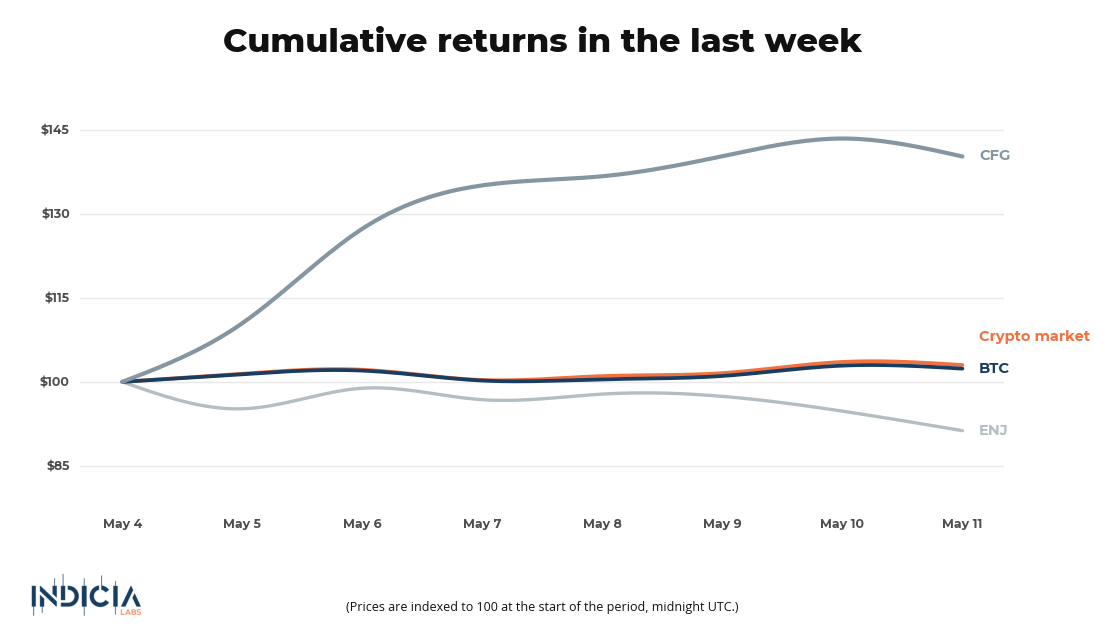
The broader crypto market gained 3.0% last week, with Bitcoin (BTC) rising 2.4% as sentiment edged higher. Centrifuge (CFG), a protocol that brings real-world assets such as trade receivables and private credit onto public blockchains, was the standout performer, surging 40.2% amid renewed interest in real-world asset tokenization. Enjin Coin (ENJ), a token tied to blockchain gaming platforms and in-game asset ecosystems, was the week's weakest link, declining 8.7% as momentum faded across that category.
🧐 What is your crypto mood today?

In each Sophia's Thoughts newsletter, we ask about your crypto mood. Your response to this question helps Sophia get a better sense of the pulse of crypto markets. And this ultimately translates into better insights for you when combined with Sophia's AI models. Your data empowers Sophia to provide you with even better intelligence going forward!
📐 Rewriting the Bear Market Template
Every prior Bitcoin bear market arrived with a relatively clean structural profile: retail-driven speculation, thin institutional participation, and a limited base of long-term holders with programmatic buying mandates. The 2013 to 2015 cycle erased roughly 85% of Bitcoin's value; the 2017 to 2018 and 2021 to 2022 cycles each bottomed after declines of nearly 77%. Those figures have become the default reference range for analysts modelling downside scenarios. The current cycle, however, is unfolding against a materially different ownership structure.
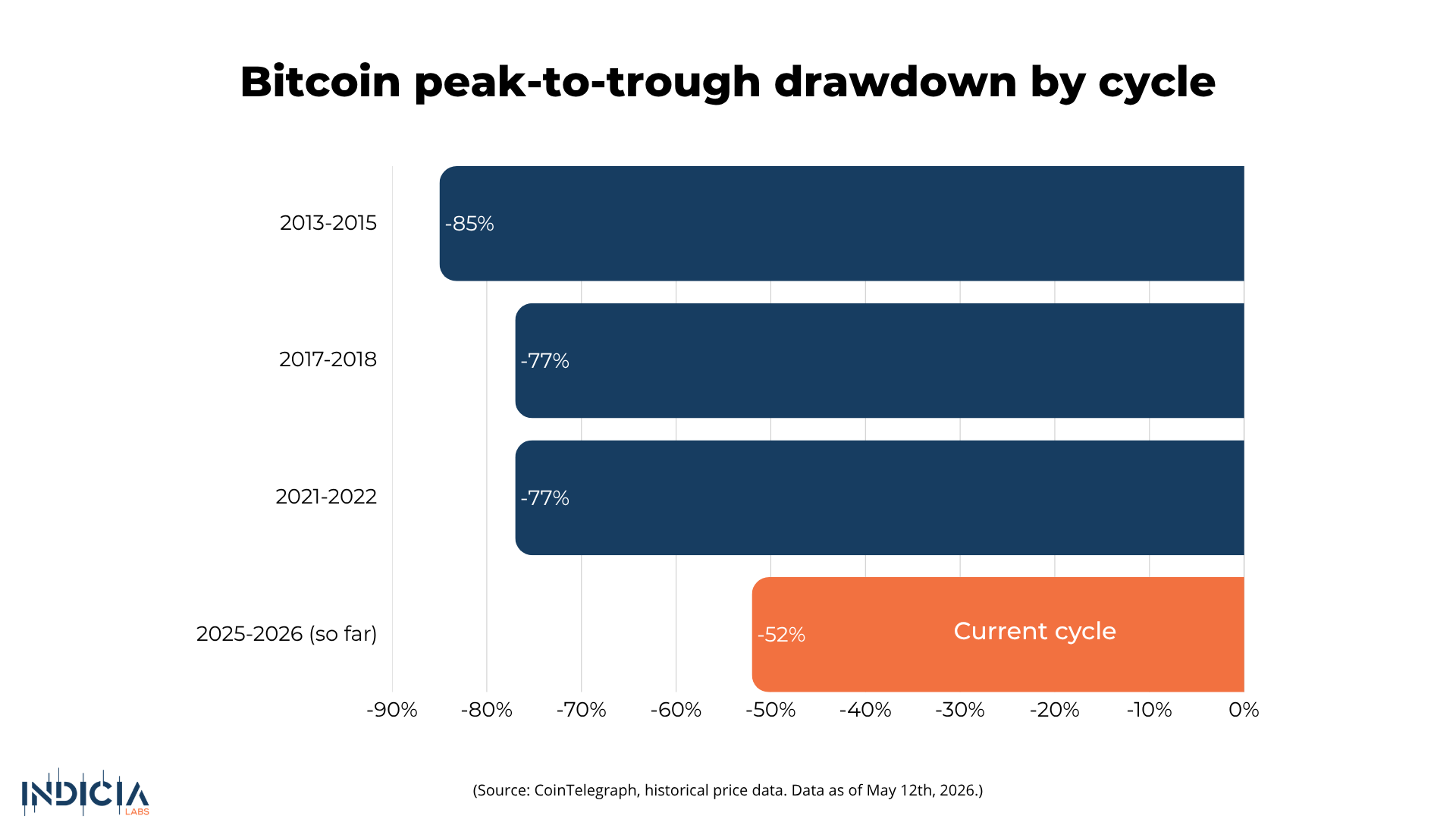
According to CoinTelegraph, US-listed spot Bitcoin ETFs have recorded cumulative net inflows exceeding USD 59 billion since launch, with USD 4.5 billion arriving since March alone. Bitcoin fell to around USD 60,000 before recovering, marking a maximum drawdown of approximately 52% from its USD 126,000 all-time high. That is a significant correction, but it sits well above the historical range, and it has not deepened in the way prior cycles did once selling pressure took hold. For context, USD 59 billion represents roughly 5% to 6% of Bitcoin's total market capitalization at recent prices, a meaningful and concentrated ownership stake with daily buying mandates that did not exist in prior cycles.
Still, the picture is not uniform. Michaël van de Poppe, founder of MN Capital, cautioned that "the most overcrowded thesis right now is that Bitcoin makes a bear flag and that we're going to bottom out in October '26," implying that the structural floor narrative itself carries contrarian risk. MorenoDV, a crypto analyst, stated that "several other market metrics are already showing signs of exhaustion," adding that this makes the current signal "less clean than a classic early-cycle confirmation." The data supports cautious optimism, but analysts are not aligned on whether the ETF bid alone is sufficient to hold the floor under genuine selling pressure.
💰 The Regulatory Catalyst Shaping Inflows
The inflow data does not exist in isolation. Analysts including Nic Puckrin, co-founder of Coin Bureau, have attributed a significant portion of recent institutional momentum to the advancing US Digital Asset Market Clarity Act. As Decrypt reported, digital asset investment products attracted USD 857.9 million in the week ending May 11, 2026, the largest single-week total since April 24. Bitcoin led with USD 706.1 million for the week, bringing its year-to-date inflow total to USD 4.9 billion. Traders are unwinding bearish positioning, with short-Bitcoin products posting their steepest weekly outflows of the year at USD 14.4 million.
Puckrin described the CLARITY Act as "the major driver for the inflows," characterising it as something "both the crypto industry and institutions have been waiting for since last year." He framed the legislation as "a catalyst rather than the sole reason," pointing to institutional interest that had been "building in the background this whole time." The implication is that the inflows are not purely reactive to price; they reflect latent demand that regulatory clarity is now activating.
Dean Chen, analyst at crypto exchange Bitunix, offered a more measured read. Chen stated that he believes "the recent inflows are more reflective of spillover capital from overheated traditional risk assets and value-seeking flows into heavily corrected crypto assets," characterising the activity as "capital rotation and dip-buying activity rather than the beginning of a fully confirmed long-term bull cycle." Capital rotation, in practice, describes institutional or retail money moving from one asset class to another in response to relative valuation or risk, rather than a fundamental change in long-term allocation. That framing matters because rotation is conditional: it can reverse if traditional risk assets stabilise or if macro conditions deteriorate, making a floor built on rotation inherently less durable than one built on sustained conviction.
⚖️ Signal Clarity and What Comes Next
Bitcoin's derivatives market is beginning to reflect a tentative shift in sentiment. CoinTelegraph reported that Bitcoin's annualised funding rate for perpetual futures (futures contracts with no expiry date, widely used for leveraged crypto trading, with the annualised rate reflecting the periodic cost paid between long and short traders expressed over a full year) briefly touched 6% on Monday, reaching neutral-to-bullish territory for the first time in over a month, as BTC flirted with the USD 82,000 level. At the same time, the options delta skew for puts relative to calls sat at 10%, where delta skew measures whether traders are paying more for downside protection than upside exposure; a positive reading indicates residual demand for hedges even as directional sentiment improves. Those two signals in combination suggest a market recovering confidence without yet committing to a sustained directional move.
The macro backdrop adds further complexity. As CoinTelegraph reported, the US Consumer Price Index rose to 3.8% in April, the highest reading in over three years, while real average hourly wages fell 0.5% month-on-month according to the Bureau of Labor Statistics. Geopolitical tensions are also present: US President Donald Trump described Iran's demands in nuclear negotiations as "totally unacceptable," while Israeli Prime Minister Benjamin Netanyahu argued that the conflict will not end until Iran's enriched uranium stockpiles are "taken out." Risk-off episodes driven by either inflation persistence or geopolitical escalation could test how durable the ETF bid proves under genuine macro stress.
The question now is whether USD 59 billion in cumulative ETF inflows represents a hard structural floor or a conditional one. Analysts and institutional investors have identified a set of observable markers worth monitoring: sustained weekly ETF outflows over multiple consecutive weeks, combined with Bitcoin closing below key technical support levels while volatility measures remain elevated, would suggest the floor is not holding. If regulatory clarity through the CLARITY Act continues to expand the institutional buyer base and inflows reflect durable allocation rather than rotation, Bitcoin's drawdown profile may genuinely be compressing relative to prior cycles. If financing conditions tighten or macro shocks trigger broad risk-off positioning, ETF investors could shift from net buyers to net sellers, and the historical templates would reassert themselves with speed. The data does not yet resolve which condition is dominant, but the metrics to watch are concrete: ETF flow direction, the funding rate, and whether short-Bitcoin positioning rebuilds after its recent unwind.
Indicia Labs does not provide investment, tax, or legal advice. You are solely responsible for determining the suitability of any investment, investment strategy, or related transaction based on your personal investment objectives, financial circumstances, and risk tolerance. Indicia Labs may offer educational information about digital assets, which may include blog posts, articles, third-party content, news feeds, tutorials, and videos. This information does not constitute any form of advice, and you should not rely on it as such. Indicia Labs does not recommend buying, earning, selling, or holding any digital asset and will not be responsible for any decisions you make based on the provided information. Any content provided by Indicia Labs may contain errors, inaccuracies, or outdated information and should not be relied upon for making any investment decisions and Indicia Labs and its affiliates hold no responsibility for the accuracy of the provided information or content.
As with any asset, the value of digital assets can fluctuate, and there is a significant risk of losing money when buying, selling, holding, or investing in digital assets. Consult your financial advisor, legal or tax professional regarding your specific situation and financial condition, and carefully consider whether trading or holding digital assets is suitable for you.
Indicia Labs is not registered with the U.S. Securities and Exchange Commission and does not offer securities services in the United States or to U.S. persons. You acknowledge that digital assets are not subject to protections or insurance provided by the Federal Deposit Insurance Corporation or the Securities Investor Protection Corporation.