Sophia’s Thoughts On Long Term Holder Accumulation

The data tells two stories at once. Beneath the wave of forced selling and ETF outflows, long-term holders are doing what on-chain records from prior drawdowns consistently show at inflection points: accumulating.
These are Sophia's Thoughts:
Short-term holders sold more than 10,000 BTC worth approximately USD 770 million at a loss on May 19, with sellers exiting at roughly USD 76,900 against an average cost basis of USD 78,440 as Bitcoin fell to a weekly low of USD 76,201.
Spot Bitcoin ETFs shed USD 648.64 million in a single session, driven by geopolitical anxiety and shifting Federal Reserve rate expectations, yet Strategy added 24,869 BTC worth USD 2.01 billion in the same week.
The divergence between retail capitulation and institutional accumulation may determine the direction of the next sustained price move, though the USD 74,000 to USD 75,000 support zone first requires a credible defense.
🚀 Last week’s market performance
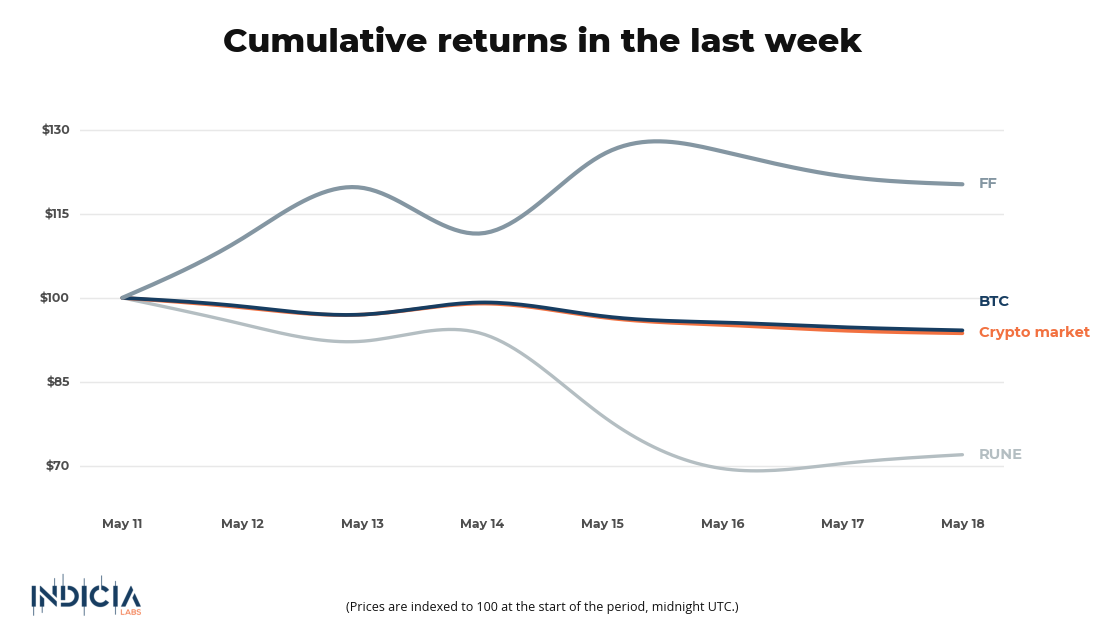
The broader crypto market declined 6.3% over the past seven days, with Bitcoin (BTC) falling 5.8% amid intensifying risk-off sentiment. FF (FF) was the week's standout performer, rising 20.3% against the broader trend. THORChain's RUNE (RUNE) was the hardest hit among tracked assets, declining 28.0%.
🧐 What is your crypto mood today?

In each Sophia's Thoughts newsletter, we ask about your crypto mood. Your response to this question helps Sophia get a better sense of the pulse of crypto markets. And this ultimately translates into better insights for you when combined with Sophia's AI models. Your data empowers Sophia to provide you with even better intelligence going forward!
📉 The Capitulation Print
The week's most telling data point arrived on Monday, May 19. According to CoinTelegraph, more than 10,000 BTC worth approximately USD 770 million were transferred by short-term holders to Binance at a loss, with sellers exiting at roughly USD 76,900 against an average cost basis of USD 78,440. Amr Tah, a CryptoQuant analyst, described the activity as reflecting "short-term holder stress, forced selling, or capitulation from weaker hands during a correction." Bitcoin had set a local high of USD 82,800 on May 6 before retracing to a weekly low of USD 76,201, as confirmed by Decrypt.
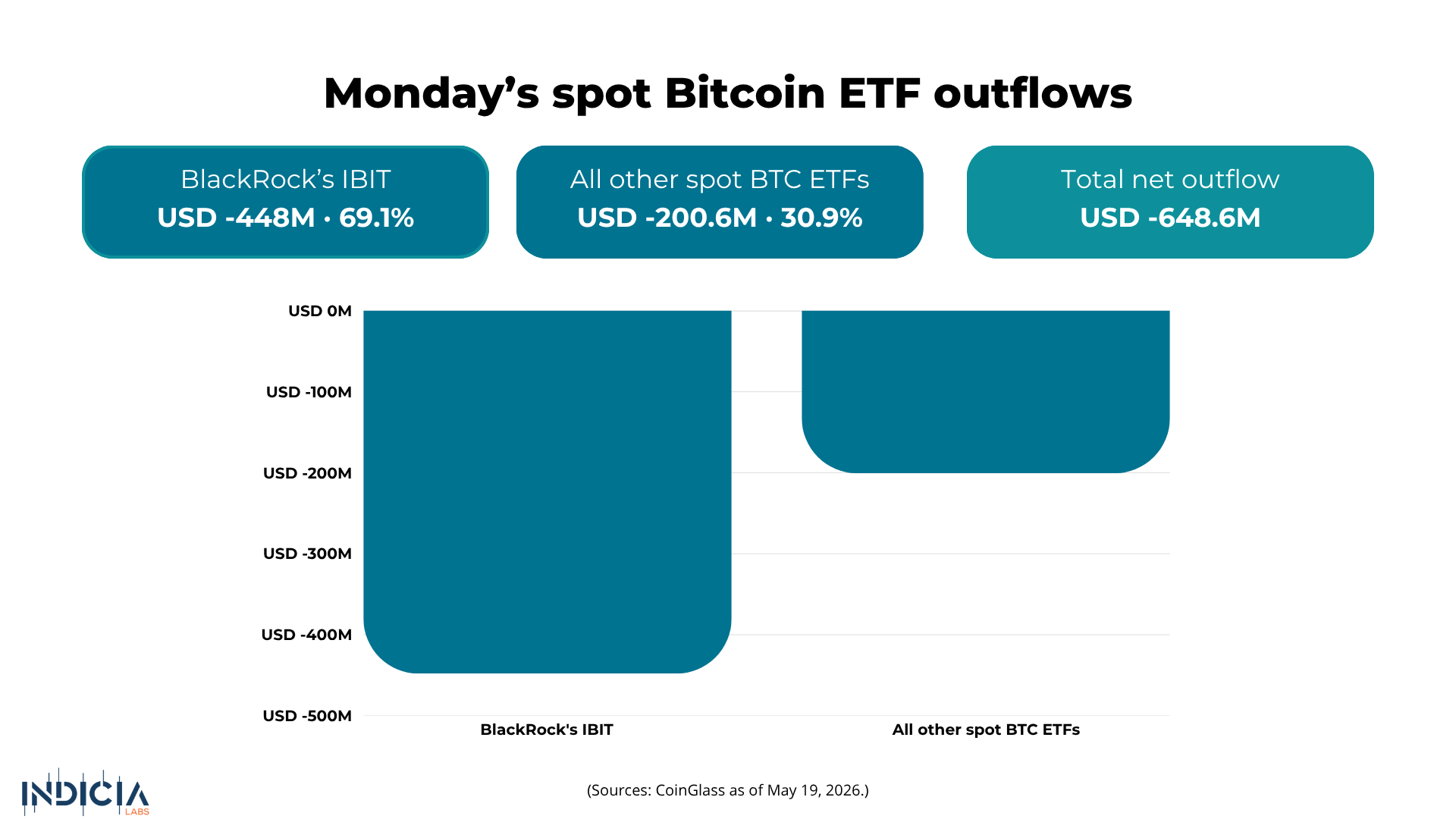
The macro backdrop amplified the selling pressure. Illia Otychenko, lead analyst at CEX.IO, attributed the move in part to conditions "driven by last week's U.S. inflation data, which significantly shifted market expectations around Federal Reserve policy, with rising expectations of a rate hike this year," as well as "rising concerns that the U.S.-Iran conflict could escalate again." Agne Linge, Advisor to the Board at blockchain financial infrastructure firm Wefi, characterized ETF outflows as "correlated to the general market and reflect the de-risking strategy that was conducted by fund managers in light of geopolitical events." According to Decrypt, spot Bitcoin ETFs shed USD 648.64 million on Monday alone, with BlackRock's IBIT accounting for USD 448 million of that figure, and the Crypto Fear and Greed Index falling to 25, signaling Extreme Fear.
The aggregate picture is sobering. Glassnode data cited by CoinTelegraph shows that more than 7.8 million BTC are currently held at a loss, a supply overhang that represents concentrated selling pressure markets must absorb before any sustained move higher becomes structurally credible. Analyst Alek_Carter posted on X that "money is rotating out fast, panic is creeping in, and traders are clearly hitting the risk-off button hard," while Alex Marzell observed that "momentum is starting to shift back to the bears."
🐋 The Other Side of the Trade
While short-term holders were liquidating, a different type of market participant moved in the opposite direction. CoinTelegraph reported that Michael Saylor's Strategy purchased 24,869 Bitcoin for USD 2.01 billion between May 11 and 17, bringing its total holdings to 843,738 BTC. Sunny Mom, a CryptoQuant analyst, noted that the structural shift toward institutional participation is "reflecting growing institutional adoption" and "changes how BTC forms its bottom." That framing is worth holding alongside the data: whether this acquisition reflects deep conviction or a pre-scheduled allocation cadence is not publicly disclosed, and the distinction matters for assessing whether similar buying recurs on further weakness.
That distinction matters because the mechanism of price discovery is shifting. In prior cycles, the period following capitulation events, when holders sell into weakness (the distribution phase, in market terminology), has tended to resolve through retail re-accumulation. ETF vehicles and treasury buyers now introduce a different profile of demand: institutional capital that can arrive in scale and compress how long that selling pressure persists. Still, the near-term technical picture offers little comfort. CoinTelegraph's analysis identified the USD 74,000 to USD 75,000 zone as the most critical support test of the current bear market, a level that held in Q1 2025 before Bitcoin rallied toward cycle highs at USD 126,000. The support thesis, as that analysis notes, is grounded in realized price history and on-chain liquidation clustering in that range.
The range of analyst price targets reflects genuine uncertainty. Sunny Mom placed the cycle bottom between USD 65,900 and USD 70,500, noting that "if USD 70.5K holds, we'll slowly grind out a bottom in the upper range." Michael van de Poppe, founder of MN Capital, stated that the current setup "doesn't look great," adding that "if this area doesn't hold, then we're most likely cascading through the lows of the recent rally and test below USD 65,000 for support."CME FedWatch data now shows a 98.8% probability of no rate change through June, removing a near-term monetary tailwind that markets had previously priced in.
⚠️ Signal and Noise
Not all signals in a distressed market are clean. Blockchain data platform Bubblemaps identified a cluster of nine Polymarket wallets that collectively earned USD 2.4 million with a 98% win rate on prediction contracts tied to U.S. military operations, according to CoinTelegraph's investigation. The wallets placed concentrated bets immediately before events including the February 28 attack on Iran and the subsequent U.S.-Iran ceasefire agreement, with four wallets each earning approximately USD 400,000 on a single contract. Nicolas Vaiman, CEO of Bubblemaps, called the pattern "symptomatic of someone with an unfair informational advantage."
Vaiman added that while certainty is not possible, "it is suspicious that funds were routed through CEXs and third-party services before funding new Polymarket accounts, effectively covering their tracks." The episode surfaces a structural concern for crypto markets during periods of geopolitical stress: information asymmetry does not disappear in decentralized markets; it finds new venues. For Bitcoin, geopolitical shock events may continue to generate abrupt, hard-to-anticipate price moves that compress the window between signal and reaction.
The question now is whether the USD 74,000 to USD 75,000 support zone can hold long enough for institutional accumulation to offset the remaining forced selling. If that level is defended and ETF flows stabilize, the concentrated supply overhang above USD 76,000 becomes the next analytical test, not a resolution. If financing conditions tighten further and geopolitical risk persists, institutional buyers may face their own redemption pressure, converting a structural bid into a structural headwind. Both scenarios remain live.
Indicia Labs does not provide investment, tax, or legal advice. You are solely responsible for determining the suitability of any investment, investment strategy, or related transaction based on your personal investment objectives, financial circumstances, and risk tolerance. Indicia Labs may offer educational information about digital assets, which may include blog posts, articles, third-party content, news feeds, tutorials, and videos. This information does not constitute any form of advice, and you should not rely on it as such. Indicia Labs does not recommend buying, earning, selling, or holding any digital asset and will not be responsible for any decisions you make based on the provided information. Any content provided by Indicia Labs may contain errors, inaccuracies, or outdated information and should not be relied upon for making any investment decisions and Indicia Labs and its affiliates hold no responsibility for the accuracy of the provided information or content.
As with any asset, the value of digital assets can fluctuate, and there is a significant risk of losing money when buying, selling, holding, or investing in digital assets. Consult your financial advisor, legal or tax professional regarding your specific situation and financial condition, and carefully consider whether trading or holding digital assets is suitable for you.
Indicia Labs is not registered with the U.S. Securities and Exchange Commission and does not offer securities services in the United States or to U.S. persons. You acknowledge that digital assets are not subject to protections or insurance provided by the Federal Deposit Insurance Corporation or the Securities Investor Protection Corporation.