Stablecoin settlement volumes have crossed a threshold that is difficult to dismiss. The question now is whether the infrastructure buildout signals lasting monetary change, or simply a well-funded experiment in search of a use case.
These are Sophia's Thoughts:
Visa's stablecoin settlement volume has surpassed a USD 20 billion annualized run rate, more than 15 times year-ago levels, as over 160 card programs and a near-200% rise in payment volume signal that stablecoins are moving from experiment to embedded financial plumbing.
The infrastructure layer is expanding rapidly, with Circle acquiring Singapore-based Tazapay for USD 400 million, sovereign pilots launching in Uzbekistan and Switzerland, and McKinsey data placing genuine stablecoin payment volume at roughly USD 390 billion annualized, still just 0.02% of global flows.
Institutional adoption is real, but it does not automatically translate into token appreciation; the assets doing the work are dollar-pegged stablecoins, not governance tokens or speculative plays adjacent to the sector.
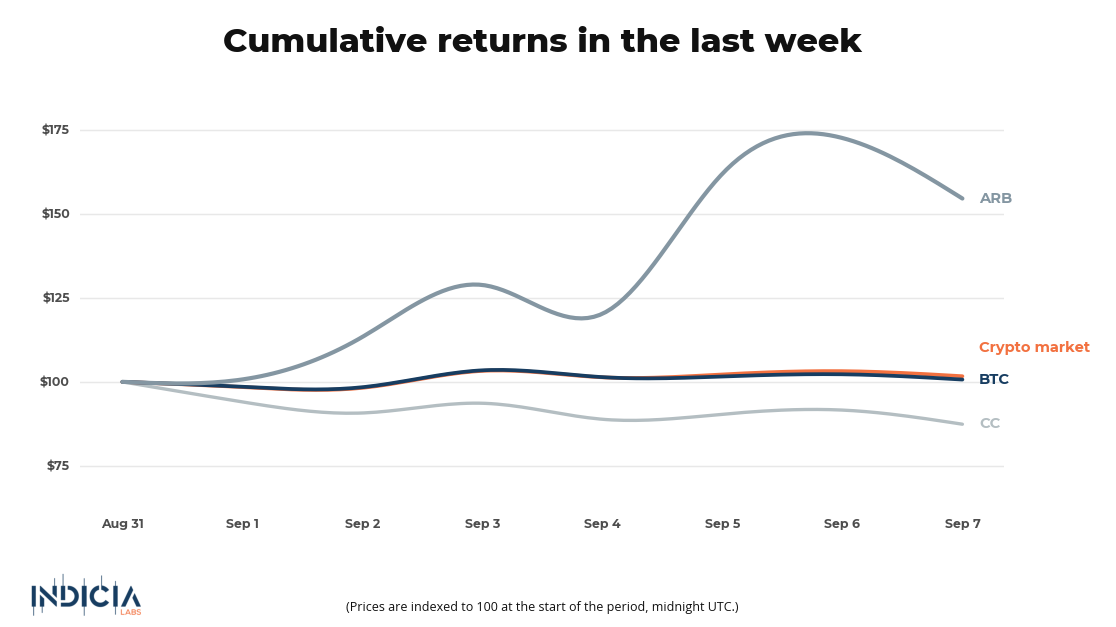
🚀 Last week’s market performance

In each Sophia's Thoughts newsletter, we ask about your crypto mood. Your response to this question helps Sophia get a better sense of the pulse of crypto markets. And this ultimately translates into better insights for you when combined with Sophia's AI models. Your data empowers Sophia to provide you with even better intelligence going forward!
💳 Visa Crosses the Threshold
The most consequential stablecoin data point of the week did not come from a crypto-native protocol. According to Cointelegraph, Visa's stablecoin settlement volume has surpassed a USD 20 billion annualized run rate, a figure that represents more than 15 times the level recorded a year earlier. More than 160 stablecoin-linked card programs now operate on Visa's network, and stablecoin-linked card payment volume is up nearly 200% year over year as of early September 2026. Rubail Birwadker, Visa's global head of growth products and partnerships, described stablecoins as "changing how money moves."
Speculative trading does not drive these numbers. They reflect settlement activity, meaning actual merchants, card issuers, and payment processors are using stablecoin rails to clear transactions. Visa management, during its fiscal third-quarter earnings call in July, described the company as "investing in each layer of the stablecoin stack," a framing that positions this as strategic infrastructure rather than a product pilot. According to Cointelegraph, Credit Coop has financed more than USD 2.5 billion in cumulative settlement volume since 2023, involving more than 3,000 borrowing events and 9,000 repayments.
That context matters, because broader stablecoin volume figures require careful reading. As Decrypt noted, headline figures of USD 30 trillion or more in annual stablecoin volume mostly reflect bots, exchange flows, and automated trading rather than genuine payments. McKinsey and Artemis place genuine stablecoin payment activity at roughly USD 390 billion annualized, still only about 0.02% of global payment volume. Visa's run rate represents a verifiable slice of real economic activity, which is precisely what makes it a credible signal.
🌏 Infrastructure Expanding Across Borders
The sovereign dimension of stablecoin adoption is accelerating in parallel. Cointelegraph reported that Uzbekistan has launched a pilot program testing a som-pegged stablecoin called HUMO, backed by government securities and operating within a regulatory sandbox jointly overseen by the National Agency for Prospective Projects and the country's central bank. More than 20 merchants are prepared to test HUMO payments, with licensed crypto exchange Asterium serving as the project partner. Each HUMO token is pegged one-to-one with the Uzbek som.
Meanwhile, Switzerland's CHFD sandbox has entered its testing phase, with nine companies now actively trialing a Swiss franc-based stablecoin. Financial market operator SIX and payment app TWINT joined the initiative as new participants alongside existing bank partners. The pilot is examining whether programmable payments can reduce fraud on online marketplaces, support fair access to event tickets, and make public payments more efficient. These are not speculative use cases; they are problems that existing payment infrastructure has failed to solve at scale.
Circle is moving aggressively on the private-sector side as well. The company has agreed to acquire Singapore-based cross-border payments platform Tazapay in a USD 400 million all-stock deal, pending approval from the Monetary Authority of Singapore. Tazapay processed more than USD 25 billion in annualized payment volume as of the announcement date, up from more than USD 10 billion in August 2025, a doubling in roughly twelve months. Irfan Ganchi, Senior Vice President of Payments at Circle, said the deal "will increase Circle's capability to originate and terminate payments globally, near-instant and 24/7, which is a meaningful step toward making USDC the default payment rail for cross-border commerce."
⚖️ Adoption Is Not a Price Catalyst for Speculative Tokens
The structural risk for retail investors lies in conflating stablecoin adoption with token-level upside. The assets doing the settlement work are dollar-pegged or fiat-pegged stablecoins, instruments designed by definition not to appreciate. USDC, the stablecoin most directly tied to Circle's expanding footprint, holds its peg. Growth in USDC transaction volume is a revenue story for Circle as a private company, not a return story for holders of adjacent governance tokens.
The intermediated reality of today's stablecoin stack reinforces that point. Decrypt's analysis makes clear that stablecoins currently settle only the middle leg of cross-border transactions, meaning they handle the transfer of value between counterparties once funds have already entered the system, while banks remain essential at the entry and exit points where local currency is converted. Stripe paid USD 1.1 billion for Bridge, whose core product is orchestrating those bank relationships, not eliminating them. Licensed operators, card networks, and payment acquirers are therefore better positioned to capture economic value from this buildout than open token ecosystems.
The cross-border payments market reached USD 208 trillion in 2025, according to FXC Intelligence, which frames the genuine stablecoin opportunity as both enormous in absolute terms and still nascent as a share of total flows. Regulatory approvals, bank partnership depth, and the conversion of sovereign pilots into production deployments are the observable conditions that would determine whether current adoption rates follow an S-curve toward scale or plateau at the infrastructure layer. These are structural signposts worth monitoring, not a forecast. The more serious analytical risk lies in markets pricing in adoption momentum before the revenue pathways and the regulatory frameworks that govern them are fully resolved.
Indicia Labs does not provide investment, tax, or legal advice. You are solely responsible for determining the suitability of any investment, investment strategy, or related transaction based on your personal investment objectives, financial circumstances, and risk tolerance. Indicia Labs may offer educational information about digital assets, which may include blog posts, articles, third-party content, news feeds, tutorials, and videos. This information does not constitute any form of advice, and you should not rely on it as such. Indicia Labs does not recommend buying, earning, selling, or holding any digital asset and will not be responsible for any decisions you make based on the provided information. Any content provided by Indicia Labs may contain errors, inaccuracies, or outdated information and should not be relied upon for making any investment decisions and Indicia Labs and its affiliates hold no responsibility for the accuracy of the provided information or content.
As with any asset, the value of digital assets can fluctuate, and there is a significant risk of losing money when buying, selling, holding, or investing in digital assets. Consult your financial advisor, legal or tax professional regarding your specific situation and financial condition, and carefully consider whether trading or holding digital assets is suitable for you.
Indicia Labs is not registered with the U.S. Securities and Exchange Commission and does not offer securities services in the United States or to U.S. persons. You acknowledge that digital assets are not subject to protections or insurance provided by the Federal Deposit Insurance Corporation or the Securities Investor Protection Corporation.