
Bitcoin is holding near USD 78,000 as global bond yields push toward multi-decade highs, forcing a fundamental question about what kind of asset it has become. Is the tightening relationship between Bitcoin and gold a signal of maturity, or a warning that crypto's uncorrelated premium is quietly eroding?
These are Sophia's Thoughts:
Sovereign bond markets are cracking, with Japanese and U.S. Treasury yields surging to levels not seen since 1996 and 2007 respectively, and Bitcoin's behavior during this dislocation has drawn renewed attention to its potential role as a macro hedge alongside gold.
Institutional conviction is building at current prices, with Strive adding 1,800 BTC for USD 143 million and Strategy resuming purchases after a summer of selling, even as markets price in a 60% probability of a Federal Reserve rate hike in September.
The critical question is whether Bitcoin's tightening relationship with traditional safe-haven assets reduces its alpha generation potential, or whether it confirms that the asset class has earned a permanent seat at the institutional portfolio table.
🚀 Last week’s market performance
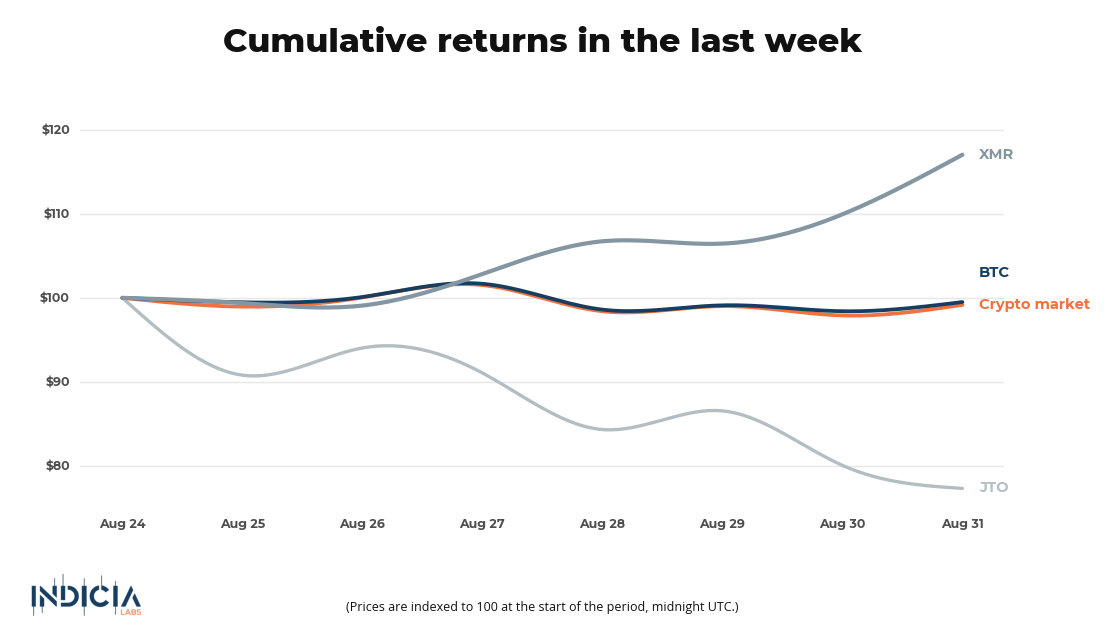
The broader crypto market declined 0.8% over the past seven days, with Bitcoin (BTC) slipping 0.5% as macro uncertainty weighed on risk appetite. Monero (XMR) was the standout performer, gaining 17.0%, possibly reflecting renewed interest in privacy-focused assets. Jito (JTO) was the week's worst performer, falling 22.7% amid broad weakness in Solana-ecosystem tokens.
🧐 What is your crypto mood today?

In each Sophia's Thoughts newsletter, we ask about your crypto mood. Your response to this question helps Sophia get a better sense of the pulse of crypto markets. And this ultimately translates into better insights for you when combined with Sophia's AI models. Your data empowers Sophia to provide you with even better intelligence going forward!
📉 The Sell That Shook the Narrative
The backdrop for Bitcoin's price action this week is one of the most disorderly sovereign debt environments in a generation. As CoinTelegraph reported, Japan's 10-year government bond yield surged to 3% for the first time since 1996, while its 30-year yield touched a record 4.18%. In the United States, the 10-year Treasury yield reached 4.78% and the 30-year climbed to 5.269%, six basis points short of its highest level since January 2007. Robin Brooks, senior fellow at the Brookings Institution, captured the severity of Japan's position: "For the past two years, Japan has been in a 'Liz Truss' bond market crisis," a reference to the 2022 UK gilt market collapse triggered by unfunded tax cuts, "whereby its currency falls even as government bond yields go ever higher. We've never had a major G10 sovereign experience something like this and it's deeply destabilizing."
The U.S. Treasury's response has been to at least double the size of its debt buyback transactions to USD 4 billion from September, a move intended to stabilize the long end of the yield curve. Markets appear unconvinced. As The Kobeissi Letter noted on X, "The bond market appears to be completely ignoring the US Treasury." Treasury Secretary Scott Bessent, in a candid interview with CNBC, offered little reassurance, stating simply: "I haven't bought anything yet."
Meanwhile, Federal Reserve Chair Kevin Warsh signaled at the Jackson Hole symposium that the path to easing remains uncertain. According to CoinTelegraph's weekly Bitcoin overview, Warsh stated that "while this summer's PCE and CPI readings," two closely watched inflation measures, "were better than expected, they do not tell me that underlying trends have meaningfully improved," adding that forward guidance had "overstayed its welcome." CME Group's FedWatch Tool now places the probability of a September rate hike at 60%, up from 41.4% the prior week, a shift that complicates the near-term outlook for risk assets.
🪙 Bitcoin as Macro Hedge: Thesis or Reality?
Against this backdrop, Bitcoin's price behavior has drawn attention from some of the most closely watched macro voices in global finance. Rather than selling off sharply alongside equities, it has held a relatively tight range near USD 78,000, a pattern that several analysts have characterized as more consistent with gold than with traditional risk assets. Ray Dalio, in a post on LinkedIn cited by CoinTelegraph, articulated the thesis directly: "As general advice, I suggest diversifying well in asset classes and countries that have strong income statements and balance sheets... underweighting debt assets like bonds, and overweighting gold and a bit of Bitcoin."
The institutional accumulation occurring at current prices adds weight to that reading. Strive Asset Management purchased 1,800 Bitcoin for approximately USD 143 million between August 24 and August 28, at an average price of USD 79,431 per coin, bringing its total holdings to 23,156 BTC and making it the fifth-largest publicly traded corporate Bitcoin holder. Separately, Strategy resumed Bitcoin purchases after a summer of selling, acquiring 4,603 BTC for USD 369.7 million at USD 80,318 per coin, a repurchase price that sits 29% above the approximately USD 62,250 average at which the firm sold 6,948 BTC between May and August.
The distinction that matters here is between accumulation as speculation and accumulation as structural portfolio positioning. Institutional buyers entering at these prices, above prior exit levels, are building exposure to an asset they appear to view as a macro instrument rather than a directional trade. Whether that view is durable, or a function of the current bond crisis that may fade as the yield environment normalizes, remains the central unresolved question for the asset class.
📉 Technical Resistance and the Road Ahead
Bitcoin's price structure tells a more cautious story than the macro thesis alone might suggest. Rekt Capital, a trader and analyst widely followed for technical work, noted to followers on X that "Bitcoin is still hovering beneath the Macro Downtrending resistance, having upside wicked briefly beyond it. Still the pivotal resistance and by staying below it, Bitcoin continues its series of Macro Lower Highs." Bitcoin's 50-week exponential moving average (EMA), a trend-smoothing indicator that tracks average price over roughly a year of weekly closes, sits at USD 77,269 and is serving as near-term support. Rekt Capital also flagged deterioration in the Relative Strength Index (RSI, a momentum indicator that measures the speed and size of recent price moves), warning that "if the Daily RSI continues to make Lower Highs, that'll contribute to mounting weakness here."
Labor market data adds another layer of uncertainty. August nonfarm payrolls are expected to show only 50,000 jobs added, and the Bureau of Labor Statistics revised away 79,000 jobs for the 12 months through March, what The Kobeissi Letter described as "the 4th consecutive annual downward adjustment, matching the streak that ended in 2010 after the 2008 Financial Crisis." Glassnode, in research published last week, noted that "every overhead structure we track now sits between $81K and $86K; that band is where the recovery's demand meets its test."
If labor data disappoints and the Fed proceeds with a September hike, Bitcoin may face a repricing of risk sentiment even as its macro hedge characteristics argue for resilience, two forces that could partially offset one another. The base case, for now, is that Bitcoin holds support near its 50-week EMA while the USD 81,000 to USD 86,000 band defines the ceiling of the current recovery. Whether it can break that range decisively may depend less on crypto-native catalysts and more on whether bond markets stabilize enough for institutional risk appetite to return in force.
Indicia Labs does not provide investment, tax, or legal advice. You are solely responsible for determining the suitability of any investment, investment strategy, or related transaction based on your personal investment objectives, financial circumstances, and risk tolerance. Indicia Labs may offer educational information about digital assets, which may include blog posts, articles, third-party content, news feeds, tutorials, and videos. This information does not constitute any form of advice, and you should not rely on it as such. Indicia Labs does not recommend buying, earning, selling, or holding any digital asset and will not be responsible for any decisions you make based on the provided information. Any content provided by Indicia Labs may contain errors, inaccuracies, or outdated information and should not be relied upon for making any investment decisions and Indicia Labs and its affiliates hold no responsibility for the accuracy of the provided information or content.
As with any asset, the value of digital assets can fluctuate, and there is a significant risk of losing money when buying, selling, holding, or investing in digital assets. Consult your financial advisor, legal or tax professional regarding your specific situation and financial condition, and carefully consider whether trading or holding digital assets is suitable for you.
Indicia Labs is not registered with the U.S. Securities and Exchange Commission and does not offer securities services in the United States or to U.S. persons. You acknowledge that digital assets are not subject to protections or insurance provided by the Federal Deposit Insurance Corporation or the Securities Investor Protection Corporation.