Sophia’s Thoughts On Stablecoin Market Divergence

The stablecoin market is dividing along functional lines, and the split is not a coincidence. Where USDT and USDC settle tells a more precise story about the shape of the crypto economy than price charts alone.
These are Sophia's Thoughts:
Dune Analytics data published by CoinTelegraph show USDT settled approximately USD 95 billion in commerce payments during H1 2026 versus USD 14 billion for USDC, while USDC on Base alone processed roughly USD 2.6 trillion in transfer volume in June, confirming a structural split by use case rather than market share alone.
The divergence reflects two distinct economic realities: USDT's grip on emerging-market payments and remittances, where Tron wallets hold 93% of supply outside exchanges, contrasts with USDC's dominance in the high-frequency, protocol-driven on-chain activity that defines modern DeFi.
As regulators tighten frameworks and institutional capital deepens its presence, which stablecoin an asset settles into increasingly determines liquidity access, counterparty risk, and yield opportunity, making the USDT-USDC divide a question of financial infrastructure, not just branding.
🚀 Last week’s market performance
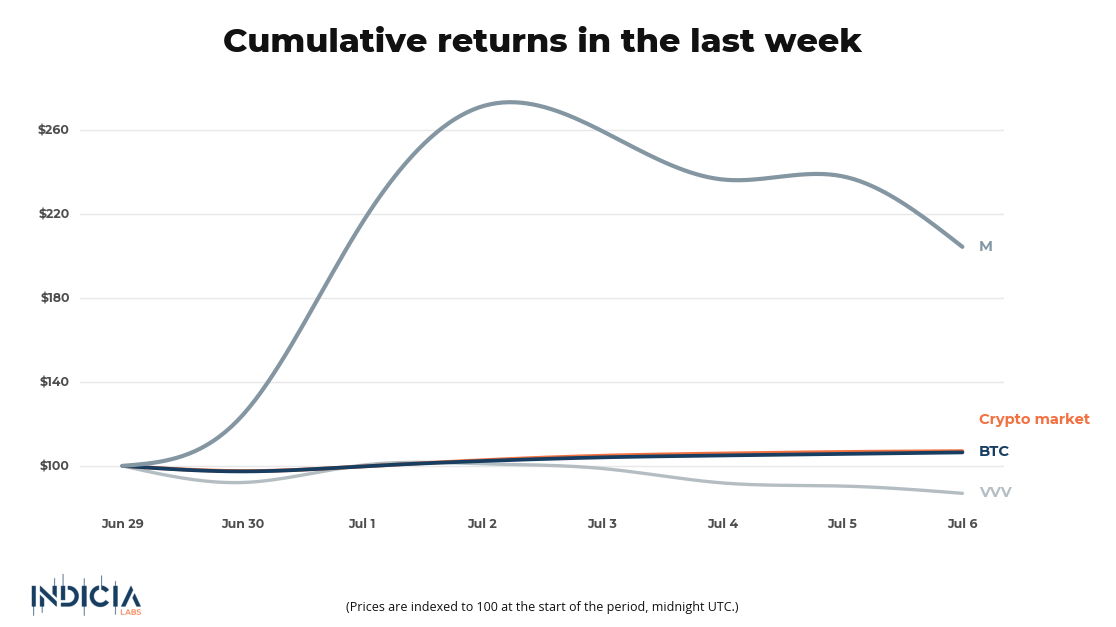
The broader crypto market gained 7.0% over the past week, with Bitcoin (BTC) rising 6.4% as sentiment shifted toward risk-on. M (M) was the week's standout performer, surging 104.3% amid a sharp increase in speculative appetite across smaller-cap tokens. VVV (VVV) was the worst performer, declining 13.1% as momentum faded following an earlier run-up.
🧐 What is your crypto mood today?

In each Sophia's Thoughts newsletter, we ask about your crypto mood. Your response to this question helps Sophia get a better sense of the pulse of crypto markets. And this ultimately translates into better insights for you when combined with Sophia's AI models. Your data empowers Sophia to provide you with even better intelligence going forward!
💵 The Stablecoin Fault Line
For years, analysts grouped stablecoins into a single category, but data from Dune Analytics published by CoinTelegraph on July 7 confirms what on-chain flows have been signaling: USDT and USDC now serve different economies. During H1 2026, USDT settled approximately USD 95 billion in identified commerce payments, compared with USD 14 billion for USDC. In business-to-business volumes specifically, USDT commanded roughly 92% of the USD 48 billion total. It is worth flagging that the "identified commerce payments" figure reflects Dune's classification methodology, which categories transactions by on-chain signals rather than direct merchant reporting, so the figures capture patterns rather than exhaustive economic totals.
The mechanism behind USDT's dominance in payments is structural rather than accidental. On Tron, USDT's largest network, approximately 93% of the token's supply sits in ordinary wallets rather than on exchanges, a distribution profile consistent with real-economy usage, savings behavior, and cross-border settlement in markets where dollar access is constrained. Think of USDT as the remittance and savings instrument: tokens held in personal wallets, used to move value across borders or preserve purchasing power, not to trade. That is the profile of a currency in active circulation.
USDC's story is told in different terms. USDC on Base processed roughly USD 2.6 trillion in transfer volume in June 2026, the highest of any token-chain pair, while USDC on Ethereum handled another USD 1.6 trillion. Those figures represent protocol activity: DeFi settlement and high-frequency on-chain transactions where USDC moves automatically between smart contracts, sometimes recycled through the same protocols multiple times within a single day. Think of USDC as the DeFi trading engine. The same stablecoin ticker conceals two fundamentally separate financial functions, and that distinction matters for anyone assessing liquidity or counterparty risk, meaning the risk that the other party in a transaction fails to deliver.
🌍 Tether Extends Its Reach
While the data maps USDT's existing dominance, Tether is actively reinforcing it at the infrastructure level. The company announced a USD 20 million strategic investment in Mercado Bitcoin, a Brazilian exchange founded in 2013 that serves 4.5 million users and has issued more than R$2 billion in tokenized assets. Relative to Tether's scale, USD 20 million is a targeted allocation rather than a transformational commitment, but its direction is meaningful: it connects USDT to a regulated distribution network in one of Latin America's largest financial markets. Paolo Ardoino, Tether's CEO, framed the rationale plainly: "Tether's mission is to build open, accessible, and efficient financial infrastructure for the world. Mercado Bitcoin has built exactly that, a regulated, full-stack on-chain financial platform serving millions of users across one of the world's most dynamic financial markets."
At the same time, Tether faces a different kind of pressure in Europe. Former Tether CIO Richard Heathcote is seeking to sell part of his 1.26% stake in the company, according to a Bloomberg report, while USDT has been delisted by a growing number of Markets in Crypto-Assets (MiCA)-authorized platforms after Tether opted not to seek compliance with the EU framework. With a circulating supply of roughly USD 184 billion and approximately 59% of the stablecoin market, Tether is expanding in markets where regulatory frameworks are permissive while ceding ground where they are not. The asymmetry is deliberate, and it carries long-term consequences for how broadly USDT can function as a settlement layer.
🏛️ Institutions Redraw the Map
The stablecoin divergence is unfolding against a backdrop of accelerating institutional engagement with digital asset infrastructure. Vanguard, which manages approximately USD 12.5 trillion in global assets, posted a job listing for a Head of Digital Assets on July 7, 2026, tasking the role with leading strategy on tokenization, stablecoins, blockchain infrastructure, and client-facing digital asset products. The firm's direction has shifted materially: as recently as August 2024, its CEO stated it would not launch crypto ETFs. Nate Geraci, an ETF analyst, noted the shift with characteristic brevity on X: "Life moves pretty fast."
The tokenized real-world asset market has grown to USD 33.5 billion, including USD 14.9 billion in tokenized US Treasury products, according to RWA.xyz data. MiCA-compliant euro stablecoins have more than doubled in combined market cap over the past year, rising 128% to USD 673.9 million, though that figure represents just 0.22% of the dollar stablecoin market, underscoring how thoroughly dollar-pegged tokens continue to dominate the on-chain financial system. Meanwhile, EDX Markets, a US-focused institutional crypto exchange, raised USD 76 million in a Series C round led by Japan's SBI Holdings, with proceeds earmarked for expanded clearing, settlement, and international growth, the kind of infrastructure investment that determines which stablecoins become the default settlement layer for institutional flows.
The question now is whether regulatory fragmentation accelerates the bifurcation or creates a third lane. If MiCA pushes euro-denominated stablecoins into meaningful scale, and if US legislation crystallizes compliance standards for USDC, the current two-track system could become a multi-track one, with settlement choice becoming a jurisdiction and counterparty decision as much as a liquidity one. For assets settling on Ethereum, where USDC already processes USD 1.6 trillion in monthly transfer volume, sustained institutional demand behind compliant dollar stablecoins may prove more durable than headline market share figures currently suggest, though that outcome depends on regulatory clarity materializing and institutional adoption continuing at its present pace rather than stalling.
Indicia Labs does not provide investment, tax, or legal advice. You are solely responsible for determining the suitability of any investment, investment strategy, or related transaction based on your personal investment objectives, financial circumstances, and risk tolerance. Indicia Labs may offer educational information about digital assets, which may include blog posts, articles, third-party content, news feeds, tutorials, and videos. This information does not constitute any form of advice, and you should not rely on it as such. Indicia Labs does not recommend buying, earning, selling, or holding any digital asset and will not be responsible for any decisions you make based on the provided information. Any content provided by Indicia Labs may contain errors, inaccuracies, or outdated information and should not be relied upon for making any investment decisions and Indicia Labs and its affiliates hold no responsibility for the accuracy of the provided information or content.
As with any asset, the value of digital assets can fluctuate, and there is a significant risk of losing money when buying, selling, holding, or investing in digital assets. Consult your financial advisor, legal or tax professional regarding your specific situation and financial condition, and carefully consider whether trading or holding digital assets is suitable for you.
Indicia Labs is not registered with the U.S. Securities and Exchange Commission and does not offer securities services in the United States or to U.S. persons. You acknowledge that digital assets are not subject to protections or insurance provided by the Federal Deposit Insurance Corporation or the Securities Investor Protection Corporation.