Sophia’s Thoughts on When USDT Becomes a Sanctions Problem
Stablecoins are being used to move sanctioned oil money, evade financial controls, and obscure the identities of state-linked actors. Whether enforcement will intensify further is less the question than how far up the crypto stack it may eventually reach.
These are Sophia's Thoughts:
The U.S. Department of Justice is seeking forfeiture of more than USD 61 million in USDT allegedly tied to black-market Iranian oil sales, with Chinese intermediaries using Tron-based wallet addresses and Binance accounts to move what prosecutors describe as more than USD 1.5 billion in sanctioned proceeds.
These enforcement actions arrive as the Clarity Act faces a troubled Senate vote, revealing that regulatory scrutiny of crypto rails is accelerating on the law enforcement track even as the legislative track stalls.
The compliance implications for USDT, the exchanges that carry it, and the investors who hold it are real and growing, regardless of how stablecoin legislation ultimately resolves.
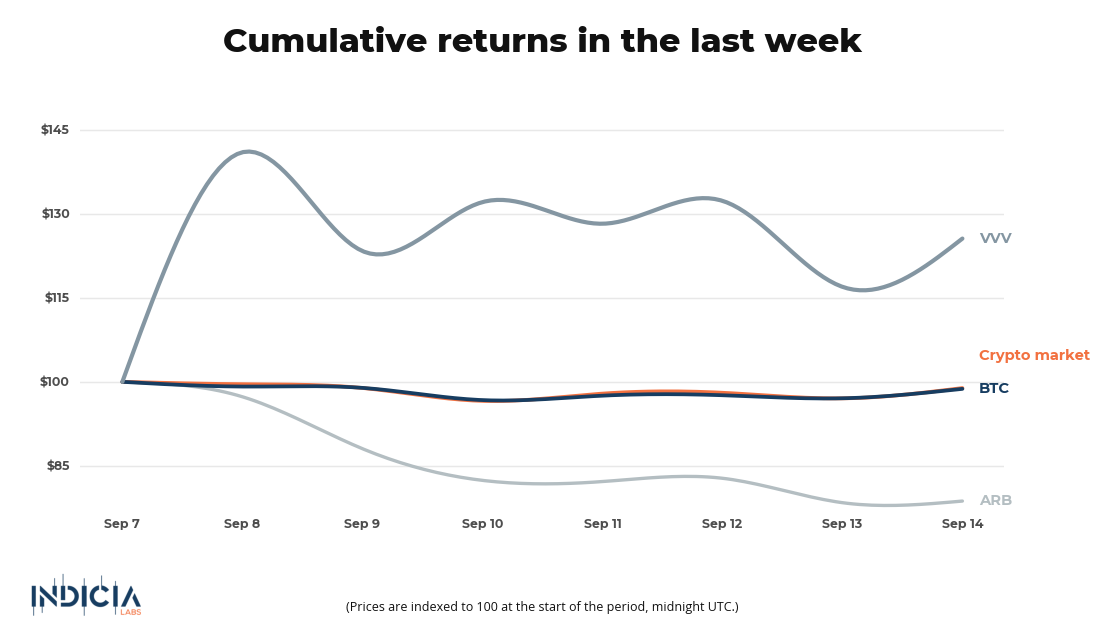
🚀 Last week’s market performance

In each Sophia's Thoughts newsletter, we ask about your crypto mood. Your response to this question helps Sophia get a better sense of the pulse of crypto markets. And this ultimately translates into better insights for you when combined with Sophia's AI models. Your data empowers Sophia to provide you with even better intelligence going forward!
⚖️ The Sanctions Fault Line
The U.S. Department of Justice filed a civil forfeiture complaint this week targeting approximately USD 61 million in USDT allegedly connected to black-market Iranian crude oil sales. Civil forfeiture is a legal process through which the government seizes assets alleged to be proceeds of crime, without necessarily charging individuals. According to prosecutors, Chinese companies Blessed Trust and Hexa Whale, both incorporated in Hong Kong, used Binance accounts and Tron-based USDT addresses - Tron being a public blockchain network commonly used for stablecoin transfers - to convert sanctioned oil payments into cryptocurrency on behalf of Iran's government and the Islamic Revolutionary Guard Corps. Deputy U.S. Attorney Sean S. Buckley stated that "the Government of Iran used a network of cryptocurrency actors in China and elsewhere to launder more than $1.5 billion in illicit oil money intended to benefit the Iranian military and the terror-designated IRGC."
The mechanics matter. Blessed Trust allegedly presented itself as a wealth management or crypto custody business while routing sanctioned oil proceeds through what prosecutors describe as a layered network of wallets, exchanges, and money-transfer businesses. Tether cooperated, freezing approximately USD 61.19 million across ten Tron addresses in 2025. Binance stated that it "did not permit transactions with sanctioned individuals and would continue cooperating with law enforcement," and noted that the case "was not filed against the exchange and did not allege wrongdoing by Binance."
The enforcement action is not an isolated case. As Cointelegraph reported, USDT was also central to a failed USD 230 million Venezuelan crude oil deal in late 2023, in which Venezuela's state oil company PDVSA demanded partial payments in USDT as a workaround to U.S. financial sanctions, with Poland's state energy group Orlen recovering only approximately USD 29 million in oil value from the advance before the arrangement collapsed. These cases, taken together, establish a pattern that prosecutors and regulators are unlikely to treat as coincidence, though both involve state actors and large-scale sanctions violations rather than typical commercial stablecoin activity.
🏛️ Legislation Stalls, Enforcement Does Not
While enforcement agencies have moved with visible urgency, the legislative track has moved in the opposite direction. Senate Republicans released a revised Clarity Act, describing it as their "last, best and final offer*" ahead of a cloture vote - a procedural threshold requiring 60 senators to agree to end debate and advance a bill - that was scheduled for Tuesday. Senator Cynthia Lummis warned that "*a no vote on Tuesday means opposing real ethics reforms on politicians' personal investments, handing American leadership in digital assets to our foreign competitors, and leaving Americans with zero protections in the digital asset markets."
Democratic opposition proved durable. Senator Mark Warner described the revised ethics provision as not "near enough," while Senator Ruben Gallego said the latest offer left "much to be desired." Senator Raphael Warnock argued that "Democrats should not advance legislation that fails to address opportunities for corruption that are occurring 'in real time.'" The odds of the Clarity Act becoming law fell to 16% on Polymarket - a prediction market where probabilities reflect crowd-sourced expectations, not guaranteed outcomes - having briefly spiked to 35%.
Separately, eight banking trade groups including the American Bankers Association and Bank Policy Institute wrote to Senate leaders arguing that the bill's current language contains loopholes allowing interest-like payments on stablecoin balances. Their letter stated plainly that "a circuit breaker" - a provision designed to halt stablecoin redemptions under stress conditions - "that activates only after substantial deposit flight has already occurred is not a safeguard at all." The legislative paralysis means enforcement actions, not statutes, are currently defining the compliance boundary for stablecoins, though whether selective prosecution of bad actors clarifies that boundary for good-faith market participants, or simply creates uncertainty, remains an open question.
🔍 The Compliance Repricing
The dual enforcement pressure on USDT carries downstream implications for the broader stablecoin ecosystem. More than USD 300 billion in stablecoins are now in circulation, with the U.S. dollar accounting for 98% of that value, and Tether's USDT alongside Circle's USDC holding nearly USD 150 billion in Treasury bills at the end of 2025. Carolyn Wilkins, a member of the Bank of England's Financial Policy Committee, described the dollar's position in stablecoins as carrying a "considerable first-mover advantage." At the same time, sustained enforcement exposure could complicate that advantage if institutions begin hedging into alternatives with cleaner compliance records, a shift that remains speculative but is increasingly discussed among legal and compliance professionals.
Meanwhile, a separate enforcement action this week charged two Robinhood engineers with commodities fraud for allegedly using confidential listing information to trade perpetual futures - derivative contracts with no expiry date that allow traders to speculate on an asset's price - on Hyperliquid. U.S. Attorney Jamie McDonald stated that "Today's charges make clear that corporate insiders cannot evade the securities and commodities laws by trading based on misappropriated information in derivatives like perpetual futures, tokenized securities, or other similar financial instruments." The charge signals that prosecutors are actively expanding the legal perimeter around crypto market activity, not contracting it.
The WTO has noted that stablecoins account for only 3% of total international payments, with Juan Marchetti, Director of the Trade in Services and Investment Division, observing that "the constraint is not technology. It is actually regulation and the lack of development of regulatory frameworks." If enforcement actions continue to outpace regulatory frameworks, the practical effect may be a narrowing of which stablecoins and which exchanges retain the institutional trust needed to operate at scale. That outcome, should it materialise, would represent an editorial assessment rather than a directional investment signal; what metrics to watch - including issuer reserve transparency, exchange freeze-cooperation records, and on-chain transaction velocity - may matter more to market participants than any single legislative vote.
Indicia Labs does not provide investment, tax, or legal advice. You are solely responsible for determining the suitability of any investment, investment strategy, or related transaction based on your personal investment objectives, financial circumstances, and risk tolerance. Indicia Labs may offer educational information about digital assets, which may include blog posts, articles, third-party content, news feeds, tutorials, and videos. This information does not constitute any form of advice, and you should not rely on it as such. Indicia Labs does not recommend buying, earning, selling, or holding any digital asset and will not be responsible for any decisions you make based on the provided information. Any content provided by Indicia Labs may contain errors, inaccuracies, or outdated information and should not be relied upon for making any investment decisions and Indicia Labs and its affiliates hold no responsibility for the accuracy of the provided information or content.
As with any asset, the value of digital assets can fluctuate, and there is a significant risk of losing money when buying, selling, holding, or investing in digital assets. Consult your financial advisor, legal or tax professional regarding your specific situation and financial condition, and carefully consider whether trading or holding digital assets is suitable for you.
Indicia Labs is not registered with the U.S. Securities and Exchange Commission and does not offer securities services in the United States or to U.S. persons. You acknowledge that digital assets are not subject to protections or insurance provided by the Federal Deposit Insurance Corporation or the Securities Investor Protection Corporation.