Sophia’s Thoughts on Why Bitcoin Corporate Holders Are Quietly Exiting

Corporate Bitcoin's most prominent advocate is openly disclosing a shift. Does the "hodl forever" playbook still hold when the balance sheet demands otherwise?
These are Sophia's Thoughts:
Strategy has sold approximately 6,948 BTC since May, executing recent trades below its cost basis while simultaneously selling more than USD 650 million in MSTR common stock since July 1, marking a meaningful departure from its established accumulation-only posture.
The mechanics behind the selling reveal a shift in priorities: Bitcoin is now being monetized to fund preferred stock buybacks, suggesting the treasury thesis becomes subordinate to capital structure management when financing conditions tighten.
The broader question is whether Strategy's pivot signals an isolated pressure point or an early indicator of the concentration risk embedded across corporate Bitcoin treasury models more broadly.
🚀 Last week’s market performance
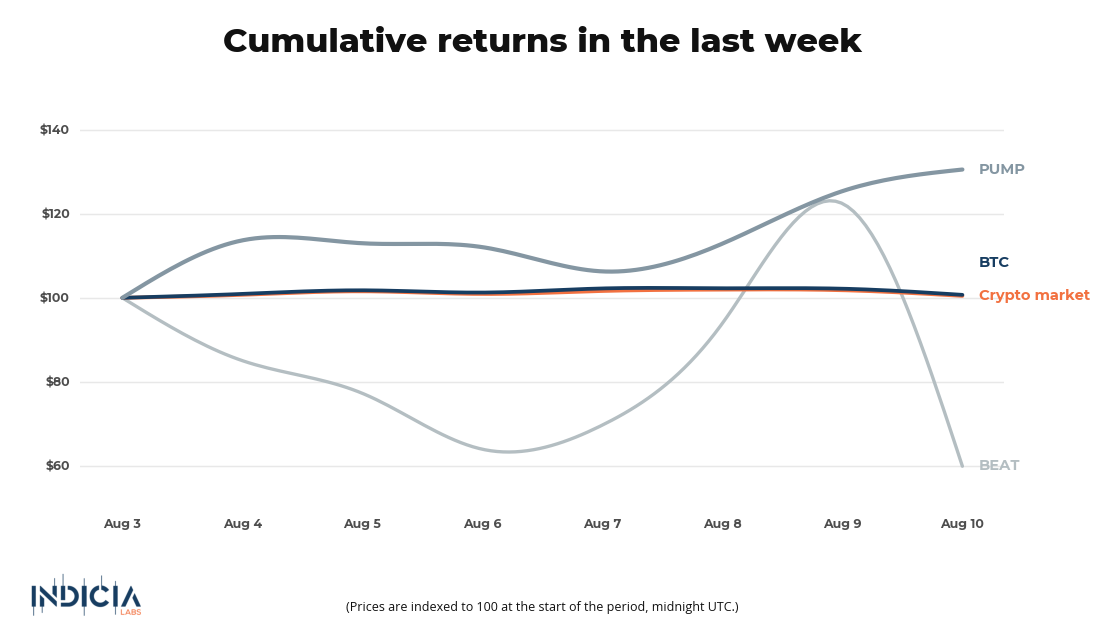
The broader crypto market edged up 0.5% last week, with Bitcoin (BTC) gaining 0.7% as markets traded in a narrow range. PUMP (PUMP) was the standout performer, rising 30.5%, though the reasons behind the move could not be independently verified at time of publication. BEAT (BEAT) was the week's worst performer, declining 40.1%, with no independently verified causal explanation available at time of publication.
🧐 What is your crypto mood today?

In each Sophia's Thoughts newsletter, we ask about your crypto mood. Your response to this question helps Sophia get a better sense of the pulse of crypto markets. And this ultimately translates into better insights for you when combined with Sophia's AI models. Your data empowers Sophia to provide you with even better intelligence going forward!
📉 The Sell That Shook the Narrative
Strategy's identity rested on a single, unambiguous proposition: accumulate Bitcoin and never sell. That proposition is now being publicly revised. As Decrypt reported, the company sold 1,690 BTC for USD 108.6 million last week, executing the trade at an average price of USD 64,262, roughly USD 11,100 below its reported cost basis of USD 75,385 per coin. The sale, disclosed in an 8-K filing (a material event disclosure required by the US Securities and Exchange Commission), marked the third consecutive week of Bitcoin disposals and pushed cumulative sales since May to approximately 6,948 BTC for roughly USD 432.5 million, according to Decrypt's analysis.
The framing from leadership has evolved accordingly. Michael Saylor, Executive Chairman of Strategy, addressed the backlash directly in an interview on the David Lin podcast: "I'm very famous for saying 'never sell your Bitcoin.' That's why the internet went crazy when we said we might sell it. But if I was being more precise: never be a net seller of Bitcoin. It just wouldn't have been so viral." The qualification matters. Saylor's original statement carried the weight of an absolute commitment; the amended version introduces a ratio-based threshold that permits tactical sales provided aggregate purchases remain dominant. Strategy CEO Phong Le reinforced that framing in a Monday interview with FOX Business, noting the company has bought approximately 25 times more BTC than it has sold this year and affirming, "We'll get back to buying more Bitcoin throughout the course of the year."
Yet the direction of travel is difficult to ignore. Strategy has not purchased any Bitcoin since June, and holdings now sit 6,916 coins below their June peak. The stated rationale for recent sales is funding preferred stock buybacks, specifically the STRC instrument, which rebounded to USD 95 following the repurchase activity. That dynamic reveals a capital structure under pressure: Bitcoin, once framed by the company as its primary long-duration treasury asset, is now being liquidated to service financial obligations.
💧 When the Treasury Thesis Meets the Balance Sheet
The broader mechanics of Strategy's selling program illuminate a tension that corporate Bitcoin treasury models have long been expected to avoid. In late June, Strategy introduced its Digital Credit Capital Framework, a program authorising the company to sell up to USD 1.25 billion in Bitcoin to fund capital obligations, granting it formal authority to treat Bitcoin holdings as a liquidity source rather than an inviolable reserve. As Phong Le told CNBC, "At the point where selling Bitcoin versus selling equity to pay a dividend is better for our bitcoin-per-share, we will do it." That statement, where "bitcoin-per-share" refers to the amount of Bitcoin attributable to each outstanding share of MSTR stock, reframes Bitcoin as one lever among several in a capital allocation toolkit.
The concern, from an analytical standpoint, is that this logic may be most likely to activate when Bitcoin prices are under pressure. Strategy is currently selling at a loss relative to its cost basis, which means the optimization it describes is being tested against declining asset values and rising pressure from preferred instruments. According to Decrypt, cash reserves have risen to USD 4.65 billion, up from USD 4 billion as of August 2, covering approximately 2.7 years of preferred dividend and debt obligations. That buffer is meaningful, but in a leveraged treasury model, the structural concern is that selling activity may intensify rather than diminish during sustained price weakness.
Meanwhile, the company's ambitions are expanding in a different direction. On August 10, Saylor posted on X: "We intend to make $STRC the iPhone of Digital Assets." The statement points toward a product-driven identity built around the preferred stock instrument, which may indicate that the treasury model is evolving into something more dependent on capital market conditions than its original framing suggested.
🔍 What the Liquidity Signal Says
Strategy's sales do not exist in isolation. Tether's USDT market capitalisation has contracted by USD 4 billion over the past two months, with CryptoQuant analysts noting that "nearly USD 870 million of USDT supply disappeared over the latest 11-day period, showing that the contraction is not merely a legacy effect from earlier redemptions." CryptoQuant explicitly cautions that correlation between USDT flows and Bitcoin price does not establish causality, but the analysts observe that "periods of sustained USDT expansion have generally coincided with stronger Bitcoin price regimes, while prolonged contractions have accompanied weaker demand, deeper corrections, and deteriorating market conditions." Stablecoin supply, in that framing, functions as a directional sentiment gauge rather than a causal driver.
Bitcoin dropped below USD 64,000 during the week, with Cointelegraph markets reporting a 1.5% single-day decline on August 10. Gold reached USD 4,435 per ounce, a nine-week high, as total single-day inflows into the SPDR Gold Shares ETF hit USD 637 million on August 5, with retail-specific inflows at USD 50 million. Ki Young Ju, CEO of CryptoQuant, posted on X that "Bitcoin-gold correlation is back to digital-gold-era levels," a signal that macro risk-off conditions may be driving rotation rather than crypto-specific conviction. Independent analyst William Clemente offered a measured counterpoint, stating he thinks "Bitcoin is 'cheap' although we could have a leg lower at some point throughout the year."
The question now is whether Strategy's selling, however framed as tactical and ratio-bound, functions as a structural signal for the corporate treasury model at scale. What to watch: whether other leveraged corporate Bitcoin holders begin disclosing similar capital structure pressures, whether Strategy's cash reserves stabilize or continue rising as sales proceed, and whether USDT supply begins recovering alongside Bitcoin demand. If corporate treasury selling proves isolated to Strategy's preferred stock complexity, the narrative impact may exceed the market impact; if balance sheet pressures prove more widespread, the concentration risk the company helped create could become a structural headwind for Bitcoin in a sustained bear market.
Indicia Labs does not provide investment, tax, or legal advice. You are solely responsible for determining the suitability of any investment, investment strategy, or related transaction based on your personal investment objectives, financial circumstances, and risk tolerance. Indicia Labs may offer educational information about digital assets, which may include blog posts, articles, third-party content, news feeds, tutorials, and videos. This information does not constitute any form of advice, and you should not rely on it as such. Indicia Labs does not recommend buying, earning, selling, or holding any digital asset and will not be responsible for any decisions you make based on the provided information. Any content provided by Indicia Labs may contain errors, inaccuracies, or outdated information and should not be relied upon for making any investment decisions and Indicia Labs and its affiliates hold no responsibility for the accuracy of the provided information or content.
As with any asset, the value of digital assets can fluctuate, and there is a significant risk of losing money when buying, selling, holding, or investing in digital assets. Consult your financial advisor, legal or tax professional regarding your specific situation and financial condition, and carefully consider whether trading or holding digital assets is suitable for you.
Indicia Labs is not registered with the U.S. Securities and Exchange Commission and does not offer securities services in the United States or to U.S. persons. You acknowledge that digital assets are not subject to protections or insurance provided by the Federal Deposit Insurance Corporation or the Securities Investor Protection Corporation.