
Sophia's Thoughts On XRP's Inflow Surge

XRP's inflow lead over Bitcoin last week has raised a pointed question: whether XRP is emerging as a competing destination for institutional capital alongside Bitcoin, or whether the headline figures obscure a more fragile picture.
These are Sophia's Thoughts:
XRP attracted $119.6M in inflows last week, its largest weekly total since mid-December, even as only 43% of coins are currently in profit, a level last seen in November 2024.
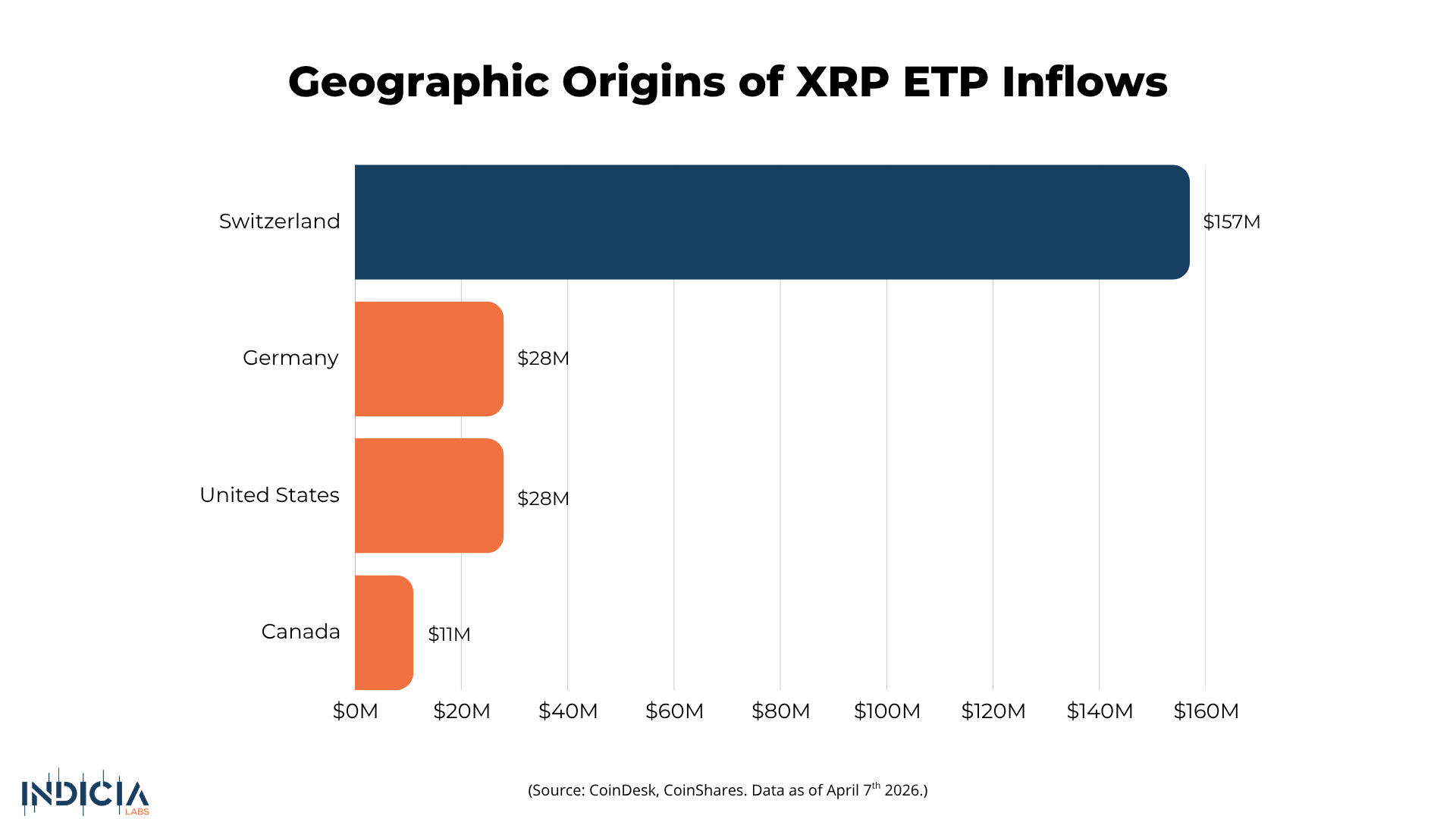
Switzerland alone accounted for ~70% of global crypto ETP demand, pointing to European institutional appetite rather than a broad-based rotation.
With supply in profit at multi-month lows and technicals pointing to a potential test of $1.10, the gap between fund flow momentum and holder stress remains the key tension to watch
🚀 Last week’s market performance
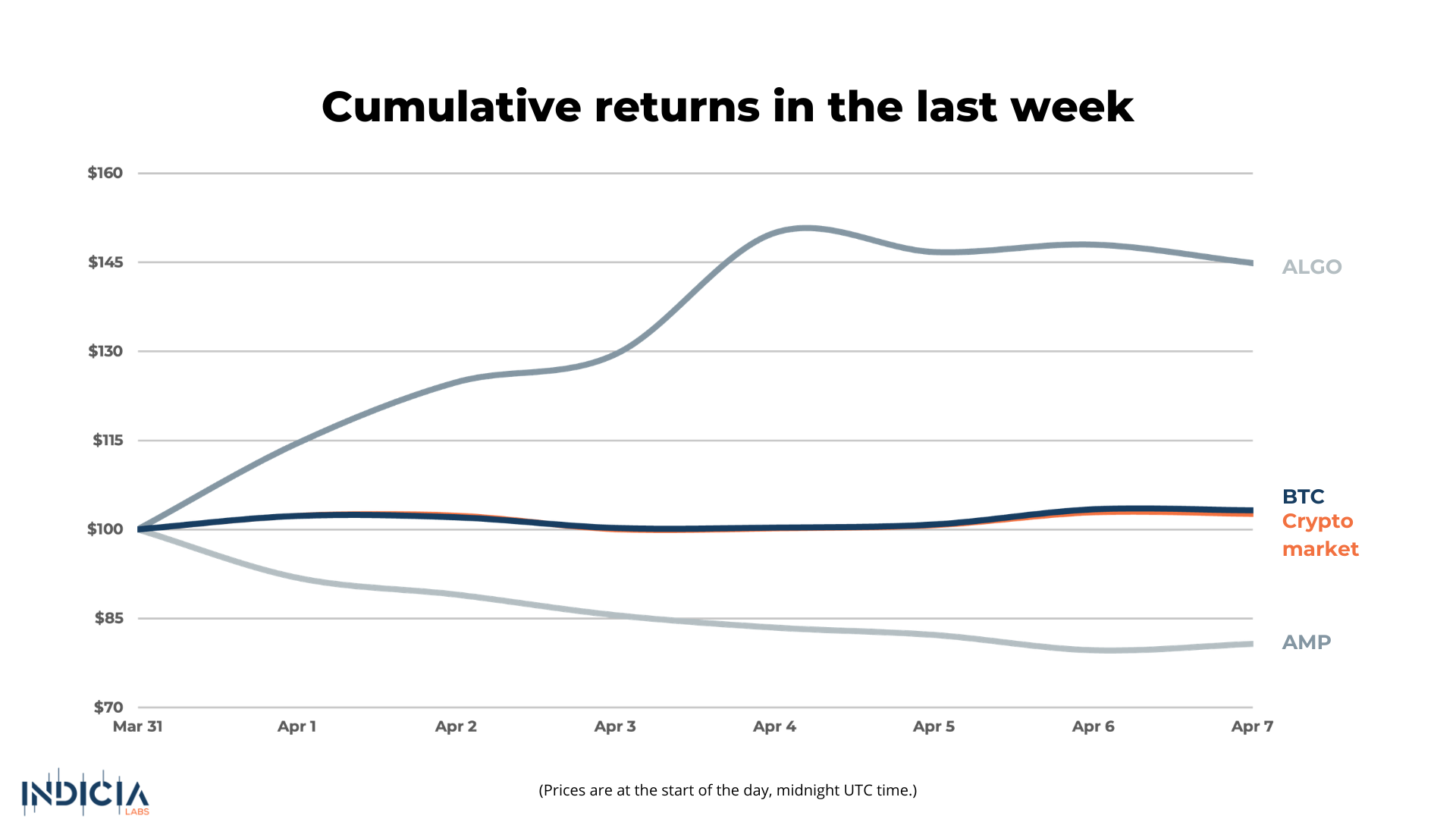

In each Sophia's Thoughts newsletter, we ask about your crypto mood. Your response to this question helps Sophia get a better sense of the pulse of crypto markets. And this ultimately translates into better insights for you when combined with Sophia's AI models. Your data empowers Sophia to provide you with even better intelligence going forward!
💸 XRP's Inflow Lead Deserves Scrutiny
Decrypt reported that global crypto investment products attracted $224 million in inflows last week, reversing a $414 million outflow the prior week, according to a CoinShares report. XRP led all assets with $119.6 million in inflows, representing more than half of the global total and its largest weekly tally since mid-December 2024. Bitcoin attracted $107.3 million in inflows, a partial recovery that nonetheless left it trailing XRP for the week.
The geographic distribution of those inflows complicates any straightforward rotation narrative. As CoinDesk reported, Switzerland alone accounted for approximately $157 million of the $224 million total, representing roughly 70% of global crypto exchange-traded product (ETP) demand. Germany and the United States each contributed approximately $28 million; Canada added $11 million. Virtually none of XRP's inflows originated from U.S. spot XRP ETFs, pointing instead to European and international ETP demand as the primary driver. One plausible explanation is regulatory arbitrage: the European Union's Markets in Crypto-Assets framework has provided clearer digital asset classification rules than the United States has to date, which may give European institutional allocators more latitude to add XRP exposure ahead of their U.S. counterparts.
That distinction matters because a rotation narrative requires broad-based participation across geographies and investor types. What last week's data describes is a concentrated burst of European institutional interest in XRP, not a structural reallocation away from Bitcoin. XRP's year-to-date inflows reached $159 million, equal to 7% of assets under management, a meaningful figure but one that must be read alongside deteriorating on-chain conditions to be properly assessed.
📉 On-Chain Stress Beneath the Surface
The inflow headline contrasts sharply with what on-chain data reveals about XRP holder conditions. According to Glassnode data cited by CoinTelegraph, only 43% of all XRP coins were in profit as of last Tuesday, the lowest level since November 2024. "Supply in profit" refers to the share of coins whose purchase price was below the current market price; a falling reading means a growing proportion of holders are sitting on unrealized losses. Investors who accumulated XRP above $2 over the last 12 months have been realizing losses at a pace of $20 million to $110 million per day since November 2024, and average wallets active on the XRP Ledger over the past year are down 41% on their positions.
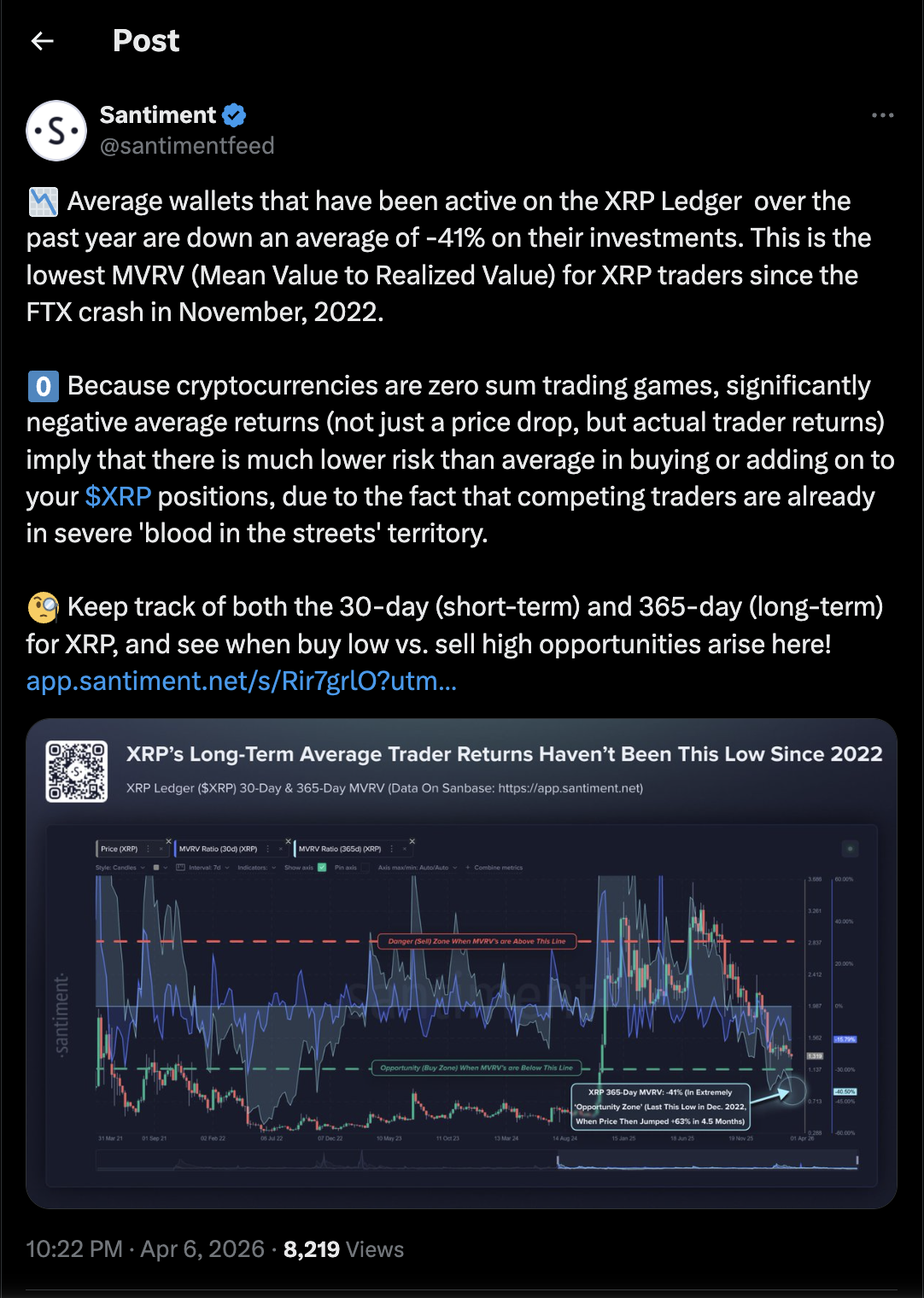
Santiment posted on X that "this is the lowest MVRV (Market Value to Realized Value) for XRP traders since the FTX crash in November, 2022." The MVRV ratio compares XRP's current market price to the average price at which coins last moved on-chain, giving a proxy for aggregate unrealized profit or loss across the holder base. The same post offered a contrarian read, noting that "significantly negative average returns imply that there is much lower risk than average in buying or adding on to your $XRP positions, due to the fact that competing traders are already in severe 'blood in the streets' territory." Crypto Town Hall, an analyst on X, characterized the loss realization as reflecting "widespread holder drawdowns, often seen during late-stage corrections."
Historical precedent offers a cautionary frame. Between January and June 2022, XRP's price fell from above $0.75 to $0.30 as the supply in profit collapsed from just under 50% to as low as 20%. The current reading of 43% sits above those historical troughs, but the direction of travel, combined with a rising wedge breakdown identified by CoinTelegraph (a chart pattern where price breaks below an upward-sloping channel, signaling a potential reversal), points toward a potential test of $1.10 if selling pressure continues. Whether that technical target is reached depends in part on whether exchange inflows from distressed holders accelerate, a signal that on-chain monitors are watching closely.
⚖️ The Regulatory Clarity Variable
One factor that could shift the XRP narrative is the pace of regulatory development in the United States. James Butterfill of CoinShares, as reported by CoinDesk, attributed weakness in Ether products partly to uncertainty around the Digital Asset Market Clarity Act, commonly known as the CLARITY Act, a stablecoin bill closely tied to Ethereum's ecosystem that passed the House in mid-2025 but has stalled in the Senate over disagreements on stablecoin yield provisions. XRP, by contrast, enters this period with its U.S. legal status considerably more settled following its extended litigation with the Securities and Exchange Commission, a prolonged regulatory dispute that constrained institutional access to the asset for several years.
Meanwhile, a separate development last week illustrated how federal jurisdiction questions are being resolved across adjacent markets. A federal appeals court ruled 2-1 on April 6 that New Jersey has no authority to regulate prediction market platform Kalshi under state gambling laws, determining instead that its sports-related markets fall under the jurisdiction of the Commodity Futures Trading Commission (CFTC). Tarek Mansour, Kalshi's co-founder and CEO, stated: "The Third Circuit ruled in Kalshi's favor. People use prediction markets because they're more fair, transparent, and reward being right. Free markets work. We should keep them that way." The dissenting judge, Jane R. Roth, countered that she viewed "Kalshi's actions as a performative sleight meant to obscure the reality that Kalshi's products are sports gambling." The ruling reinforces a broader pattern of federal regulators asserting primacy over digital financial products, a backdrop that has historically benefited assets with clearer regulatory standing.
If U.S. spot XRP ETF inflows remain muted while European demand continues to drive the headline figures, the rotation story will remain structurally incomplete. The base case is that XRP's inflow lead reflects a concentrated, geography-specific bid rather than a durable reallocation of institutional capital. Whether deteriorating on-chain metrics eventually weigh on that European conviction, or whether a broader U.S. institutional entry validates the move, is the question that will define XRP's trajectory through the remainder of the quarter.
Indicia Labs does not provide investment, tax, or legal advice. You are solely responsible for determining the suitability of any investment, investment strategy, or related transaction based on your personal investment objectives, financial circumstances, and risk tolerance. Indicia Labs may offer educational information about digital assets, which may include blog posts, articles, third-party content, news feeds, tutorials, and videos. This information does not constitute any form of advice, and you should not rely on it as such. Indicia Labs does not recommend buying, earning, selling, or holding any digital asset and will not be responsible for any decisions you make based on the provided information. Any content provided by Indicia Labs may contain errors, inaccuracies, or outdated information and should not be relied upon for making any investment decisions and Indicia Labs and its affiliates hold no responsibility for the accuracy of the provided information or content.
As with any asset, the value of digital assets can fluctuate, and there is a significant risk of losing money when buying, selling, holding, or investing in digital assets. Consult your financial advisor, legal or tax professional regarding your specific situation and financial condition, and carefully consider whether trading or holding digital assets is suitable for you.
Indicia Labs is not registered with the U.S. Securities and Exchange Commission and does not offer securities services in the United States or to U.S. persons. You acknowledge that digital assets are not subject to protections or insurance provided by the Federal Deposit Insurance Corporation or the Securities Investor Protection Corporation.