Sophia’s Thoughts On Global Unrest

The U.S.-Iran conflict has moved faster than most geopolitical crises, and Bitcoin has held its ground, though the conditions supporting that resilience remain contested.
These are Sophia's Thoughts:
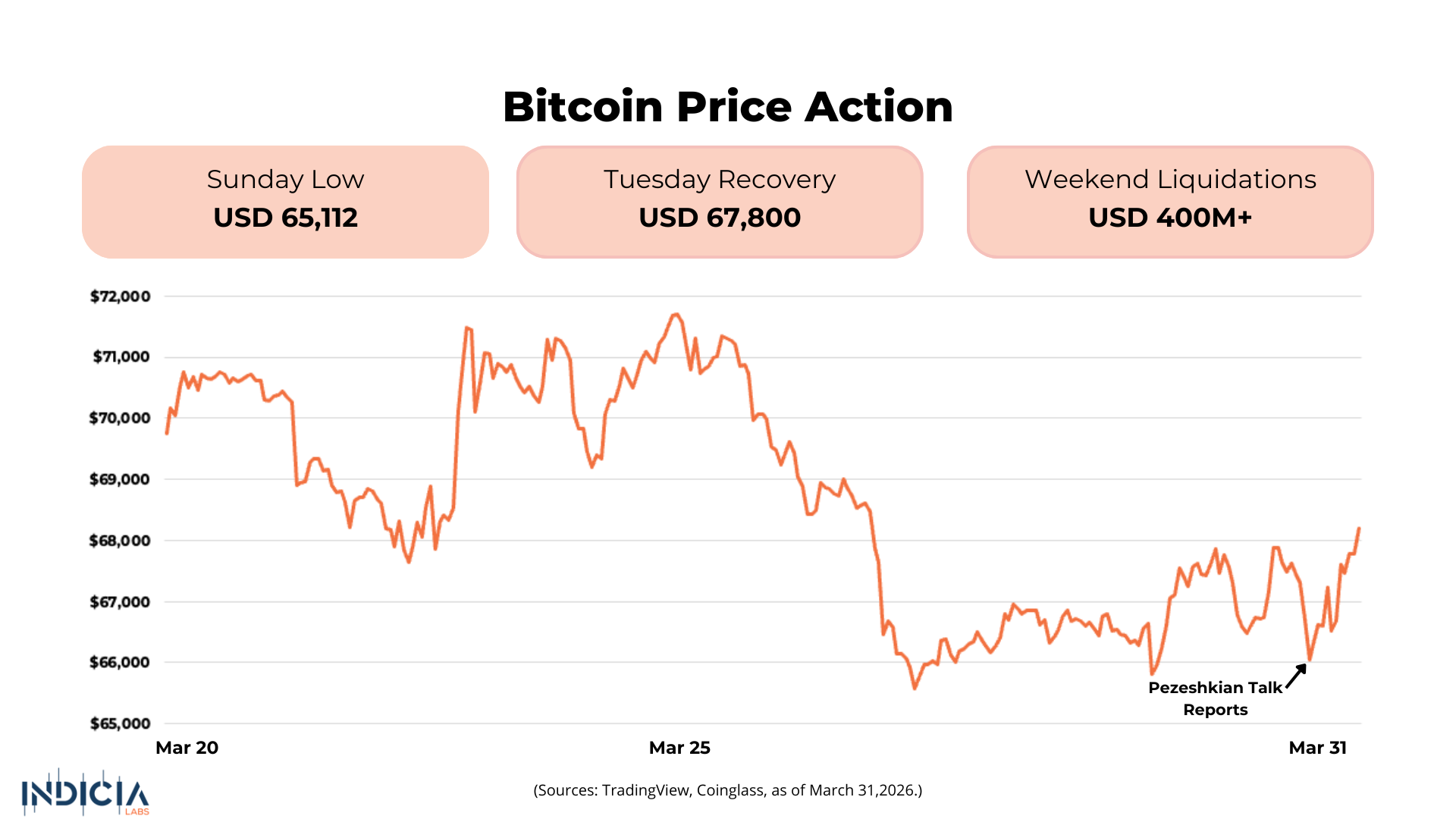
Bitcoin dropped to USD 65,112 over the weekend amid reports of a potential U.S. ground operation in Iran, before recovering toward USD 67,800 on Tuesday following reports that Iranian President Masoud Pezeshkian may be willing to negotiate an end to the conflict.
Oil is up 48% since the war began on February 28, gas prices have risen 35%, and the Federal Reserve is widely expected to hold rates unchanged.
The path forward depends heavily on whether diplomacy materializes and whether institutional flows return, as analysts warn that resolution alone is not sufficient to trigger a sustained Bitcoin rally without regulatory clarity and fresh capital.
🚀 Last week’s market performance
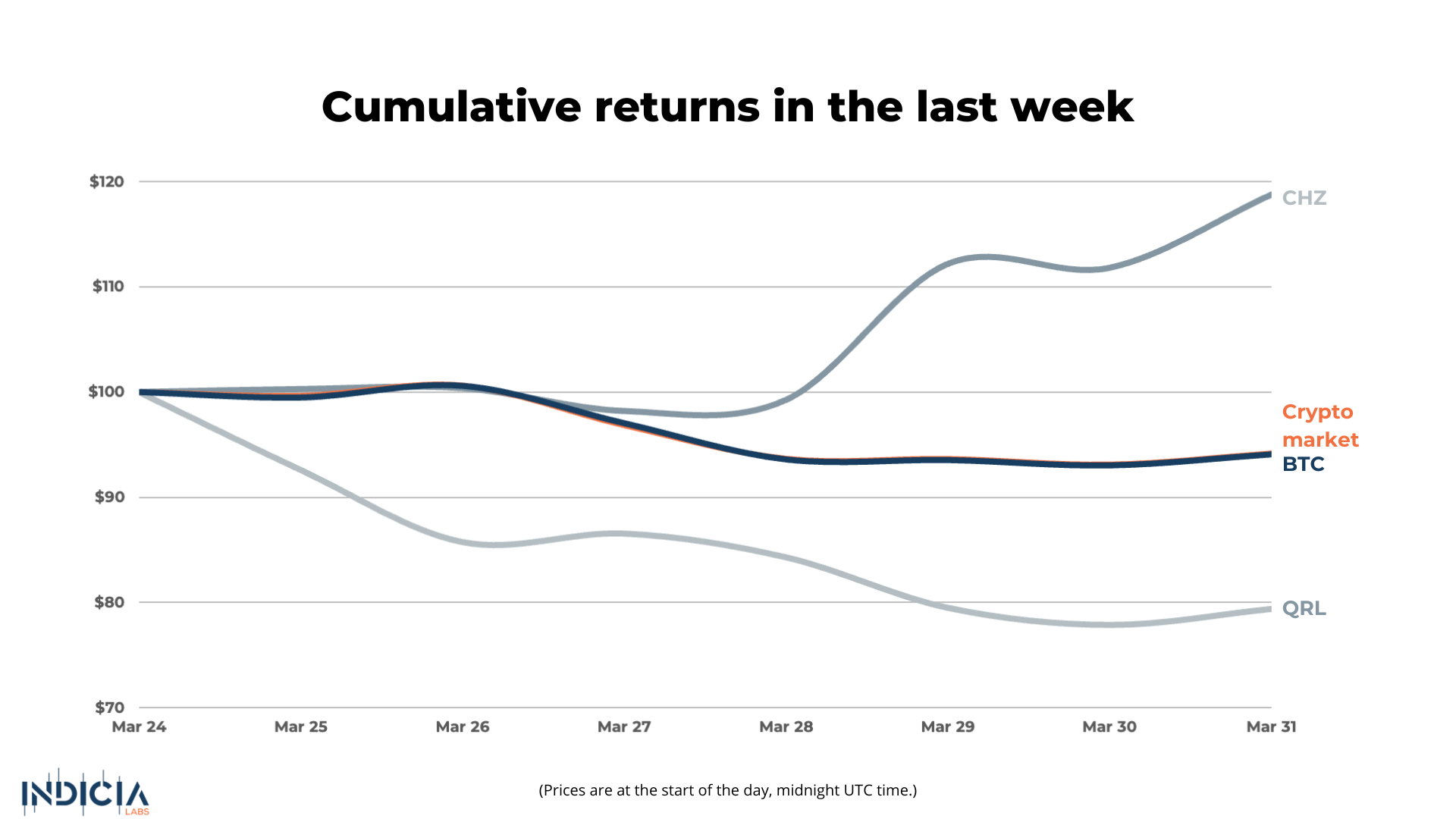
This week, the broader crypto market declined 5.8%, with Bitcoin (BTC) falling 5.9% as tensions in the Middle East persisted and oil prices continued higher. Chiliz (CHZ) was the standout performer, gaining 18.8% ahead of the World Cup, while Quantum Resistant Ledger (QRL) led declines, dropping 20.6%.
🧐 What is your crypto mood today?

In each Sophia's Thoughts newsletter, we ask about your crypto mood. Your response to this question helps Sophia get a better sense of the pulse of crypto markets. And this ultimately translates into better insights for you when combined with Sophia's AI models. Your data empowers Sophia to provide you with even better intelligence going forward!
⚔️ Bitcoin Under Fire
Bitcoin's sharpest move of the week came on Sunday, when the price fell to USD 65,112 following reports that President Trump was considering a ground operation in Iran to extract uranium. Over USD 400 million in positions were liquidated over the weekend, according to CoinGlass data. Willy Woo, an on-chain analyst, noted that "old school on-chain models suggest a Bitcoin bottom between $46k-$54k," suggesting the timeline for a recovery may be extended regardless of how the conflict develops.
By Tuesday, the picture had shifted. Bitcoin rose to USD 67,800 after reports, unconfirmed at time of publication, that Pezeshkian was open to ending hostilities in exchange for security guarantees. The Nasdaq rose approximately 3.1% on the same news, Coinbase shares gained more than 6%, and WTI crude slipped from just shy of USD 105 per barrel to USD 102. The co-movement across risk assets confirmed that this is a macro-driven moment rather than a crypto-specific one.
Bitcoin's relative resilience attracted attention from analysts. Alex Kuptsikevich, chief market analyst at FxPro, observed that"crypto has pulled back, but appears stronger than stocks," noting that the cryptocurrency market is "finding support on dips to the lows seen since early February, demonstrating horizontal stabilization following the slump" (meaning prices have been moving sideways rather than continuing to fall), while equities form a downtrend. Ethereum held at USD 2,062 as of Tuesday morning, providing a secondary signal that the broader market has not entered capitulation.
🛢️ The Hormuz Problem
Even if a ceasefire emerges, one structural risk may persist. White House Press Secretary Karoline Leavitt stated at a Monday briefing that ensuring safe passage for oil tankers through the Strait of Hormuz is not one of the "core objectives" of the campaign. That framing matters because it means elevated oil prices could persist well beyond any diplomatic agreement, keeping inflation high and reducing the likelihood that the Federal Reserve pivots toward rate cuts, which historically support risk assets including Bitcoin.
The CME FedWatch tool currently assigns a 97.4% probability that the Federal Reserve will hold rates unchanged at its April 29 meeting. That near-certainty reflects how constrained monetary policy has become: a commodity-driven inflation surge does not invite rate cuts, but a slowing economy does not invite hikes. When oil prices remain elevated and inflation stays above target, the real return on investment after adjusting for inflation compresses, historically pushing investors toward assets they expect to hold value independently of central bank policy, though whether Bitcoin reliably plays that role during geopolitical shocks remains an open empirical question.
Erik Amirbai Lang, co-founder of N4T, a movement-driven cryptocurrency project, argued that Trump's approach "signaled pressure and deterrence rather than commitment to a prolonged conflict, given his reluctance to accept U.S. casualties and preference for deal-making over military escalation," suggesting the administration may seek an exit before energy markets fully reprice.
For Bitcoin and Ethereum, Lacie Zhang, research analyst at Bitget Wallet, said a ceasefire "could unlock a strong risk-on rally," but cautioned that "Bitcoin is unlikely to embark on a bull run without sustained institutional flows and regulatory clarity." Institutional flows, in this context, refers to large-scale capital allocation from funds, asset managers, and corporate treasuries through instruments such as spot ETFs and futures, the kind of sustained buying that moves price over weeks rather than hours. With Myriad users currently assigning a 61% chance that Bitcoin's next move takes it to USD 55,000 rather than USD 84,000, the market is not yet pricing in a clean resolution.
⚖️ Regulation in the Crossfire
The same conditions making a Bitcoin recovery fragile on the macro side are compounding on the regulatory side. Even if oil prices ease and the Fed finds room to pivot, analysts including Lacie Zhang have been clear that institutional flows won't return in scale without legislative clarity, and that clarity remains elusive.
The Digital Asset Market CLARITY Act is still under negotiation in Congress, and Charles Hoskinson, founder of Cardano, has expressed significant reservations about its prospects. Speaking to CoinDesk, Hoskinson warned the bill could involve "15 years of rulemaking and slow rolling," and added that "if the Democrats win in 2029, there are avenues in the existing text that they can use to weaponize the CLARITY Act." His concern that "rulemaking has no technical people in the room" points to a structural problem that legislative momentum alone is unlikely to resolve.
Hoskinson's critique extends to the bill's treatment of new projects. "I'm not happy with all new projects starting as a security by default," he said, warning that "future projects can't compete" under the current framework. The consequence, if this view holds, is that established assets including Bitcoin and Ethereum may benefit from regulatory entrenchment at the same moment they are being stress-tested by geopolitical and monetary headwinds.
That is the bind markets are currently in. A ceasefire could reopen the window for institutional re-entry. A Fed pivot, however unlikely at 97.4% hold probability, would help further. But if legislation stalls, the structural bid that a sustained recovery requires may not materialize on the timeline markets are pricing. As Hoskinson put it, "if you try to do everything in one piece of legislation, you're going to end up getting kind of a Frankenstein's monster." Resolution of the conflict is a necessary condition for a rally. It is not, on its own, a sufficient one.
Indicia Labs does not provide investment, tax, or legal advice. You are solely responsible for determining the suitability of any investment, investment strategy, or related transaction based on your personal investment objectives, financial circumstances, and risk tolerance. Indicia Labs may offer educational information about digital assets, which may include blog posts, articles, third-party content, news feeds, tutorials, and videos. This information does not constitute any form of advice, and you should not rely on it as such. Indicia Labs does not recommend buying, earning, selling, or holding any digital asset and will not be responsible for any decisions you make based on the provided information. Any content provided by Indicia Labs may contain errors, inaccuracies, or outdated information and should not be relied upon for making any investment decisions and Indicia Labs and its affiliates hold no responsibility for the accuracy of the provided information or content.
As with any asset, the value of digital assets can fluctuate, and there is a significant risk of losing money when buying, selling, holding, or investing in digital assets. Consult your financial advisor, legal or tax professional regarding your specific situation and financial condition, and carefully consider whether trading or holding digital assets is suitable for you.
Indicia Labs is not registered with the U.S. Securities and Exchange Commission and does not offer securities services in the United States or to U.S. persons. You acknowledge that digital assets are not subject to protections or insurance provided by the Federal Deposit Insurance Corporation or the Securities Investor Protection Corporation.