Sophia’s Thoughts On Binance's EU Exit

Regulatory fragmentation has found its most consequential test case yet. If Binance loses its MiCA license bid, European crypto traders may discover what liquidity concentration really costs.
These are Sophia's Thoughts:
Reuters reported that EU regulators are preparing to reject Binance's MiCA licensing application, which would effectively bar the world's largest crypto exchange from operating legally in the European Union from July 1, 2026.
Binance's potential exit is not merely a compliance story; it is a structural liquidity event, one that could widen spreads, reduce market depth, and fragment European trading activity across smaller, less capitalized venues.
The outcome hinges on a final ESMA review of the Greek regulator's approval, leaving European traders in a period of acute uncertainty at a moment when macro conditions are already testing market resilience.
🚀 Last week’s market performance
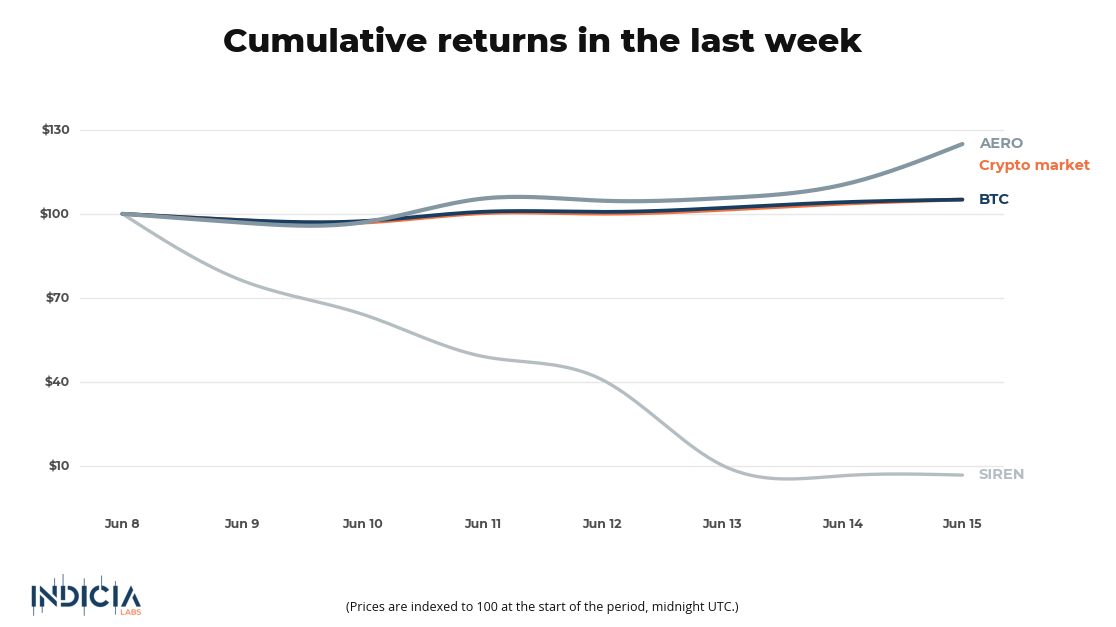
The crypto market gained 5.1% over the past week, with Bitcoin (BTC) also rising 5.1% as risk sentiment improved. Aerodrome Finance (AERO) led all assets with a gain of 24.9%, buoyed by renewed interest in decentralised exchange infrastructure. At the other end, SIREN (SIREN) collapsed 93.3%, recording the week's sharpest decline amid a near-total loss of market confidence in the token.
🧐 What is your crypto mood today?

In each Sophia's Thoughts newsletter, we ask about your crypto mood. Your response to this question helps Sophia get a better sense of the pulse of crypto markets. And this ultimately translates into better insights for you when combined with Sophia's AI models. Your data empowers Sophia to provide you with even better intelligence going forward!
⚖️ The MiCA Deadline Closes In
The Markets in Crypto-Assets regulation brought a framework of legal certainty to crypto in the European Union, but its June 30 compliance deadline now acts as a hard filter on which exchanges survive in the region. As CoinTelegraph reported, Binance applied for its MiCA license in Greece under the Hellenic Capital Market Commission in January 2026. Greece's HCMC completed its review and considered the application compliant with MiCA requirements, subject to final review at the European Securities and Markets Authority. Reuters then reported that EU regulators were nonetheless preparing to reject the bid, creating a direct tension between a national regulator's approval and a supranational body's apparent opposition.
The stakes are unusually high given Binance's scale in the region. In a blog post responding to the Reuters report, Binance stated that it "serves more users in Europe than any other crypto exchange, and any delay or distortion in our MiCA path has consequences beyond Binance." Whether that framing holds up will depend on how quickly compliant alternatives can absorb displaced volume. A July 1 rejection would not simply inconvenience one company; it would abruptly redirect the trading activity of a large base of European crypto traders toward a smaller set of compliant alternatives, with limited time to migrate funds or establish accounts on new platforms.
Binance warned further that a rejection "risks weakening liquidity, reducing competition and user choice, and pushing activity, jobs, investment, and tax revenue outside the EU." Whether ESMA views those consequences as the exchange's problem or Europe's problem is precisely what the coming days will determine. For now, the deadline remains fixed and Binance's EU future unresolved.
💧 Why Liquidity Concentration Is the Real Risk
Most investors think of exchange risk in terms of security or solvency. The subtler and often more consequential risk is liquidity concentration: the degree to which a single venue accounts for a disproportionate share of order book depth (the total volume of buy and sell orders available at various price levels, which determines how easily large trades execute without moving the price). According to its own self-reported figures, Binance serves more users in Europe than any other crypto exchange. A forced exit does not destroy that demand, but it does fragment it across venues that have not yet faced equivalent user load.
Fragmentation raises costs in ways that those costs do not always register immediately. When buy and sell orders split across multiple venues with lower individual depth, bid-ask spreads widen, meaning the gap between the best available buy price and the best available sell price grows, making each trade marginally more expensive. For retail traders, those costs accumulate quietly. For institutions managing positions in size, they represent a material change in execution quality. The exchanges most likely to absorb displaced Binance volume, including Coinbase, Kraken, and a handful of EU-licensed venues, carry broad capability but would be absorbing a significant step-change in user load and trading activity simultaneously.
The more serious risk lies in the transitional period itself. If Binance's application is rejected close to or on the June 30 deadline, users may have limited time to migrate funds, establish accounts on alternative platforms, and adjust their trading infrastructure. Rapid, disorderly user migration tends to suppress activity rather than simply redirect it, creating a short-term liquidity gap that could amplify volatility in European trading hours. Monitoring ESMA's published timeline and beginning account setup on a secondary exchange well ahead of any formal rejection announcement would reduce the execution risk that a compressed transition window creates.
📉 A Macro Backdrop That Does Not Help
The potential Binance exit is arriving at a moment when the broader macro environment is already adding pressure to crypto markets. CoinTelegraph's analysis noted that the Bank of Japan raised its short-term policy rate by 25 basis points to 1.0% on June 16, 2026, marking Japan's highest interest rate level since 1995. Bitcoin averaged a 5.74% decline in the 30 days following each of the last four BoJ rate hikes. André Dragosch, European Head of Research at Bitwise, observed that "BoJ rate-hiking cycles have historically coincided with US recessions, with the COVID shock being the main exception," a pattern that markets are once again being forced to price in.
At the same time, Bitcoin's recovery from its recent dip to USD 60,000 has drawn cautious assessments from analysts. Nick Ruck, Director at LVRG Research, told CoinTelegraph that "momentum remains weak, with declining volume and stagnant on-chain metrics indicating that the recovery lacks conviction and could quickly fade." Separately, Ruck noted that geopolitical catalysts will "continue to dominate crypto price action." Glassnode noted that accumulation trend scores (a metric tracking whether investors are net buyers across wallet size cohorts) turned higher across multiple wallet cohorts, suggesting supply absorption after the move to USD 60,000. JDK Analysis, a closely followed trading account, cautioned separately that "there is still a major pocket of untapped liquidity below that shouldn't be ignored."
If the MiCA ruling goes against Binance, it would land in a macro environment already characterised by thin conviction and elevated sensitivity to structural shocks. A liquidity event of this scale, coinciding with tightening monetary conditions in Japan and a fragile recovery in Bitcoin, could produce outsized effects relative to what any single regulatory decision would normally generate. Whether the transition proves orderly or disruptive remains the structural condition worth watching most closely in the weeks ahead.
Indicia Labs does not provide investment, tax, or legal advice. You are solely responsible for determining the suitability of any investment, investment strategy, or related transaction based on your personal investment objectives, financial circumstances, and risk tolerance. Indicia Labs may offer educational information about digital assets, which may include blog posts, articles, third-party content, news feeds, tutorials, and videos. This information does not constitute any form of advice, and you should not rely on it as such. Indicia Labs does not recommend buying, earning, selling, or holding any digital asset and will not be responsible for any decisions you make based on the provided information. Any content provided by Indicia Labs may contain errors, inaccuracies, or outdated information and should not be relied upon for making any investment decisions and Indicia Labs and its affiliates hold no responsibility for the accuracy of the provided information or content.
As with any asset, the value of digital assets can fluctuate, and there is a significant risk of losing money when buying, selling, holding, or investing in digital assets. Consult your financial advisor, legal or tax professional regarding your specific situation and financial condition, and carefully consider whether trading or holding digital assets is suitable for you.
Indicia Labs is not registered with the U.S. Securities and Exchange Commission and does not offer securities services in the United States or to U.S. persons. You acknowledge that digital assets are not subject to protections or insurance provided by the Federal Deposit Insurance Corporation or the Securities Investor Protection Corporation.