Sophia’s Thoughts On Traditional Finance Quietly Reshaping Crypto

Traditional finance is not waiting for crypto to mature. It is building the rails itself, and the infrastructure being laid this week suggests the convergence is structural, not cyclical.
These are Sophia's Thoughts:
Reuters reported that EU regulators are preparing to reject Binance's MiCA licensing application, which would effectively bar the world's largest crypto exchange from operating legally in the European Union from July 1, 2026.
Binance's potential exit is not merely a compliance story; it is a structural liquidity event, one that could widen spreads, reduce market depth, and fragment European trading activity across smaller, less capitalized venues.
The outcome hinges on a final ESMA review of the Greek regulator's approval, leaving European traders in a period of acute uncertainty at a moment when macro conditions are already testing market resilience.
🚀 Last week’s market performance
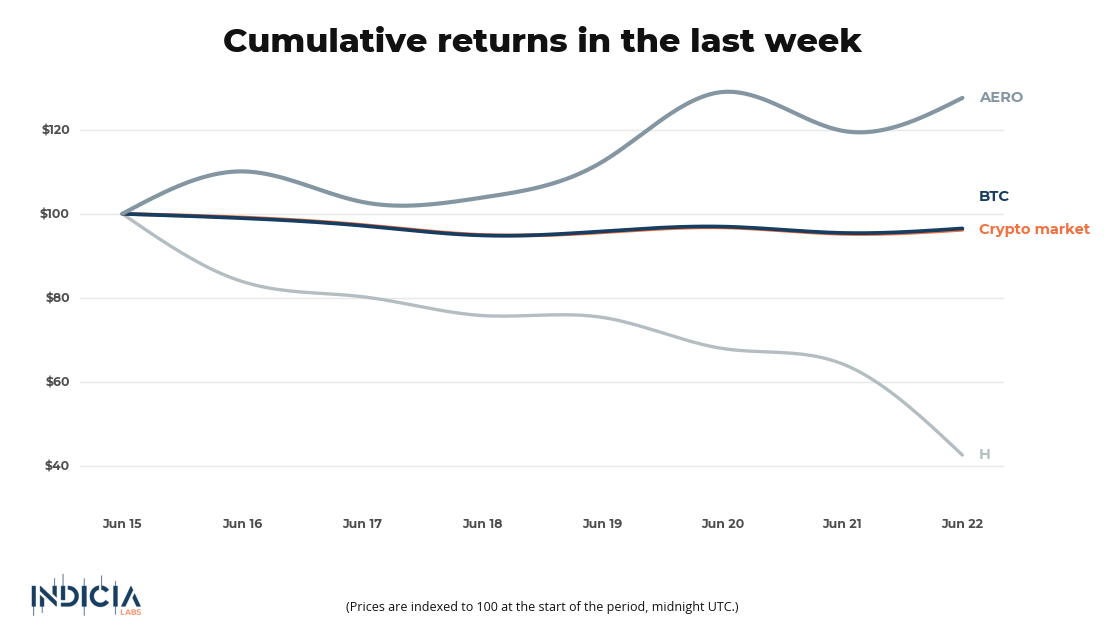
The broader crypto market declined 3.8% over the past seven days, with Bitcoin (BTC) falling 3.5% as risk assets traded cautiously. Aerodrome Finance (AERO) was the week's standout, surging 27.6%. Humanity (H) suffered the sharpest decline, dropping 57.4% over the period.
🧐 What is your crypto mood today?

In each Sophia's Thoughts newsletter, we ask about your crypto mood. Your response to this question helps Sophia get a better sense of the pulse of crypto markets. And this ultimately translates into better insights for you when combined with Sophia's AI models. Your data empowers Sophia to provide you with even better intelligence going forward!
🏦 Banks Are Building the Rails
The most consequential development this week may be one that generated relatively little market noise. Project Pangea, announced on June 23, brings together Chainlink, FairSquareLab, UniKA (a consortium of more than a dozen Korean commercial banks), and Qivalis (a euro stablecoin consortium backed by 37 European banks) to evaluate atomic swaps, meaning instant, trustless exchanges of one asset for another without a central intermediary, of euro- and Korean won-denominated stablecoins. The project targets foreign exchange settlement, a market that the Bank for International Settlements estimates processes roughly USD 9.6 trillion in daily trading volume. The scale of that market illustrates why even a modest migration to blockchain-based settlement could change how crypto infrastructure is assessed by institutional participants.
Project Pangea is a working group, not a live network, and no production timeline has been announced. That distinction matters because it separates a genuine research commitment from a marketing signal. Still, the composition of the consortium is notable: these are not crypto-native firms testing an idea in isolation but established commercial banking groups evaluating whether stablecoins can replace traditional cross-border payment intermediaries, the network of correspondent banks that currently route international transactions between financial institutions. Ripple CEO Brad Garlinghouse has described stablecoins' current momentum as a ChatGPT moment for financial institutions, and the Pangea announcement does suggest a threshold has been crossed in institutional seriousness. A falsifiable signal that this pilot is progressing beyond exploratory status would be a publicly announced production timeline or a disclosed settlement volume target from one of the consortium members.
Meanwhile, Citigroup projects the global stablecoin market will grow from roughly USD 315 billion today to USD 1.9 trillion by 2030. If banking consortia in Europe and Asia are now designing FX settlement systems around stablecoin building blocks, that projection reflects a demand picture anchored to institutional use cases rather than retail activity alone. Whether that translates into pricing support for BTC and ETH specifically, or whether it primarily benefits stablecoin issuers and the settlement infrastructure beneath them, is a transmission question the data does not yet answer.
🌍 MiCA as a Force Multiplier
Regulatory clarity is functioning as an accelerant in Europe. Ripple received preliminary approval from Luxembourg's financial regulator for a crypto asset service provider license under the EU's Markets in Crypto-Assets framework, adding to an Electronic Money Institution license it secured in February 2026. Combined, the two licenses would enable a broad suite of crypto asset and stablecoin payment services through a single integration point, accessible across all 30 European Economic Area countries via a single regulatory passport. Cassie Craddock, Managing Director of the UK and Europe at Ripple, stated that "MiCA has helped to unlock a new wave of institutional digital assets adoption, and we are seeing that demand accelerate across the region."
The significance of a single regulatory passport across 30 jurisdictions should not be underestimated. Before MiCA, a firm seeking to offer regulated crypto services across Europe had to navigate fragmented national licensing regimes, a process that added substantial compliance overhead and deterred many institutions from entering multiple markets simultaneously. That structural simplification reduces the compliance burden for institutions that were previously held back by regulatory fragmentation. Separately, the academic literature on network effects in financial infrastructure suggests that early movers in standardized regulatory environments often capture disproportionate market share, though the specific competitive dynamics in European crypto services remain to be tested.
At the same time, Ripple's licensing progress arrives as the July 1, 2026 deadline approaches for EU countries to begin fully applying MiCA rules. Firms that secure compliant infrastructure before that deadline enter the next phase of European digital asset services from a stronger procedural position, though the degree of commercial advantage will depend on factors including client demand, execution capacity, and whether competitors close the gap quickly. The regulatory milestone is real; the commercial outcome remains uncertain.
🏛️ The Establishment Recalibrates
Perhaps the most symbolically significant signal this week came from a figure who spent years as one of crypto's most prominent institutional critics. Agustín Carstens, former General Manager of the Bank for International Settlements, speaking at the Point Zero Forum on June 23, stated: "I have come to appreciate what stablecoins can do to promote financial innovation, inclusion and to reduce costs." He added: "We should try to establish conditions where we can live with fiat money and stablecoins." This represents a meaningful shift from a speaker who, as recently as June 2025, warned that stablecoins could emerge as a source of liquidity risk.
The recalibration does not mean that institutional concerns have disappeared. Carstens also noted: "If we really want a global system where stablecoins can interact with global currency, this has to be a cooperative effort worldwide. And I see this lagging behind." The BIS Annual Economic Report 2026, released the same week, argued that current stablecoin designs fall short of the properties that underpin trust in money and warned that widespread adoption could challenge financial stability and monetary sovereignty. Those two positions, one conceding innovation value and the other flagging systemic risk, are not contradictory. They reflect where the global regulatory conversation has settled: stablecoins are no longer debated as a fringe phenomenon but as a structural feature of the financial system requiring coordinated governance.
Franklin Templeton's completion of its acquisition of 250 Digital, creating a new division called Franklin Crypto, adds further texture to the picture. According to the announcement, the firm's tokenized assets grew from approximately USD 768 million in June 2025 to more than USD 2.5 billion by June 2026, a more than threefold increase in twelve months. The question Carstens himself flagged, that global regulatory coordination is lagging behind institutional build-out, is precisely the condition that could stall this trajectory. If coordination accelerates, the convergence between traditional finance and crypto becomes measurable in settlement volumes and licensed entities. If it stalls, announcements like Pangea and Ripple's MiCA passport remain significant signals on a timeline that cannot yet be specified.
Indicia Labs does not provide investment, tax, or legal advice. You are solely responsible for determining the suitability of any investment, investment strategy, or related transaction based on your personal investment objectives, financial circumstances, and risk tolerance. Indicia Labs may offer educational information about digital assets, which may include blog posts, articles, third-party content, news feeds, tutorials, and videos. This information does not constitute any form of advice, and you should not rely on it as such. Indicia Labs does not recommend buying, earning, selling, or holding any digital asset and will not be responsible for any decisions you make based on the provided information. Any content provided by Indicia Labs may contain errors, inaccuracies, or outdated information and should not be relied upon for making any investment decisions and Indicia Labs and its affiliates hold no responsibility for the accuracy of the provided information or content.
As with any asset, the value of digital assets can fluctuate, and there is a significant risk of losing money when buying, selling, holding, or investing in digital assets. Consult your financial advisor, legal or tax professional regarding your specific situation and financial condition, and carefully consider whether trading or holding digital assets is suitable for you.
Indicia Labs is not registered with the U.S. Securities and Exchange Commission and does not offer securities services in the United States or to U.S. persons. You acknowledge that digital assets are not subject to protections or insurance provided by the Federal Deposit Insurance Corporation or the Securities Investor Protection Corporation.