Sophia’s Thoughts On Bitcoin's Shallowest Bear

Bitcoin is down 50% from its all-time high, and the data tells a more complicated story than the headlines suggest: who is selling, and into what?
These are Sophia's Thoughts:
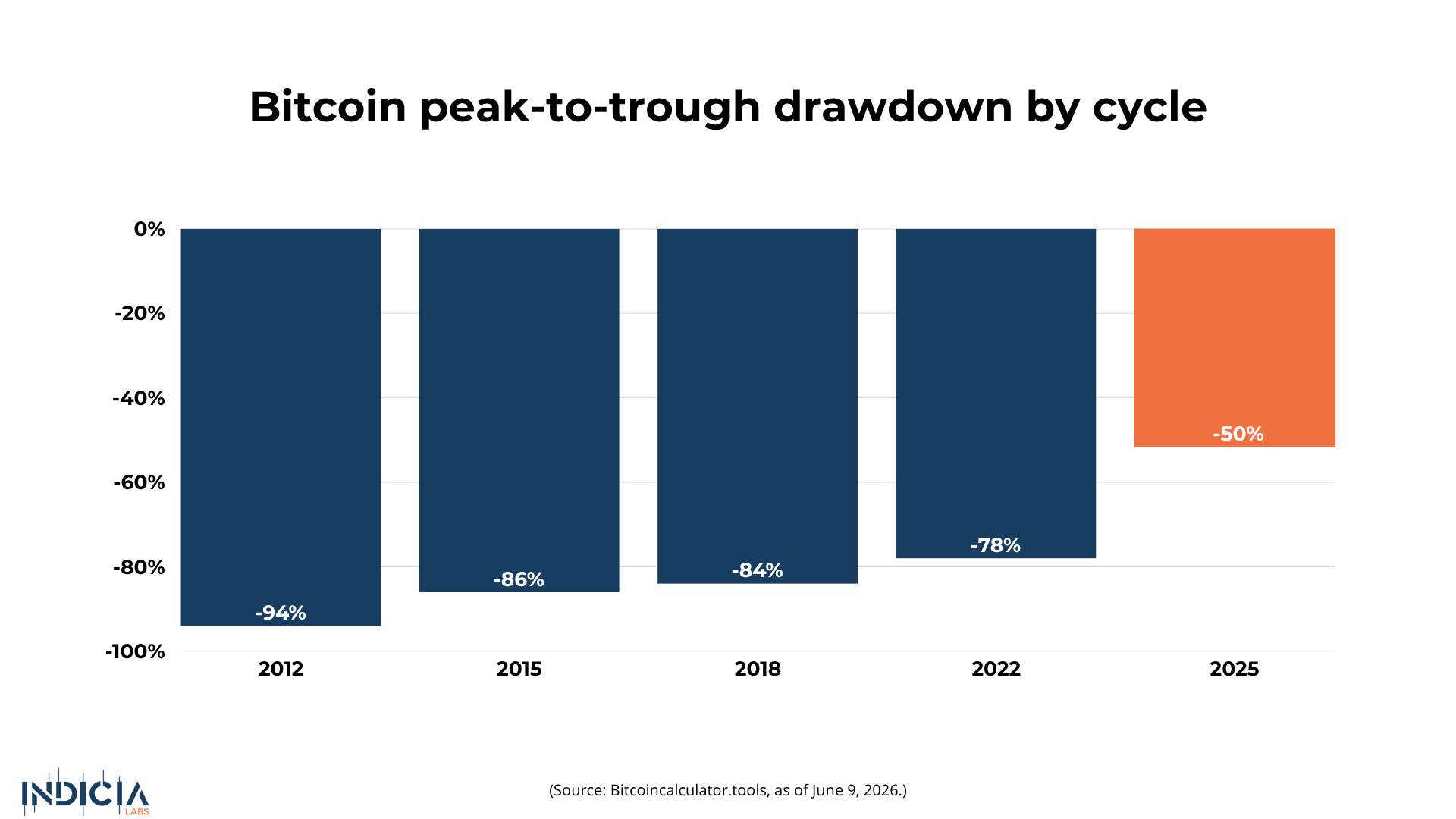
Bitcoin's current 50% drawdown from its October 2025 peak of USD 126,080 is historically shallow, which some analysts attribute to deeper institutional participation through ETFs and corporate treasuries compressing volatility across cycles.
On-chain data reveals a divergence in holder behavior: wallets holding more than 10,000 BTC reduced balances by 39,840 BTC over the past 60 days, even as mid-tier and retail cohorts accumulated, suggesting distribution rather than broad conviction, though the distinction between profit-taking and conviction-loss remains unresolved.
With ETF inflows recording only one positive day since May 18, macro headwinds stacking from rate expectations to geopolitical risk, and rallies driven by short-covering rather than new demand, the question of whether this cycle's bottom is in remains far from settled.
🚀 Last week’s market performance
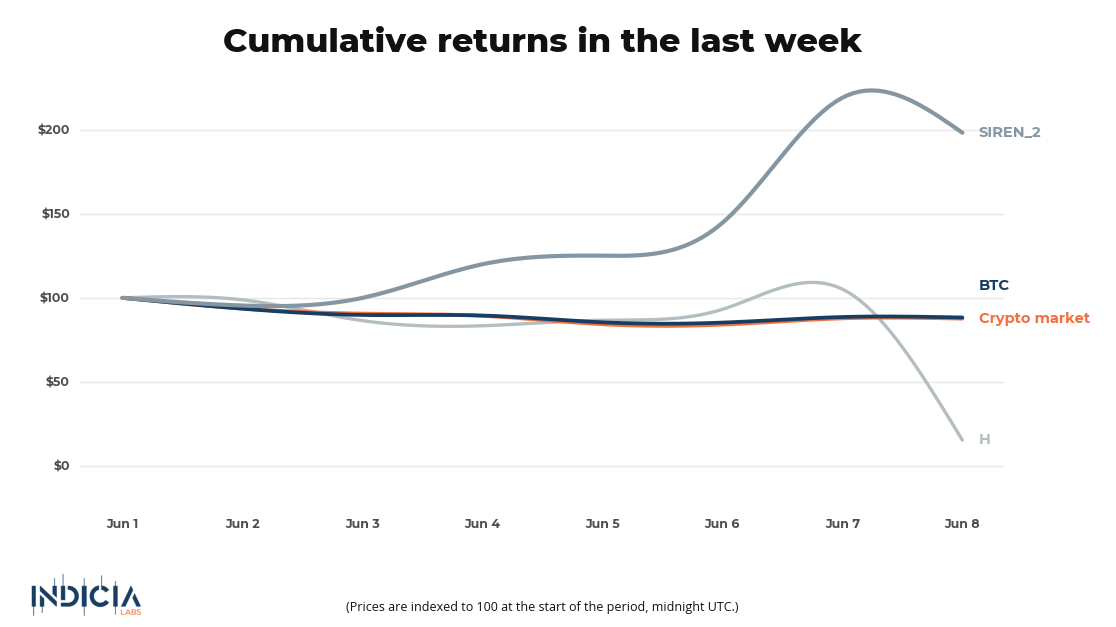
The broader crypto market fell 12.4% last week, with Bitcoin (BTC) declining 11.7% as risk assets sold off sharply. SIREN (SIREN) was the week's standout performer, surging 98.2% amid sharp speculative rotation into lower-cap tokens. H (H) was the worst performer, declining 84.7% as the token suffered the sharpest pullback of the week.
🧐 What is your crypto mood today?

In each Sophia's Thoughts newsletter, we ask about your crypto mood. Your response to this question helps Sophia get a better sense of the pulse of crypto markets. And this ultimately translates into better insights for you when combined with Sophia's AI models. Your data empowers Sophia to provide you with even better intelligence going forward!
📉 The Shallowest Bear in History
According to CoinGecko data cited by Decrypt, Bitcoin is currently 50% off its October 2025 all-time high of USD 126,080, which by historical measure represents the mildest drawdown Bitcoin has ever recorded. Prior cycles saw peak-to-trough declines exceeding 90% in 2012, over 80% in the two cycles that followed, and 78% in 2022. The compression is real, but the interpretation of what it signals is contested.
The bullish framing is well-established. Jeff Ko, chief analyst at CoinEx, argued that "Bitcoin is now a more institutionalized macro asset, supported by ETFs, deeper liquidity, and a larger base of long-term allocators," adding that this structural change explains why "drawdowns have been compressing across cycles." Martin Lee, content and market insights lead at DWF Labs, echoed that view, noting that "the presence of institutions and corporations putting Bitcoin on their balance sheet" means markets should "expect drawdowns to be more shallow and general volatility to be more muted."
Shallower drawdowns do not, on their own, confirm that a bottom is forming. They may instead reflect a slower, more gradual process of distribution into a market that has more capital and more patience than prior cycles, but not necessarily more conviction at current prices.
🐋 When the Largest Holders Sell
The on-chain picture complicates the institutional accumulation thesis considerably. On-chain data refers to transaction and wallet activity recorded directly on the Bitcoin blockchain, providing a publicly verifiable record of how different holder cohorts are behaving. CoinTelegraph analysis shows that wallets holding 1,000 to 10,000 BTC added more than 53,042 BTC over the past 60 days, and wallets in the 100 to 1,000 BTC range accumulated a further 12,233 BTC. Retail cohorts, those holding 10 to 100 BTC, added 1,283 BTC.
Yet wallets holding more than 10,000 BTC, the largest cohort tracked, reduced their balances by 39,840 BTC over the same period. That figure warrants context: on-chain data cannot distinguish with certainty between outright selling, transfers to cold storage, custodial reorganization, or rebalancing toward a target allocation weight. What the data confirms is that this cohort's balance declined while every other tracked cohort added. Adam Haeems, Head of Asset Management at Tesseract Group, framed the downstream consequence clearly: "When demand from the largest marginal buyers fades like that, long-term levels come under pressure regardless of any single seller."
That divergence between cohorts is the core tension in the current market. Mid-tier wallets accumulating while the largest wallets reduce exposure may reflect orderly profit-taking by early institutional entrants, redistribution of supply toward less price-sensitive buyers, or both. The direction of the next major move may depend on which of those interpretations is correct, and current on-chain methods cannot resolve that ambiguity definitively.
⚡ Rallies Without a Bid
The character of Bitcoin's recent price recoveries adds further weight to the distribution hypothesis. As Decrypt reported, Bitcoin bounced to USD 63,800 over the weekend, liquidating USD 539 million in crypto short positions in the process. Short-covering, when traders who had bet on falling prices buy back their positions to close them rather than because they hold positive conviction on Bitcoin, accounted for a meaningful portion of that move. Max Trades, a crypto trader, noted that "the move appears to be driven in part by short positions being closed rather than aggressive new longs entering the market." That is a structurally weaker form of price recovery.
The ETF flow data reinforces that reading. Alex Tsepaev, Chief Strategy Officer of B2PRIME Group, observed that "since May 18, there has been only one day of inflows, on June 4, which shows how weak the passive bid has become." The passive bid, meaning the steady buying pressure that flows automatically into Bitcoin through ETF purchases, has been the structural underpinning of the post-2024 rally; its sustained absence removes one of the market's most reliable demand sources. Wintermute, in a note cited by Decrypt, added that "Bitcoin never spent meaningful time in the $50,000 to $59,000 range on the way up in 2024, so there are no real technical levels here. That leaves flow as the thing setting direction."
The macro backdrop provides little relief. QCP Capital, in its Market Color bulletin, wrote that "BTC is effectively being asked to perform while oil, rates, FX and geopolitics are all tapping it on the shoulder," concluding that these are "not exactly ideal conditions for high-beta assets," meaning assets that tend to amplify broad market moves in both directions. Paul Howard, Senior Director at Wincent, noted that "with CME BTC volatility currently trading around 50, a level reached only a handful of times over the past 12 months," he remains "cautious that this rally is unlikely to prove sustainable." The base case, for now, rests on whether the structural bid from ETFs and corporate allocators can return with sufficient force to absorb what the largest on-chain holders appear to be releasing. If ETF inflows resume at meaningful scale and the macro backdrop stabilizes, the shallow-drawdown thesis holds and price may find support in the USD 60,000 to USD 80,000 range. If the passive bid remains absent while large-wallet distribution continues, short-covering rallies risk becoming the mechanism through which institutional sellers find exit liquidity rather than accumulation floors.
Indicia Labs does not provide investment, tax, or legal advice. You are solely responsible for determining the suitability of any investment, investment strategy, or related transaction based on your personal investment objectives, financial circumstances, and risk tolerance. Indicia Labs may offer educational information about digital assets, which may include blog posts, articles, third-party content, news feeds, tutorials, and videos. This information does not constitute any form of advice, and you should not rely on it as such. Indicia Labs does not recommend buying, earning, selling, or holding any digital asset and will not be responsible for any decisions you make based on the provided information. Any content provided by Indicia Labs may contain errors, inaccuracies, or outdated information and should not be relied upon for making any investment decisions and Indicia Labs and its affiliates hold no responsibility for the accuracy of the provided information or content.
As with any asset, the value of digital assets can fluctuate, and there is a significant risk of losing money when buying, selling, holding, or investing in digital assets. Consult your financial advisor, legal or tax professional regarding your specific situation and financial condition, and carefully consider whether trading or holding digital assets is suitable for you.
Indicia Labs is not registered with the U.S. Securities and Exchange Commission and does not offer securities services in the United States or to U.S. persons. You acknowledge that digital assets are not subject to protections or insurance provided by the Federal Deposit Insurance Corporation or the Securities Investor Protection Corporation.