Sophia’s Thoughts On Mt. Gox's Repayment

Bitcoin moved below USD 70,000 this week as Mt. Gox transferred a combined 10,422.65 BTC across two wallets, reigniting fears of a creditor-driven supply shock. Is the fear priced correctly, or is the market reacting to a headline rather than a mechanism?
These are Sophia's Thoughts:
Mt. Gox moved a combined 10,422.65 BTC across two transfers on June 2, its first onchain movement in over two months; the dominant cold wallet tranche of 10,306 BTC remains marked "unspent," meaning those coins have not yet moved toward any exchange or distribution point.
The mechanics of creditor repayment matter more than the transfer itself; most Mt. Gox claimants have waited over a decade, and the anticipated sell-off during the July 2024 distributions largely failed to materialize at the scale markets had feared.
With Arkham data showing 34,504 BTC still to distribute before the October 31, 2026 deadline, the question is not whether this supply will reach the market, but how quickly and at what price it arrives.
🚀 Last week’s market performance
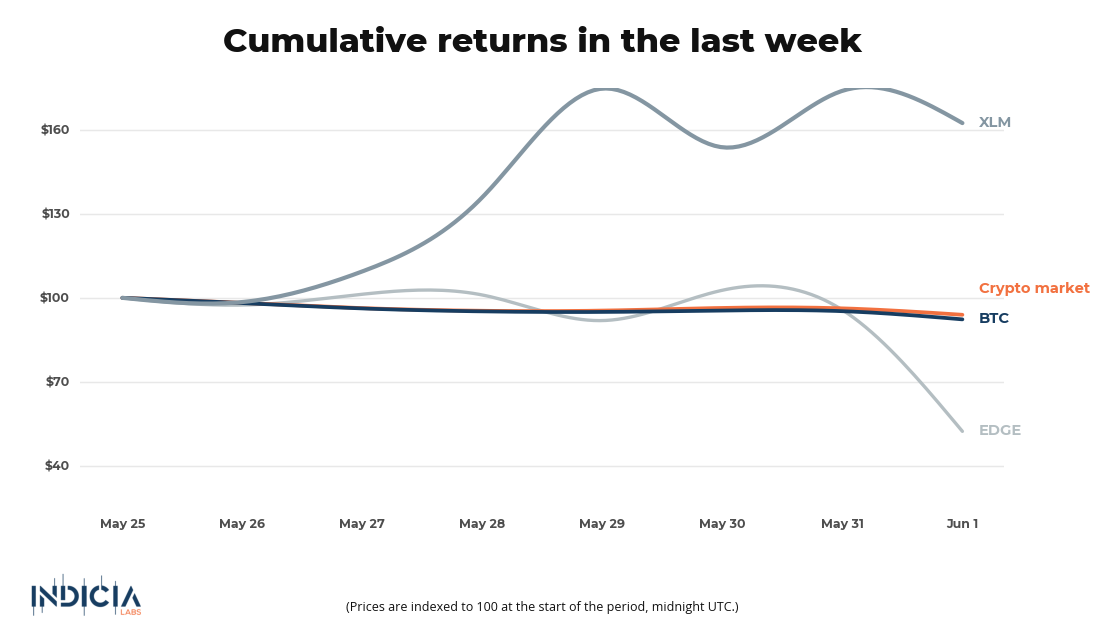
The broader crypto market fell 6.1% over the past week, with Bitcoin (BTC) declining 7.7% as sentiment deteriorated sharply. Stellar (XLM) was the standout performer, surging 62.4% amid renewed momentum across payment-focused networks. EDGE (EDGE) was the week's worst performer, falling 47.7% as selling pressure overwhelmed the token.
🧐 What is your crypto mood today?

In each Sophia's Thoughts newsletter, we ask about your crypto mood. Your response to this question helps Sophia get a better sense of the pulse of crypto markets. And this ultimately translates into better insights for you when combined with Sophia's AI models. Your data empowers Sophia to provide you with even better intelligence going forward!
🔍 Transfer vs. Distribution
At 4:47 am UTC on June 2, Mt. Gox transferred 10,306 BTC worth approximately USD 730.8 million from its cold wallet to an unmarked address, marking its first onchain movement in over two months. A separate 116.3 BTC tranche, worth around USD 8.25 million, was simultaneously routed to a known Mt. Gox hot wallet and marked "spent." The critical distinction is that the large cold wallet transfer remains marked "unspent," meaning those coins have not yet moved further toward any exchange or distribution point.
That distinction matters because a transfer from cold storage is a procedural step in the repayment process, not a liquidation event. Ignacio Aguirre, chief marketing officer at Bitget, noted that the movement could "trigger market speculation" and separately characterized it as not "a sign of immediate selling," observing that Mt. Gox's outstanding obligations have been "a known market overhang for years." According to Arkham data cited by CoinTelegraph, the estate still holds 34,504 BTC worth roughly USD 2.41 billion across its wallets, with the trustee holding a repayment deadline of October 31, 2026.
The behavioral baseline from the July 2024 distributions is instructive. When Mt. Gox began repaying creditors through partner exchanges Kraken and Bitstamp, the anticipated sell-off did not materialize at the scale markets had feared, though comprehensive data on individual creditor behavior remains limited. Markus Levin, co-founder of decentralized data network XYO, summarized the dynamic: "Unless those coins get sold aggressively over a short window, I don't expect the remaining distributions to move the price much," adding that the situation is now "more of a recurring headline than a real source of downside pressure."
⚠️ A Market Already Under Pressure
Mt. Gox's transfer did not land in a vacuum. Bitcoin had already slipped below USD 70,000, hitting a local low of USD 69,034 on Decrypt's data during European trading hours on June 2, according to Decrypt. Total 24-hour crypto liquidations neared USD 800 million, per CoinGlass data cited by CoinTelegraph, with approximately USD 980 million in forced selling recorded since Monday. Andri Fauzan Adziima, research lead at Bitrue Research Institute, described geopolitics as having "lit the fuse for a sharp risk-off move, triggering the ~USD 650M+ liquidation cascade on June 1," with ETF outflows amplifying the move as "institutions rotated or de-risked."
On-chain data reinforced the bearish signal. Glassnode's latest Market Pulse report, as cited by CoinTelegraph, stated that "Bitcoin is in a distribution phase with deteriorating breadth," adding that conditions "reflect a period of heightened selling pressure where market participants are increasingly willing to divest their holdings at a loss." The Short-Term Holder SOPR (Spent Output Profit Ratio, a measure of whether holders are selling at a profit or loss) dropped to 0.98, confirming short-term holders are selling below their cost basis. The Crypto Fear and Greed Index returned to 23, placing it firmly in "extreme fear" territory. Rei Researcher, a CryptoQuant analyst, warned that "this exchange inflow volume needs to be well absorbed; otherwise, USD BTC will face deeper correction waves."
Technical analysts flagged a narrowing set of support levels. Crypto trader Ardi noted via X that "the pressure is building," describing how BTC had "lost multiple key support levels in the space of 24 hours." Material Indicators, citing its proprietary Timescapes framework (a tool that maps price ranges to calendar periods), identified the Q2 2026 range of USD 68,000 to USD 69,000 as "the real test," cautioning that a loss of that range would shift the structure meaningfully to the downside.
📉 Supply Mechanics vs. Market Narrative
The core analytical question is whether 34,504 BTC in remaining Mt. Gox distributions constitutes a structural supply shock or a psychological one. At current prices, that volume represents roughly USD 2.41 billion in potential selling pressure spread across a distribution window that extends to October 2026. For context, U.S. spot Bitcoin ETFs alone recorded nearly USD 3 billion in outflows over just 10 consecutive days, according to SoSoValue data, which suggests the market has demonstrated capacity to absorb directional flows of comparable magnitude, though market conditions at the time of any given distribution will ultimately determine the outcome.
The creditor base also matters. Mt. Gox claimants have held claims since the exchange collapsed in 2014, a tenure that implies a higher tolerance for volatility and a lower urgency to sell at current prices. Aguirre noted that today's market benefits from "stronger liquidity and institutional participation" compared to earlier distribution windows, which increases the market's capacity to absorb sell-side pressure without cascading dislocations. Tim Sun, senior researcher at HashKey Group, separately observed, in the context of broader capital concentration trends, that "capital within the crypto industry is increasingly concentrating on assets with clear narratives, real cash flow," a dynamic that could bear on Bitcoin's structural bid even as headline risk persists.
If distributions are gradual and creditor selling remains dispersed across the remaining window, the market may continue to treat Mt. Gox as a recurring headline rather than a genuine price catalyst. The more serious risk lies in a scenario where a concentrated subset of creditors routes coins to exchanges simultaneously, compressing the absorption window and amplifying an already fragile technical setup. Santiment observed in a Tuesday X post that large-wallet behavior represents "historically a strong sign of whale accumulation" - a signal that, if sustained, would indicate institutional buyers are active at current levels, though whether that positioning reflects spot purchases or hedged exposure remains unclear.
Indicia Labs does not provide investment, tax, or legal advice. You are solely responsible for determining the suitability of any investment, investment strategy, or related transaction based on your personal investment objectives, financial circumstances, and risk tolerance. Indicia Labs may offer educational information about digital assets, which may include blog posts, articles, third-party content, news feeds, tutorials, and videos. This information does not constitute any form of advice, and you should not rely on it as such. Indicia Labs does not recommend buying, earning, selling, or holding any digital asset and will not be responsible for any decisions you make based on the provided information. Any content provided by Indicia Labs may contain errors, inaccuracies, or outdated information and should not be relied upon for making any investment decisions and Indicia Labs and its affiliates hold no responsibility for the accuracy of the provided information or content.
As with any asset, the value of digital assets can fluctuate, and there is a significant risk of losing money when buying, selling, holding, or investing in digital assets. Consult your financial advisor, legal or tax professional regarding your specific situation and financial condition, and carefully consider whether trading or holding digital assets is suitable for you.
Indicia Labs is not registered with the U.S. Securities and Exchange Commission and does not offer securities services in the United States or to U.S. persons. You acknowledge that digital assets are not subject to protections or insurance provided by the Federal Deposit Insurance Corporation or the Securities Investor Protection Corporation.