Sophia’s Thoughts On Crypto’s Next Move Up

Bitcoin crossed USD 71,000 this week as a geopolitical shock rattled oil markets before fading, but the headline-driven move raises a more important question. What structural forces will carry the next leg higher?
These are Sophia's Thoughts:
Bitcoin crossed USD 71,000 this week as Middle East tensions initially spiked crude oil prices before easing, triggering a wave of short liquidations and pushing the broader crypto market up 6.0% on the week.
The geopolitical catalyst appears to be retreating, and with Fed rate cut odds collapsing from 20% to near zero, the structural case for Bitcoin rests increasingly on on-chain accumulation, institutional positioning, and the asset's expanding share of the global store-of-value market.
Whether Bitcoin can sustain levels above USD 70,000 depends less on the next headline and more on whether macro conditions stabilize enough for long-term buyers to absorb the significant sell-side liquidity stacked just above current prices.
🚀 Last week’s market performance
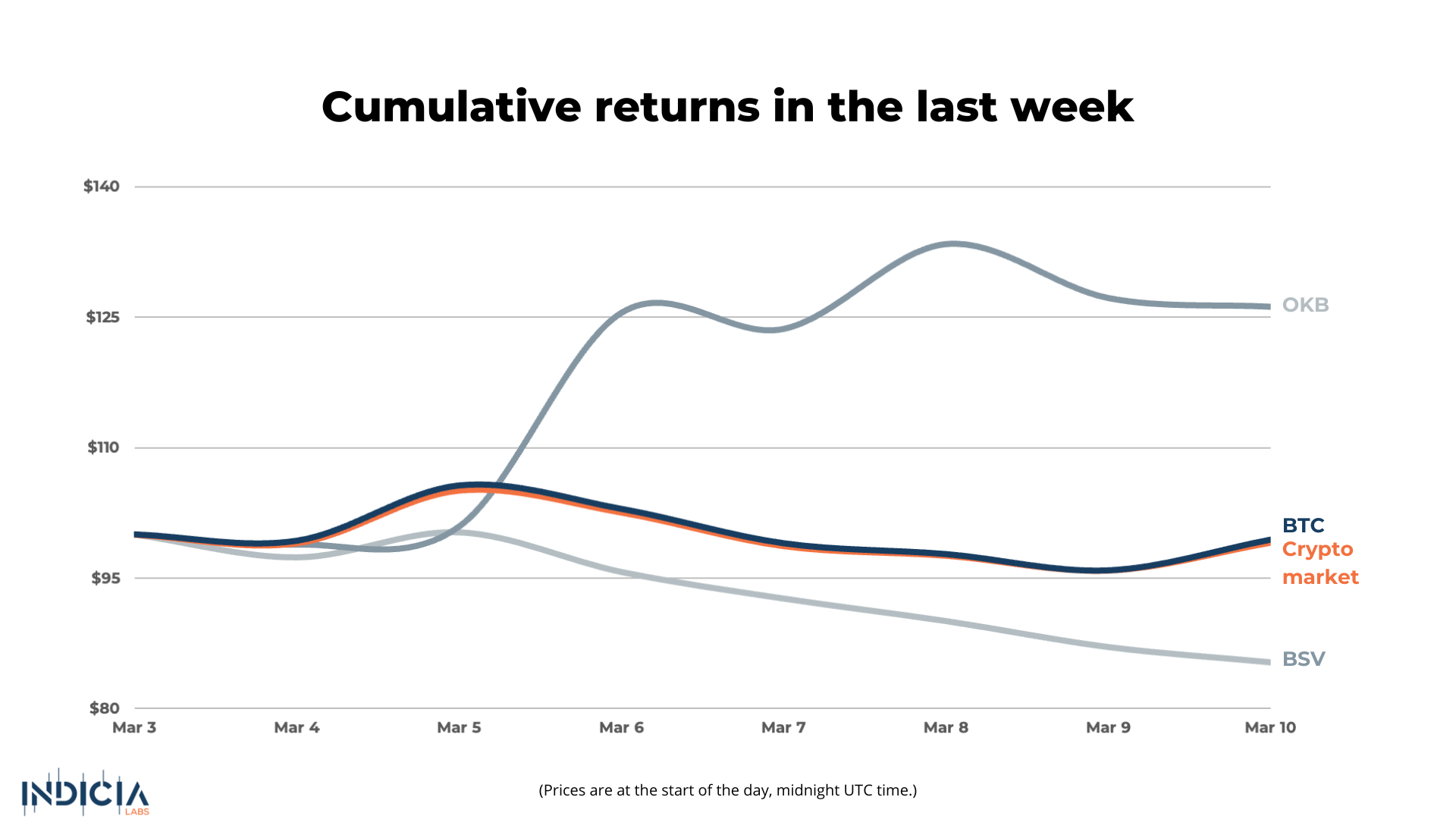
This week, the broader crypto market lost 0.9%, with Bitcoin (BTC) declining 0.6% as markets remained largely directionless. OKB (OKB) was the standout performer, gaining 26.2%, while Bitcoin SV (BSV) led declines, dropping 14.6% amid continued weakness across altcoins.
🧐 What is your crypto mood today?

In each Sophia's Thoughts newsletter, we ask about your crypto mood. Your response to this question helps Sophia get a better sense of the pulse of crypto markets. And this ultimately translates into better insights for you when combined with Sophia's AI models. Your data empowers Sophia to provide you with even better intelligence going forward!
⚡ Headlines Drove the Move. Fundamentals Will Decide What Comes Next.
An external shock pushed Bitcoin past USD 71,000 this week, not a shift in underlying market conditions. CoinDesk reported, WTI crude oil spiked to nearly USD 120 per barrel over the weekend before retreating sharply to USD 82, driven by fears of disruption to oil flows through the Strait of Hormuz. President Donald Trump warned on Truth Social that that “if Iran does anything that stops the flow of oil within the Strait of Hormuz, they will be hit by the United States of America TWENTY TIMES HARDER than they have been hit thus far.” When Trump later signaled the conflict could end “very soon,” risk assets broadly recovered.
The relief rally highlighted a structural feature of the current Bitcoin market: price is not yet moving on crypto-native catalysts. According to Decrypt, odds of a Fed rate cut at the March 18 FOMC meeting collapsed from 20% a month ago to just 0.6%, per the CME FedWatch Tool. Laurens Fraussen, research analyst at Kaiko, noted that “this rangebound behavior marks a shift from the directional volatility that characterized January’s decline from $100K+ highs. Rather than continuing lower or mounting a sustained recovery, BTC has oscillated within this band as markets await clarity on Fed policy.”
Meanwhile, Decrypt reported that roughly USD 359 million in crypto derivatives liquidations occurred during the consolidation period, citing CoinGlass data. Liquidation zones are price levels where forced buybacks of short positions cluster, potentially accelerating upward moves. Bitunix analysts observed that “derivatives liquidation distributions show a dense concentration of short liquidation zones between approximately $70,000 and $74,000 above current price levels, while leveraged long liquidity remains clustered near the $66,000–$65,000 range below,” suggesting near-term price action remains largely mechanical rather than conviction-driven. The geopolitical spark may fade; the liquidity structure will not.
📦 On-Chain Accumulation Tells a Different Story
Beneath the noisy price action, on-chain data points to a more deliberate accumulation pattern that predates this week’s move. As CoinDesk reported, nearly 600,000 BTC were accumulated in the USD 60,000–70,000 range during Bitcoin’s recent correction, with more than 200,000 BTC absorbed in the past two weeks alone, according to Glassnode. At the start of the year, roughly 997,000 BTC had last moved within that range; that figure has since risen to 1.558 million BTC, representing nearly 8% of circulating supply.
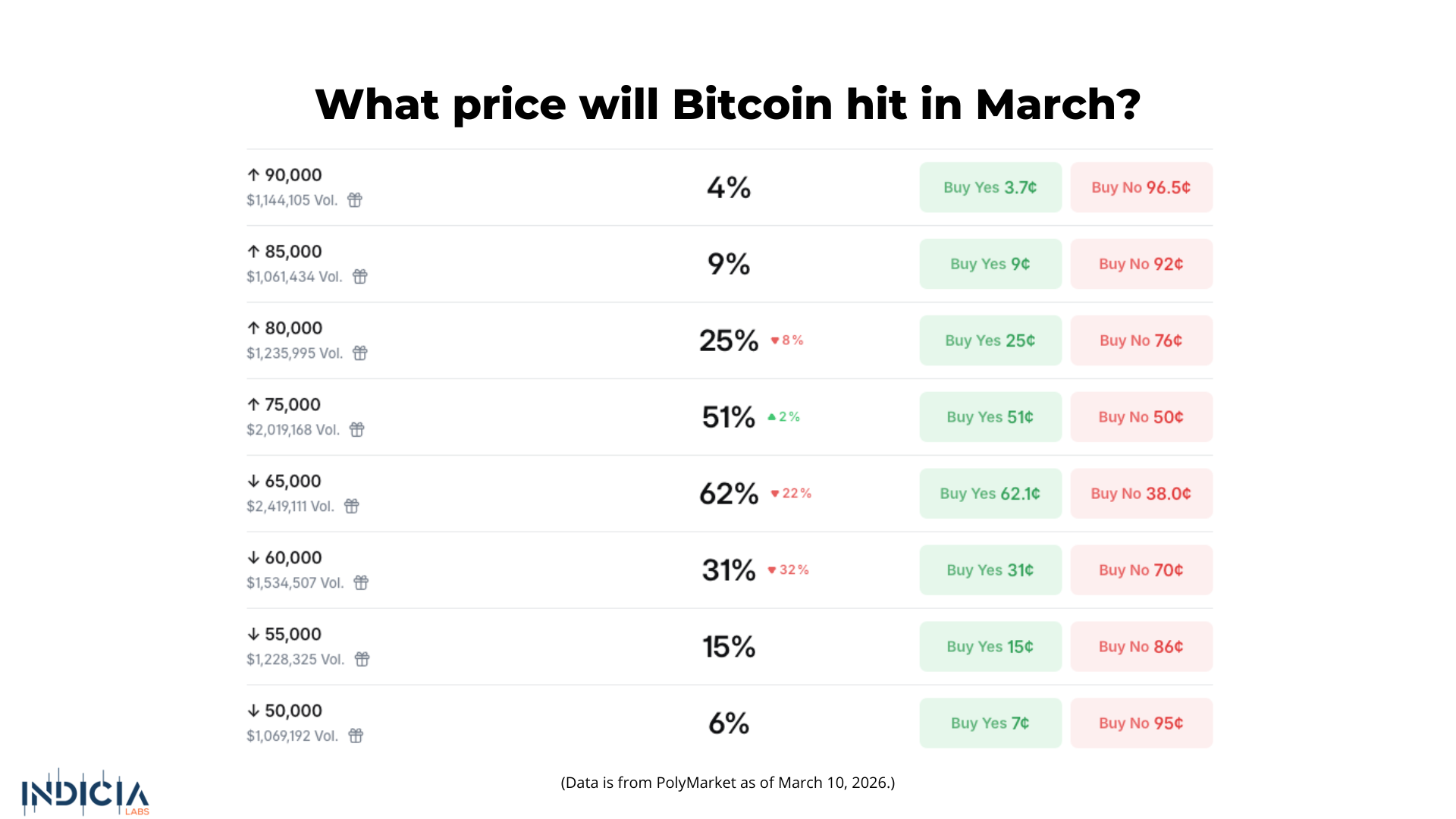
That ownership density creates a structural support layer that does not appear in price charts alone. Buyers who accumulated at those levels hold a clear cost basis and are unlikely to become forced sellers unless conditions deteriorate materially. James Harris, CEO of crypto yield platform Tesseract Group, told CoinDesk that “if support in the mid-$60k area fails, we could easily see another test lower, but for now we remain cautiously optimistic on BTC.” A break below USD 65,000 would be the clearest signal that the accumulation floor has not held. Polymarket traders believe that Bitcoin can revisit higher levels over USD 70,000.
At the same time, order book data presents a more cautious near-term signal. Crypto trader Ardi noted on X that “asks on Bitcoin just hit a 2-month high. $1.57B in sell-side liquidity stacked above price vs $1.125B in bids below,” as reported by CoinTelegraph. Within a 5% band around spot price, sell orders exceed demand by roughly 40%, a setup last seen in January after Bitcoin briefly broke above USD 98,000. Whether that sell-side clustering reflects conviction or mechanical positioning at resistance is difficult to determine from order book geometry alone; the data identifies the obstacle but does not resolve it.
🏦 The Structural Case: Store-of-Value Market Share
The longer-term investment thesis for Bitcoin does not depend on geopolitics or the Fed’s next move. Matt Hougan, Chief Investment Officer at Bitwise, has restated his long-term price target of USD 1 million per coin by framing the argument as a market share calculation. As The Block reported, the global store-of-value market sits just under USD 38 trillion, with gold accounting for roughly USD 36 trillion and Bitcoin representing about USD 1.4 trillion, or just under 4% of the total. The Block also noted that institutional investors including the Harvard endowment and Abu Dhabi sovereign wealth fund have added Bitcoin exposure.
Hougan’s base case draws a direct parallel to the gold ETF’s launch in 2004, when the entire gold market was valued near USD 2.5 trillion. The gold market has since grown at a compound annual growth rate of about 13%, reaching nearly USD 40 trillion today, according to The Block. Bitcoin would need to capture more than 50% of the current store-of-value market to reach USD 1 million per coin, but Hougan argues the trajectory points in that direction. “As I see it, the base case—that the store-of-value market will continue to grow as it has, and bitcoin will continue to gain market share as it has—leads you to much higher prices than we have today,” Hougan wrote.
That framing matters because it decouples Bitcoin’s long-term price potential from short-term macro noise, though the analogy carries assumptions worth stating plainly. Gold’s post-ETF growth unfolded without the regulatory uncertainty, central bank digital currency development, or substitution dynamics Bitcoin faces today, and those differences could alter the adoption curve. Hougan also argued, as CoinTelegraph reported, that future altcoin seasons may not lift the entire market equally, with capital likely concentrating in projects with stronger adoption and real-world applications. If that view proves correct, Bitcoin’s store-of-value narrative may attract a structurally different class of long-term capital than speculative altcoin rotations, and the quality of that demand may matter as much as the quantity.
Indicia Labs does not provide investment, tax, or legal advice. You are solely responsible for determining the suitability of any investment, investment strategy, or related transaction based on your personal investment objectives, financial circumstances, and risk tolerance. Indicia Labs may offer educational information about digital assets, which may include blog posts, articles, third-party content, news feeds, tutorials, and videos. This information does not constitute any form of advice, and you should not rely on it as such. Indicia Labs does not recommend buying, earning, selling, or holding any digital asset and will not be responsible for any decisions you make based on the provided information. Any content provided by Indicia Labs may contain errors, inaccuracies, or outdated information and should not be relied upon for making any investment decisions and Indicia Labs and its affiliates hold no responsibility for the accuracy of the provided information or content.
As with any asset, the value of digital assets can fluctuate, and there is a significant risk of losing money when buying, selling, holding, or investing in digital assets. Consult your financial advisor, legal or tax professional regarding your specific situation and financial condition, and carefully consider whether trading or holding digital assets is suitable for you.
Indicia Labs is not registered with the U.S. Securities and Exchange Commission and does not offer securities services in the United States or to U.S. persons. You acknowledge that digital assets are not subject to protections or insurance provided by the Federal Deposit Insurance Corporation or the Securities Investor Protection Corporation.