Sophia’s Thoughts On Wall Street’s Tokenization
Traditional finance is not merely experimenting with blockchain. It is building permanent infrastructure on top of it, and the institutions doing so have named timelines, named regulators, and named balance sheets behind the effort.
These are Sophia's Thoughts:
The New York Stock Exchange, CME Group, Morgan Stanley, BNY, and Invesco have each announced concrete tokenization initiatives in the same week, marking a concentration of institutional commitment to on-chain settlement rails that has few recent precedents.
Ethereum currently hosts the majority of tokenized real-world assets and serves as the settlement layer for BlackRock's USD 2 billion BUIDL fund, giving it a measurable first-mover position in the institutional buildout underway.
Whether this wave translates into near-term price appreciation remains uncertain, but the longer-term implication is a deeper, more liquid market for crypto assets as institutional plumbing becomes more entangled with on-chain infrastructure.
🚀 Last week’s market performance
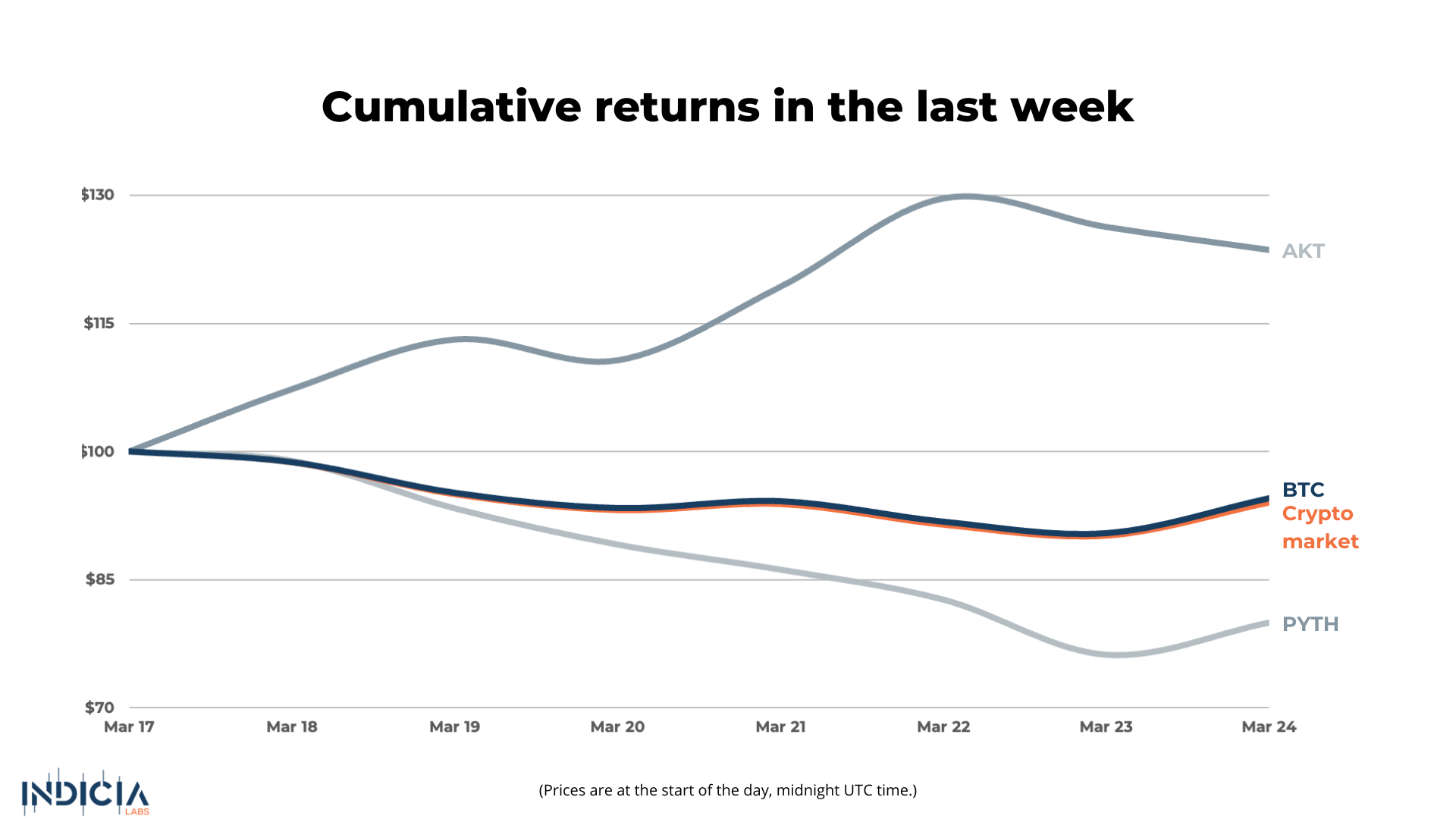
This week, the broader crypto market fell 6%, with Bitcoin (BTC) losing 5.5% as markets gave back recent gains. Akash Network (AKT) was the standout performer, surging 23.6% following the announcement of a network upgrade, while Pyth Network (PYTH) led declines, dropping 20%.
🧐 What is your crypto mood today?

In each Sophia's Thoughts newsletter, we ask about your crypto mood. Your response to this question helps Sophia get a better sense of the pulse of crypto markets. And this ultimately translates into better insights for you when combined with Sophia's AI models. Your data empowers Sophia to provide you with even better intelligence going forward!
🏗️ Laying the Rails
The New York Stock Exchange is collaborating with Securitize, the BlackRock-backed tokenization firm, to develop standards for tokens representing stocks, bonds, and ETFs and to enable round-the-clock trading on NYSE's Digital Trading Platform. Carlos Domingo, CEO of Securitize, stated: "We are proud to support NYSE in helping design the foundational transfer agent infrastructure. This is about building tokenization in a way that works within real market structure, with the protections, controls, and operational integrity." Separately, BMO became the first bank to join CME Group's tokenized cash platform built on Google Cloud Universal Ledger, enabling 24/7 margin calls and collateral movements. As Derek Vernon, BMO's head of North American treasury and payment solutions, put it: "Clients will be able to move funds continuously when markets demand it, not when banking hours allow it."
Morgan Stanley is preparing to support tokenized equities on its alternative trading system in the second half of 2026. Amy Oldenburg, Head of Digital Asset Strategy at Morgan Stanley, pushed back against the narrative that Wall Street is reacting impulsively: "TradFi is getting FOMO and is now getting involved … it really isn't accurate. We've been on a journey around the entire modernization of financial infrastructure for years." She acknowledged the complexity: "We are having to re-teach ourselves what legacy infrastructure, pipes and plumbing look like, and we can't just modernize on our own. This is an incredibly complex, integrated global network."
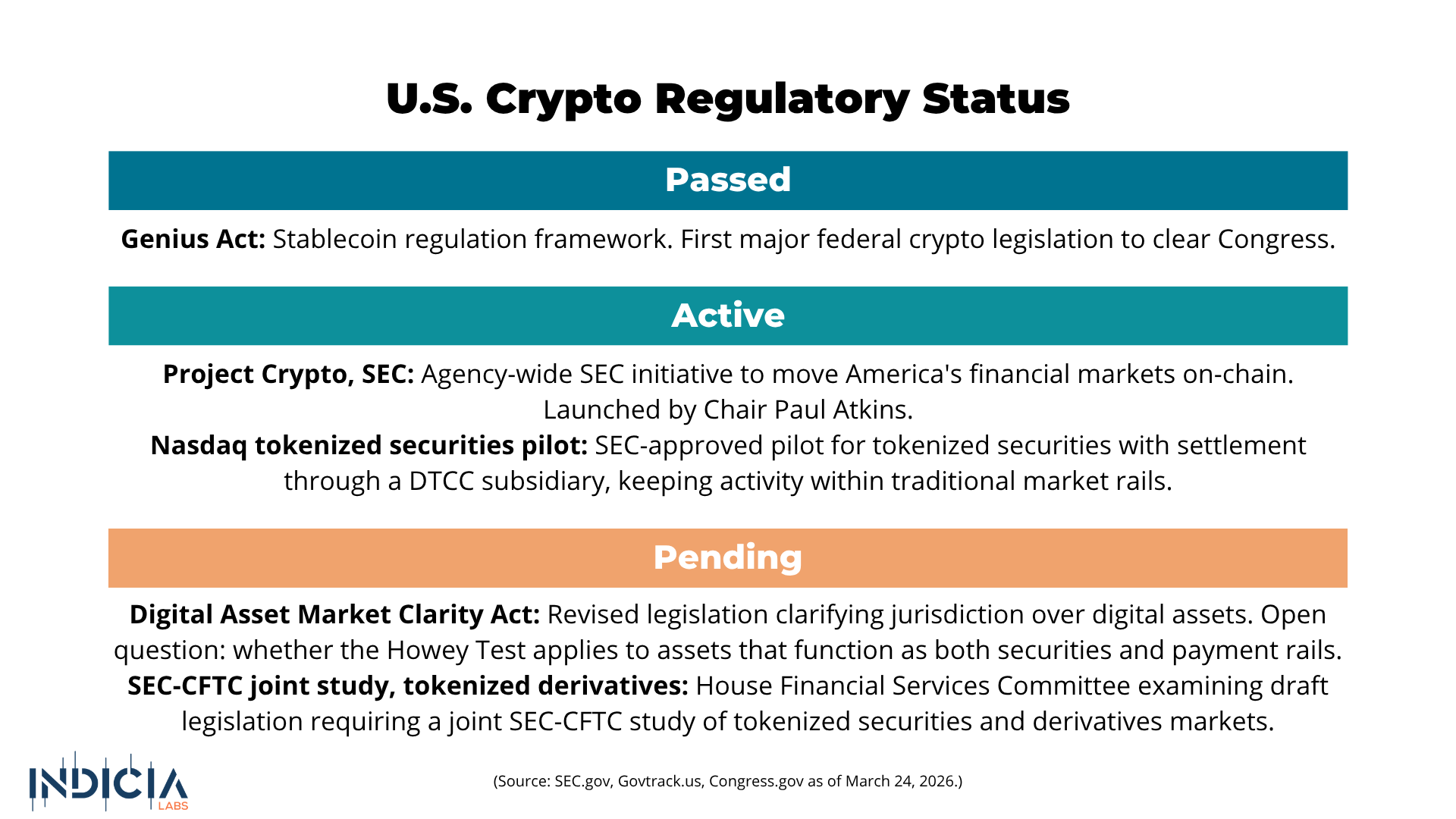
Regulators are beginning to match institutional momentum. SEC Chair Paul Atkins unveiled Project Crypto, an agency-wide initiative to "enable America's financial markets to move on-chain." Nasdaq separately received SEC approval for a tokenized securities pilot with settlement coordinated through a DTCC subsidiary. The House Financial Services Committee is examining draft legislation that could require a joint SEC-CFTC study of tokenized securities and derivatives.
The throughline across all of it: these institutions aren't building crypto-adjacent products. They're rebuilding core financial infrastructure, trading, settlement, collateral, custody, directly on-chain.
💎 Ethereum's Structural Position
The tokenization wave is not blockchain-agnostic in practice. More than half of all tokenized real-world asset value currently resides on Ethereum, which also serves as the settlement layer for BlackRock's BUIDL fund, the USD 2 billion tokenized money-market product managed by Securitize. Invesco's takeover of Superstate's USD 900 million tokenized U.S. Treasury fund reinforces this dynamic, with Kathleen Wrynn, Invesco's Global Head of Digital Assets, noting that "Superstate's onchain infrastructure pairs naturally to support Invesco's ambitions to scale tokenized offerings over time."
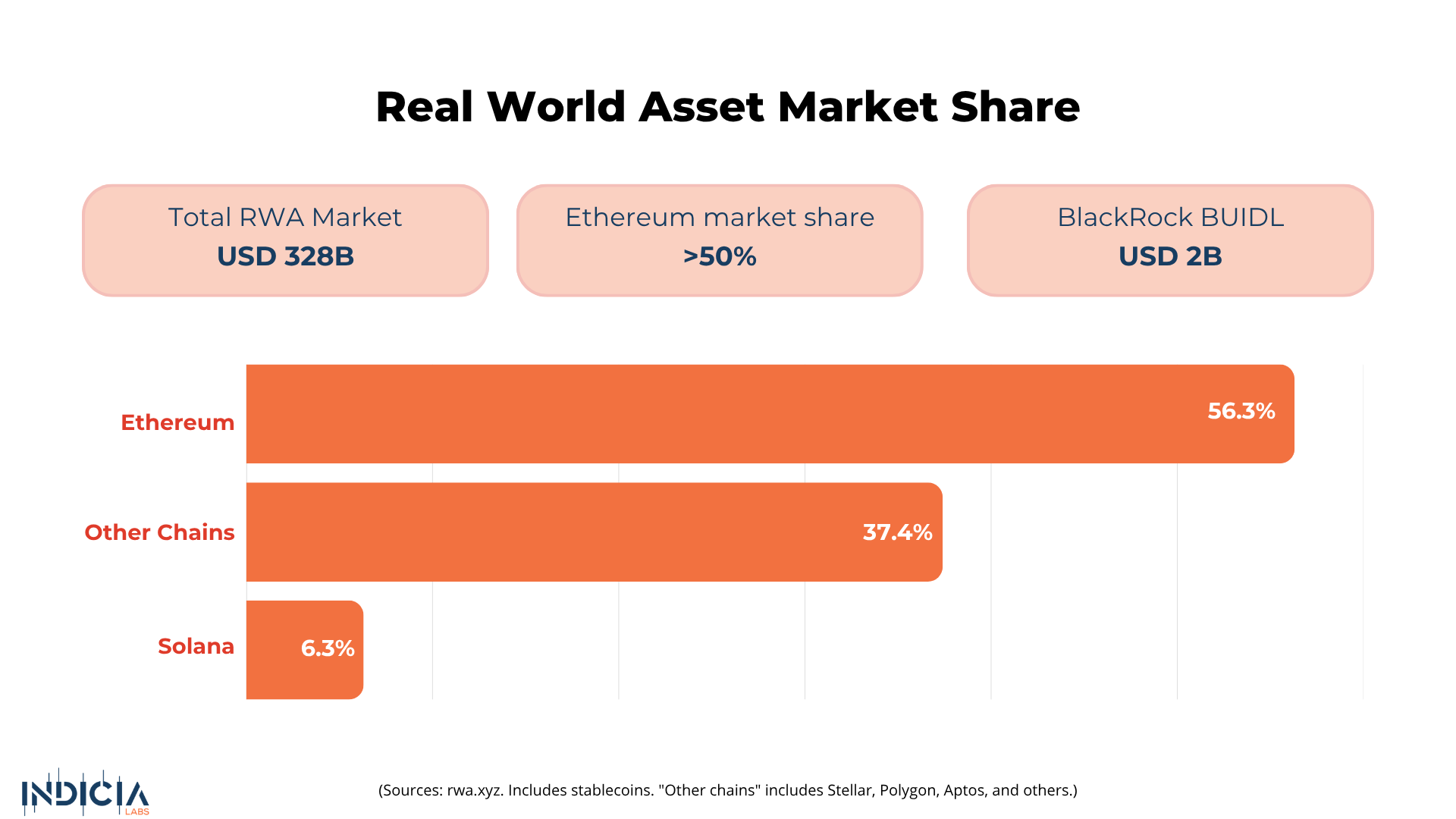
Larry Fink, CEO of BlackRock, described tokenization as "updating the plumbing of the financial system" and suggested it may be at a similar stage to the internet in 1996. The real-world asset tokenization market, including stablecoins, currently stands at USD 328 billion according to rwa.xyz data, with Ethereum holding the dominant share and Solana at 6.3%.
Solana is competing for institutional flows. The Solana Foundation launched its Developer Platform with Mastercard, Worldpay, and Western Union as early enterprise users. Raj Dhamodharan, EVP of Blockchain and Digital Assets at Mastercard, stated: "The next phase of digital asset innovation will be defined by practical use cases that integrate seamlessly with existing financial systems." The more telling measure won't be announcements. It will be which platforms attract sustained transaction volume and AUM commitments over the next 12 to 24 months.
🔑 The Bridge Builders
BNY CEO Robin Vince made perhaps the most direct case for why incumbents accelerate this transition: "We can act as a very effective bridge between the traditional finance and the digital finance ecosystems." Vince was candid about what institutions bring that technology alone cannot: "A technology that's in search of adopters can sometimes struggle, but we are an adoption vehicle." BNY has already created digital tokens representing new share classes for money market funds, and Vince identified the next frontier: "Loans are clunky. Real estate's clunky."
But Vince also named the constraint most likely to determine pace: "We need clarity and rules of the road. That hesitancy slows adoption." The GENIUS Act has passed, but a revised Digital Asset Market Clarity Act remains unresolved. Andrew Rossow, CEO of AR Media Consulting, noted that "current legal precedent doesn't cleanly answer this, and the Howey Test was not programmed or designed for instruments/assets that are both easily transferable and can also serve as securities and payment guardrails."
Mitchell Amador, founder of Immunefi, argued that regulation won't fracture the ecosystem but reshape it: "Capital seeks liquidity, and liquidity seeks composability. That means the regulated lanes will run through permissionless infrastructure." If he's right, the institutions now building tokenized settlement rails aren't building alternatives to crypto infrastructure. They're building deeper into it, and the dependency, once established, is not easily unwound.
Indicia Labs does not provide investment, tax, or legal advice. You are solely responsible for determining the suitability of any investment, investment strategy, or related transaction based on your personal investment objectives, financial circumstances, and risk tolerance. Indicia Labs may offer educational information about digital assets, which may include blog posts, articles, third-party content, news feeds, tutorials, and videos. This information does not constitute any form of advice, and you should not rely on it as such. Indicia Labs does not recommend buying, earning, selling, or holding any digital asset and will not be responsible for any decisions you make based on the provided information. Any content provided by Indicia Labs may contain errors, inaccuracies, or outdated information and should not be relied upon for making any investment decisions and Indicia Labs and its affiliates hold no responsibility for the accuracy of the provided information or content.
As with any asset, the value of digital assets can fluctuate, and there is a significant risk of losing money when buying, selling, holding, or investing in digital assets. Consult your financial advisor, legal or tax professional regarding your specific situation and financial condition, and carefully consider whether trading or holding digital assets is suitable for you.
Indicia Labs is not registered with the U.S. Securities and Exchange Commission and does not offer securities services in the United States or to U.S. persons. You acknowledge that digital assets are not subject to protections or insurance provided by the Federal Deposit Insurance Corporation or the Securities Investor Protection Corporation.