
Sophia’s Thoughts On Institutional Custody

Goldman Sachs has filed for a Bitcoin Premium Income ETF, adding another derivative layer on top of an asset that many retail investors already hold at arm's length. The question is not whether institutional demand is growing, but how many counterparties now stand between an investor and actual bitcoin.
These are Sophia's Thoughts:
Goldman Sachs filed for a Bitcoin Premium Income ETF on April 14, 2026, a product that generates income by selling options on bitcoin-linked instruments rather than holding bitcoin directly, deepening the chain of financial intermediation.
Each new product layer introduces additional counterparty risk, custody complexity, and structural exposure that differs materially from owning bitcoin directly. These distinctions are ones retail investors may not fully appreciate when seeking yield.
As institutional infrastructure around bitcoin expands rapidly, the central unresolved question is whether increasing financialization strengthens the asset's long-term legitimacy or quietly erodes the properties that gave it value in the first place.
🚀 Last week’s market performance
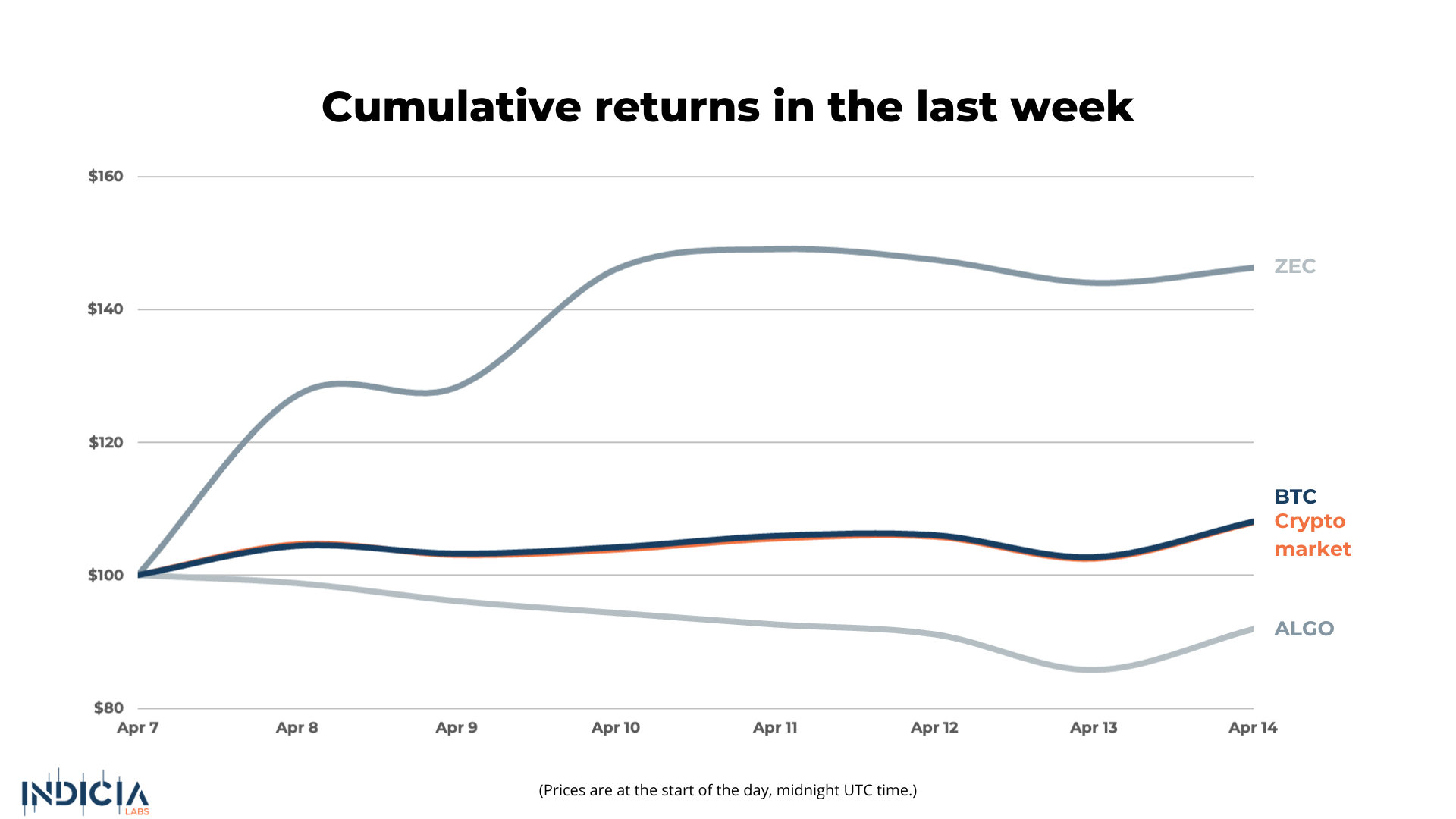
This week, the broader crypto market rose 8.0%, with Bitcoin (BTC) gaining 8.2% as momentum returned across digital assets. Zcash (ZEC) was the standout performer, surging 46.3% following the launch of a new mining pool, while Algorand (ALGO) lagged, declining 8.1%.
🧐 What is your crypto mood today?

In each Sophia's Thoughts newsletter, we ask about your crypto mood. Your response to this question helps Sophia get a better sense of the pulse of crypto markets. And this ultimately translates into better insights for you when combined with Sophia's AI models. Your data empowers Sophia to provide you with even better intelligence going forward!
🏛️ Derivatives on Derivatives
Goldman Sachs filed an application for a Bitcoin Premium Income ETF on Monday, April 14, 2026. The proposed fund does not hold bitcoin directly. Instead, it generates income by selling options tied to bitcoin-linked exchange-traded products, collecting premiums in exchange for capping a portion of the upside. Selling options to generate income is a strategy that exchanges the potential for unlimited gains for a stream of premium payments, meaning the fund's investors receive yield but surrender some of bitcoin's upside in return. The structure means investors in the fund hold exposure to options, which reference other ETFs, which in turn hold bitcoin through qualified custodians, meaning regulated entities approved to hold assets on behalf of institutional investors.
Goldman is not alone in this direction. BlackRock is preparing to launch its own iShares Bitcoin Premium Income ETF, expected to trade under the ticker BITA, following the success of its spot Bitcoin ETF, IBIT. An updated regulatory filing earlier in April showed BlackRock refining the fund's structure, with analysts expecting a launch within weeks. The fact that two of the largest asset managers in the world are moving simultaneously into options-based bitcoin income products signals that this is becoming a structural product category, not an experiment.
The commercial motivation behind these filings is worth examining carefully. Goldman's filing reflects institutional appetite for bitcoin-correlated revenue streams. Whether it reflects a conviction that bitcoin belongs in long-term custody is a separate and open question, one that investors evaluating these products should keep in mind when assessing what they are actually buying.
🔗 The Custody Stack
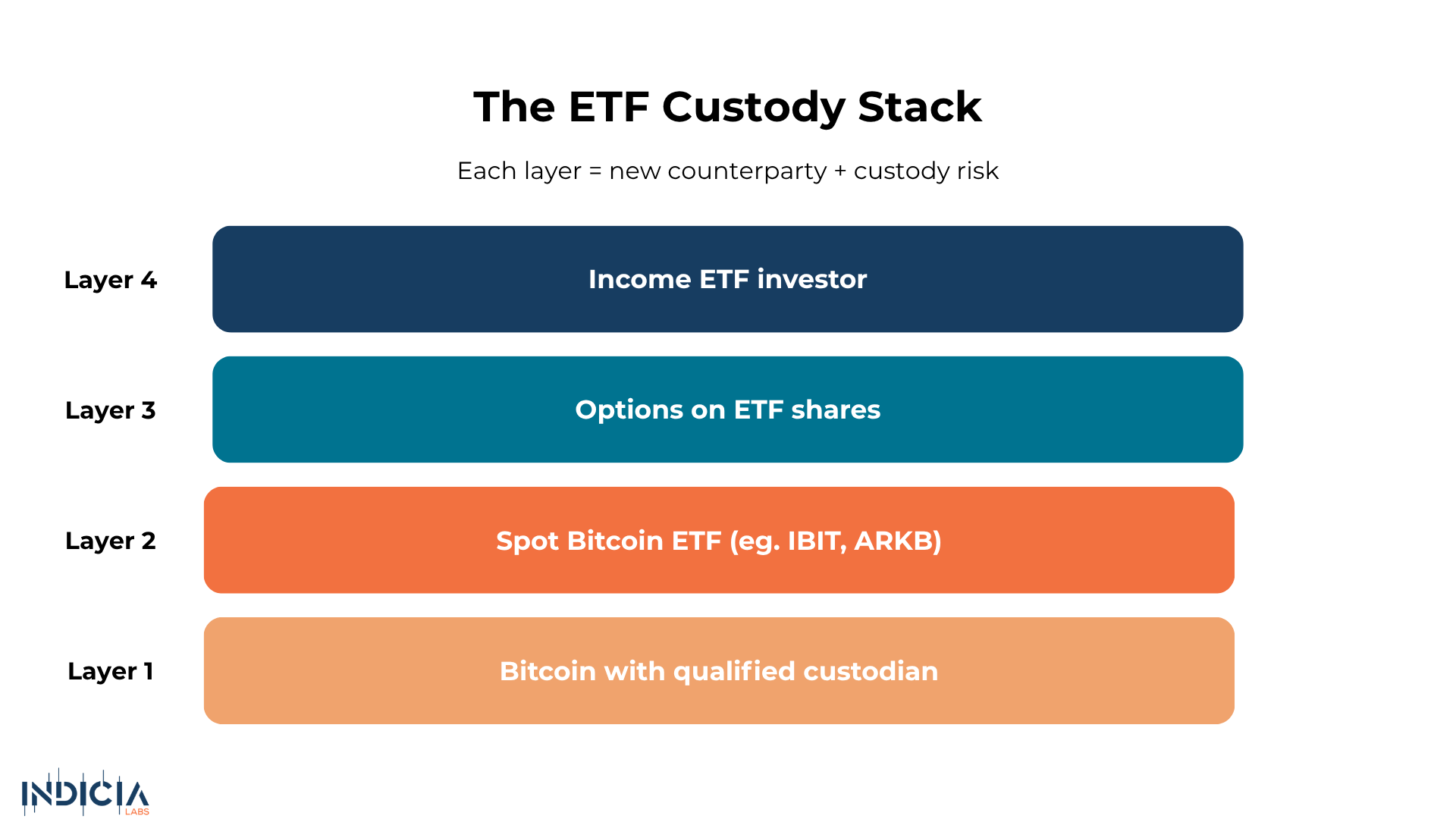
Understanding what retail investors own when they buy a bitcoin income ETF requires tracing a custody chain that runs several layers deep. At the base, physical bitcoin must reside with a qualified custodian. Above that, a spot ETF like IBIT holds that bitcoin and issues shares. Above that again, an income ETF sells options on those shares. Each layer introduces a new set of legal agreements, operational dependencies, and counterparty exposures that do not exist when holding bitcoin directly.
Institutional custody infrastructure is consolidating rapidly. BitGo, whose custody assets recently surpassed USD 100 billion, filed for a U.S. IPO targeting approximately USD 2 billion in valuation, a sign that the custody business itself is maturing into a standalone financial institution. Ledger is also preparing for a USD 4 billion IPO, enlisting Goldman Sachs, Jefferies, and Barclays as advisers. Greater consolidation among custodians brings both greater operational reliability and greater concentration risk across the system.
The more serious risk lies in what happens during a period of market stress. Options-based income strategies cap upside by design, but they do not cap downside. In a sharp bitcoin selloff, the ability of options markets to absorb selling pressure can deteriorate quickly, and the mechanics by which ETF investors redeem shares may not function smoothly when underlying liquidity dries up. An investor in an income ETF during such a period holds an instrument whose value is shaped simultaneously by options market conditions, ETF redemption mechanics, and custodian solvency. That is a materially different risk profile from a direct bitcoin position.
📈 Capital Is Still Flowing In
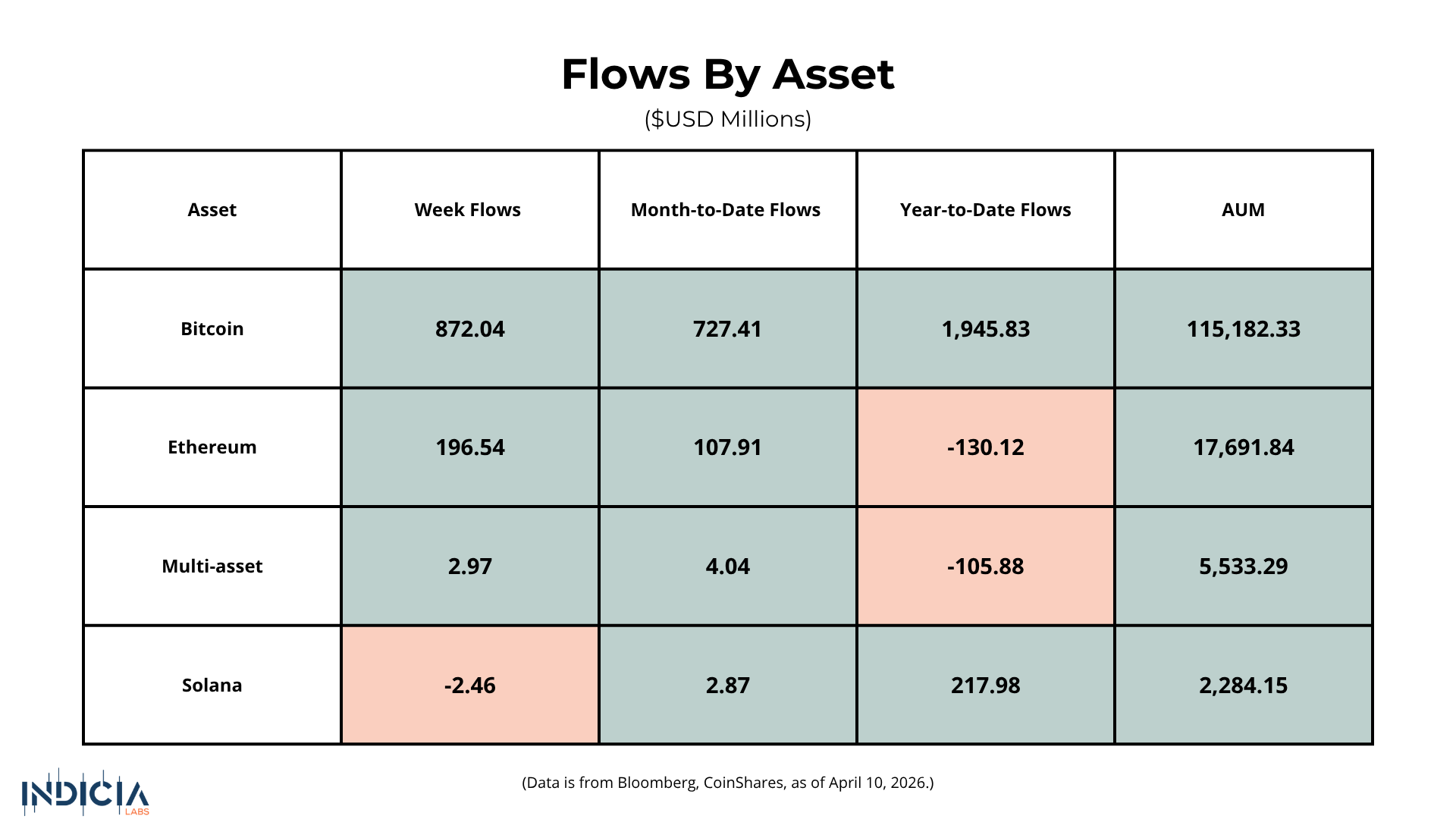
Despite the structural complexity, capital flows into the space accelerated meaningfully last week. According to CoinShares data reported by Decrypt, crypto funds attracted USD 1.1 billion in weekly inflows, the highest in three months. Bitcoin dominated with USD 871 million in inflows, while Ethereum reversed three consecutive weeks of outflows with USD 196.5 million. James Butterfill, head of research at CoinShares, attributed the recovery to "tentative ceasefire developments in Iran and softer-than-expected US CPI data restoring investor confidence."
Morgan Stanley also advanced its crypto product suite. According to Decrypt, Morgan Stanley's Bitcoin ETF launched, and Amy Oldenburg of Morgan Stanley noted that "the firm also plans to explore crypto offerings like a tokenized money market fund and tax-harvesting services for clients." The breadth of planned products suggests that major wealth managers are treating bitcoin not as a single-asset allocation but as a base layer for a broader suite of structured financial products. Meanwhile, short-Bitcoin hedging products recorded their largest inflows since November 2024 at USD 20.2 million, a figure that, at roughly 1.8% of total weekly inflows, may reflect tactical hedging by a subset of institutional participants rather than broad directional pessimism.
The macro tailwinds supporting inflows remain intact for now. If financing conditions tighten, or if a significant counterparty failure occurs anywhere in the custody chain, the layered structure that has attracted institutional capital could become the mechanism through which risk transmits back to retail investors who believed they held a straightforward, directional exposure to bitcoin. The question that remains open is not whether the stack can function under normal conditions, but whether it has been tested under the kind of stress that would reveal where the weakest link actually sits.
Indicia Labs does not provide investment, tax, or legal advice. You are solely responsible for determining the suitability of any investment, investment strategy, or related transaction based on your personal investment objectives, financial circumstances, and risk tolerance. Indicia Labs may offer educational information about digital assets, which may include blog posts, articles, third-party content, news feeds, tutorials, and videos. This information does not constitute any form of advice, and you should not rely on it as such. Indicia Labs does not recommend buying, earning, selling, or holding any digital asset and will not be responsible for any decisions you make based on the provided information. Any content provided by Indicia Labs may contain errors, inaccuracies, or outdated information and should not be relied upon for making any investment decisions and Indicia Labs and its affiliates hold no responsibility for the accuracy of the provided information or content.
As with any asset, the value of digital assets can fluctuate, and there is a significant risk of losing money when buying, selling, holding, or investing in digital assets. Consult your financial advisor, legal or tax professional regarding your specific situation and financial condition, and carefully consider whether trading or holding digital assets is suitable for you.
Indicia Labs is not registered with the U.S. Securities and Exchange Commission and does not offer securities services in the United States or to U.S. persons. You acknowledge that digital assets are not subject to protections or insurance provided by the Federal Deposit Insurance Corporation or the Securities Investor Protection Corporation.